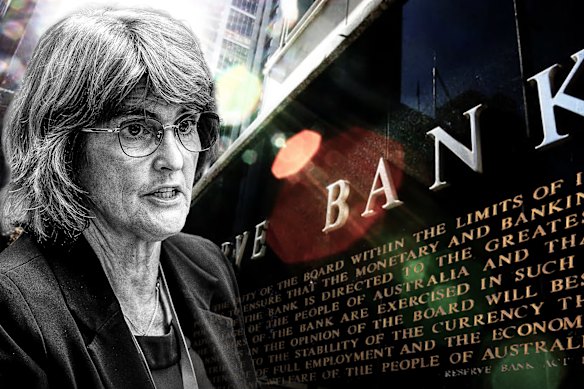
Reserve Bank governor Michele Bullock is reasonably transparent about most things. While she always declares she will “not be providing forward guidance” – the thing that got her predecessor Phil Lowe in trouble – she is better than most politicians at answering questions.
One thing Bullock has been reluctant to talk about recently, though, is a number known as the “NAIRU”: the non-accelerating inflation rate of unemployment. That’s the technical way of saying the rate of unemployment where there’s still enough room to keep price pressures, also known as inflation, low.
In her most recent press conference, Bullock said she “couldn’t give an exact number” on what the bank thought NAIRU might be. “Every time I give an exact number, people misinterpret it as meaning that I want the unemployment rate to go to X,” Bullock said. “But it’s true that it’s higher than we thought it was.”
It’s a number that the bank has refused to reveal for at least the past year or so. But a freedom of information request revealed the bank relies on several ways of calculating the figure including using an average of nine economic models (basically equations that can give numerical estimates). That particular method suggests the NAIRU sat somewhere around 5 per cent at the middle of the year.
That suggests that an unemployment figure below 5 per cent (which we have been at for the past two years) puts some upward pressure on inflation.
Now, this figure isn’t set in stone – and, in fact, changes across economies and across time. And the bank’s economists – like most others – acknowledge it’s something that needs to be taken with a grain of salt.
But it can help shed some light on how the bank sees the economy and makes its interest rate decisions.
The idea is that when most of us who want jobs have them, it means businesses are having to fight harder to find workers and keep existing ones around. In theory, it’s a situation where workers have more power (and desire) to ask for pay increases.
Several decades ago, workers did have a lot of bargaining power. Why? Largely because a lot of us – about half of employees – were part of a union, meaning when we took action (such as going on strike) it had a big effect on businesses. Today, with closer to 13 per cent union membership, wages arguably don’t rise as much, even when unemployment is quite low.
Nevertheless, there’s some concern that a tight labour market – one where there aren’t many available workers – could lead to a wage-price spiral: where workers ask for higher wages to be able to afford higher prices, with those higher wages (a higher cost for businesses) being passed on through higher prices.
And that’s where the NAIRU comes in: basically how low economists – in this case, the bank’s economists – reckon unemployment can go before it starts worsening inflation.
As Melbourne University labour market expert Jeff Borland points out, it’s not a definite or observable number. “There’s no absolute objective measure of NAIRU,” he says.
Not only does it depend on the numbers you use, and how much weighting you give to different metrics, but it also depends on how the final numbers are then interpreted. For example, while the RBA’s machines might suggest NAIRU is around 5 per cent, its economists can also exercise some judgement to acknowledge where their models might be falling short and adjust the final number.
One such shortfall, as former Reserve Bank assistant governor – and now chief economist at Westpac – Luci Ellis points out, is that most of the models the Reserve Bank uses don’t consider supply-side shocks very well.
The oil price shock, for example, which has played a big role in recent price pressures, isn’t something that can be easily plugged into an equation. That means that when there’s a jump in inflation that’s caused largely by an external supply shock, the models still tend to read that as a reflection of the labour market being too tight.
Part of the reason the bank’s final estimates for NAIRU have been a bit lower than what its models alone suggest, Ellis reckons, is likely an acknowledgement by its senior leaders that the equations they rely on tend to have a more demand-driven view on things like inflation.
The bank does draw on a range of other measures when it comes to the labour market. For example, it looks at underemployment (the share of people who have a job but want to work more hours), job vacancies, and wage growth.
And while there are some good reasons why the bank no longer publicly declares what it thinks NAIRU is (as Bullock points out, it risks being seen as a steadfast indication of how many people the bank wants to boot out of work), it means we get less insight into how the bank thinks and sees the economy. While NAIRU might be a subjective figure, it’s a useful reflection of how the bank is thinking and reasoning.
Right now, the bank is walking a tightrope between trying to rein in inflation and not cause unnecessarily high levels of unemployment. It is stuck between a rock and a hard place after the latest data showed both inflation and unemployment climbed.
While the bank will be reluctant to cut interest rates at its final meeting of the year – especially given it has been so focused on inflation (which has stayed above its 2 to 3 per cent target range for about two years now) – there is clearly some split sentiment already with three of the nine board members voting against a rate hike at the last meeting.
What’s concerning about the rate hikes is that they take 12 to 18 months to flow through.
That’s because it takes time for households and businesses to adjust their behaviour.
Exchange rates, for example (one of the ways interest rates affect the economy), change pretty rapidly. But banks that lend to you and me (not the bank that Bullock leads) tend to pass on interest rate changes at varying speeds, especially across different products.
Hungry for money, banks are typically eager to ramp up interest rates on home loans. Many of the recent cash rate moves, for example, have been followed up within days by most of the big four banks ratcheting up interest rates on Australians’ variable home loans.
But banks often drag their feet on adjusting interest rates in the same way for savings accounts. Why? Because holding off for as long as they can means they don’t have to shell out as much themselves. Along with fixed-rate loans (which may not reflect interest rate changes for several years), interest rates can take time to fully hit the economy.
We also know that businesses tend to make investment and hiring decisions well in advance. They might start having discussions when an interest rate decision is made, but they’ll often wait to see if these moves are one-off, temporary, or lasting, before committing to holding off, cancelling or changing their plans.
That means the thousands of job cuts we’ve been seeing from major companies across the economy – NAB, Canva, Bunnings, and more – may just be the start. Of course, these decisions are also affected by factors such as AI.
But with unemployment already climbing to 4.9 per cent in October (that’s one in 20 people who want a job not having one), and the inflation figure (also 4.9 per cent) likely having reached a peak, there’s a good reason for the bank to hold off on further rate rises – and perhaps to start cutting. That’s especially the case given unemployment can have a long-term “scarring effect” on people’s job prospects and livelihoods, either permanently or for decades to come.
The NAIRU might be a subjective concept (and one prone to errors), but job losses and difficulty finding work are very real, concrete and harder to bounce back from, even once the temporary supply-side pressures have slipped away.
The Market Recap newsletter is a wrap of the day’s trading. Get it each weekday afternoon.
 Millie Muroi is the economics writer at The Sydney Morning Herald and The Age covering workplace and economics. She was formerly an economics correspondent based in Canberra’s Press Gallery and the banking writer based in Sydney. Instagram/TikTok: @millie.muroiConnect via X or email.
From our partners
Disclaimer : This story is auto aggregated by a computer programme and has not been created or edited by DOWNTHENEWS. Publisher: www.smh.com.au