Inside the departure lounge, we should all spare a thought for the people going nowhere.
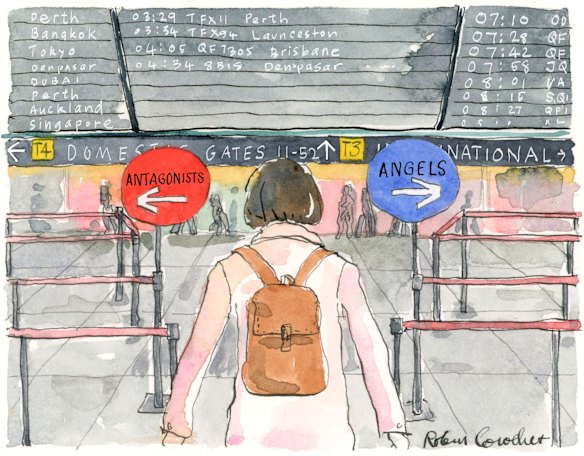
I’ve just come back from a week away on holiday and I’ve realised that, unfortunately, when I’m at an airport, I can’t completely recognise the full humanity of other people. I am the Main Character, containing multitudes, and everyone I encounter is either an angel or an antagonist depending on whether they are helping or hindering me as I navigate the terminal.
Angel: the security guy pointing out the sunglasses I almost left on the x-ray tray. Antagonist: the high-heeled lady with her portable scales, fat-shaming my suitcase at the departure gate. Angel: the woman who shifted her seat so we could both use a phone-charging port in the food court. Antagonist: child watching Paw Patrol at full volume.
For everyone else, I feel nothing at all. It’s all about me – my needs, my departure time – until I have reached my destination, when I can (hopefully) snap back into regular form.
I don’t think I’m the only one who feels this chilling effect at the airport. There are a few obvious reasons for it. You have to focus in the terminal because you’ll lose a lot of money if you miss your flight. The atmosphere of biometric surveillance – where every person is reduced to scannable data – is surely part of it too. Proximity to Qantas employees causes knock-on morale issues. (This is a shame. Hostility towards the executive leadership team running our national carrier should energise and unite all non-Qantas executive Australians! Sadly it just makes most of us tired.)
On screen, depictions of airports veer towards extremes. On one hand, airport terminals are sometimes treated as homogenous, transient “non-places”. (I’m thinking, especially, of the George Clooney movie Up in the Air). Or they’re places of high emotion and high stakes (from Home Alone, Love Actually and Carry On to reality TV shows like Border Security). My own experience tends more towards the first version, and I think that’s because I have not (yet) presented to an airport with humanitarian needs, access requests, urgent romantic confessions or smuggling objectives.
The modern airport experience is catered to people like me: able-bodied, digitally literate and English-speaking. Airlines would like to discourage human needs and human complications because they don’t want to pay human beings to deal with those things. I think their bad faith is rubbing off on me.
Perhaps I should take inspiration from on-screen airport workers. Earlier this year, I binged the SBS hit series The Airport Chaplain (starring Hugo Weaving and Shabana Azeez). I’m now watching the 2024 comedy series How Not To Die Alone, set in JFK Airport (starring Natasha Rothwell). The first of these – about a chaplain who provides “emotional, spiritual and practical support” for passengers passing through the fictional Victoria Airport – falls firmly in the camp of high-stakes, high-emotion airport drama. How Not to Die Alone is more of a workplace comedy.
They are both great series that dramatise complex workplace dynamics. And they’re both good reminders that while I – and many other passengers – may act like robots during our transient airport hours, there’s a lot going on for others, including the people who work there every day. Many airport jobs are, of course, highly exposed to economic instability and automation.
There’s a lot going on behind closed doors, too. My favourite thing about both these shows – and even about Border Security – is the scenes showing the bizarre variety of seized and surrendered goods in the restricted zone. In The Airport Chaplain there’s a storyline, based on a true story from Melbourne Airport, where a passenger tries to pass through security with live exotic fish hidden in plastic bags strapped to her legs. In How Not to Die Alone, Mel and her friend go looking in the surrendered items department for prescription painkillers and discover a $4000 luxury ham.
In real life, I’m very grateful to the people who stop dangerous stuff getting onto planes or through customs. I’m glad they do what they do. But on a less practical level, it’s nice to reflect on how weird and unpredictable people are – especially in the dehumanising environment of the airport. In the departure hall, it’s all touchscreen kiosks and WHSmith. But the restricted security zone is a world of mystery fluids, experimental dairy products and confiscated frogs. It’s a world of bonkers human fetish and conspiracy.
I’ll try to keep that in mind next time I enter an airport terminal and feel myself slipping into Main Character mode. It’s not just me who contains multitudes. Other passengers contain multitudes (of tropical fish in their pants, possibly) and I might be standing next to one of them.
From our partners
Disclaimer : This story is auto aggregated by a computer programme and has not been created or edited by DOWNTHENEWS. Publisher: www.smh.com.au