
David Blair
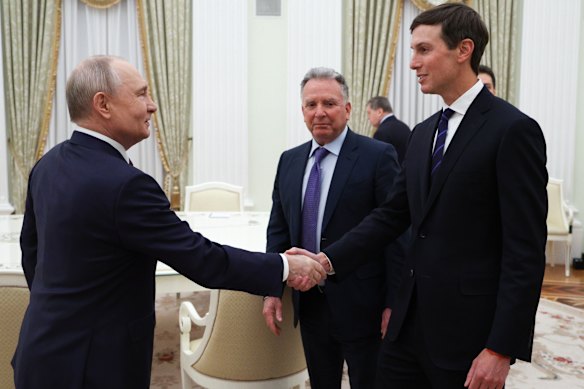
London: Perhaps it was the spires of the Kremlin, the glitter of the marble or just the irresistible charm of Russian leader Vladimir Putin and his beaming henchmen. Whatever the explanation, Jared Kushner’s four visits to Moscow as the envoy of his father-in-law, US President Donald Trump, were clearly not wasted from Russia’s perspective.
Kushner’s latest interview shows he has bought the Kremlin’s account of Ukraine’s war and fallen for Putin’s tendentious version of history hook, line and sinker.
Everything that Putin tells his foreign visitors is designed, above all, to make them forget the one supreme fact that he deliberately started Europe’s bloodiest conflict since 1945 by attacking Ukraine in 2014 and seizing 25,900 square kilometres of its territory, before escalating the onslaught into a full-scale invasion in February 2022.
Putin wants his guests to think of the war as something that mysteriously “started”, apparently of its own accord. He does his best to redirect their gaze towards the “root cause” of the tragedy, which is not that he sent hundreds of thousands of soldiers into Ukraine, but rather that Europe’s “security architecture” supposedly ignores Russia’s interests.
So the answer is not to try to stop the war with a ceasefire. Instead, the real task is to address that “root cause” by creating a new European “security architecture” to Putin’s liking, after which the war for which he definitely has no causal responsibility might solve itself.
You have to possess almost bottomless ignorance, credulity and naivety to believe any of this, yet Kushner obviously has all of those qualities in abundance. His detailed account of the effort to resolve Ukraine’s war – delivered in a podcast interview with Mathias Döpfner, the chief executive of Axel Springer, which owns London’s Telegraph – faithfully relayed the Putin view of events.
Hence, Kushner brightly announced that resolving the “post-war security architecture” is “probably the most important” task because from that stems the “root causes of the conflict”.
What exactly might those “root causes” be?
Putin thinks it was completely unreasonable that countries such as Estonia, Poland and the Czech Republic, having broken free of Soviet or Russian occupation between 1989 and 1991, should have chosen to join NATO to make sure they were never conquered again.
Putin professes to find it incredible that nations that suffered one Russian invasion after another – and were wiped off the map in the case of 18th-century Poland – somehow felt the need to acquire an insurance policy. For him, the sight of these countries joining NATO was so overwhelmingly threatening that it explains why that mysterious war suddenly descended upon Ukraine.
In fairness, Kushner briefly defied the Putin thesis by describing NATO as a “defensive” alliance. But most of what the envoy said was a watered-down repetition of the Russian argument.
Kushner complained that former US president George W. Bush “started the NATO expansion eastward”, which Putin had said was “really something he thought was a mistake”. He added that Joe Biden “invited Ukraine to join NATO – that was a statement that was made – and then the war started, and it’s been what it’s been since”.
Those 24 words contain enough layers of misunderstanding to deserve close analysis. First, Biden did not invite Ukraine to join NATO. All he did was repeat the empty pledge, dating back to the Bucharest summit of 2008, that Ukraine would one day become a member of the alliance.
He also prevented that from being a real prospect by stopping Ukraine from getting the vital “membership action plan” that would have paved the way for accession.
Second, Kushner seems to think that this imaginary statement from Biden helped to cause the conflict. But the war had started with Putin’s first invasion of Ukraine more than six years before Biden even became president.
Third, note how Kushner uses the passive voice, as if the war began of its own volition and Putin had not taken a deliberate decision to attack his neighbour.
Who told Kushner any of this? Where did he get the idea that Biden issued a new invitation for Ukraine to join NATO, presumably in 2021? It is hard to imagine any European or American diplomat being so ill-informed as to have told him this.
And what about the Russians upon whom Kushner lavished such praise? In the interview, he described Kirill Dmitriev, the head of Russia’s sovereign wealth fund, as “an incredible friend of mine” and a “strong advocate for peace”. Yuri Ushakov, Putin’s foreign policy adviser, was simply “incredible”.
As for Putin himself, Kushner called him a “grand master of politics” and an “historic figure”, who was always “well-prepared” and “very thoughtful” with a “deep understanding of the issues”.
It is not hard to imagine Putin or any of his “incredible” acolytes filling Kushner’s head with nonsense about Biden triggering the war by making some grand new invitation for Ukraine to join NATO. If so, Kushner was parroting their lines in his interview.
Another indication of his willingness to be impressed came when Kushner said: “So far, Putin has shown restraint. He’s agreed not to use nuclear weapons.” Those words suggest the envoy sets the bar quite low for restraint, at least as far as Russia is concerned.
For Ukraine, however, the standard is different. Minutes after praising Putin for being good enough not to go nuclear, Kushner implicitly criticised Ukrainian President Volodymyr Zelensky for daring to strike Russian oil refineries.
The irony is that Europe already has a “security architecture”.
In 1975, the Helsinki Final Act established 10 principles for peace, starting with the “sovereign equality” of states, the prohibition of any “threat or use of force”, the “inviolability of frontiers” and the “territorial integrity” of every country.
The problem is that Putin has broken all of these solemn obligations and hundreds of thousands of people have been killed as a result.
The solution is not another set of fine principles – a new “security architecture” – but for Putin to be compelled to observe those that Russia has already signed.
The greatest danger for any peace envoy is that in their eagerness to end the bloodshed, they end up being impartial between fairness and injustice, and right and wrong, which tempts them to favour a settlement that would reward aggression and pave the way for the next war.
As for whether Kushner has fallen into this trap, he might be judged by his own words: “This isn’t about fairness or who’s right or wrong. It’s about how do we end the killing.”
From our partners
Disclaimer : This story is auto aggregated by a computer programme and has not been created or edited by DOWNTHENEWS. Publisher: www.smh.com.au



