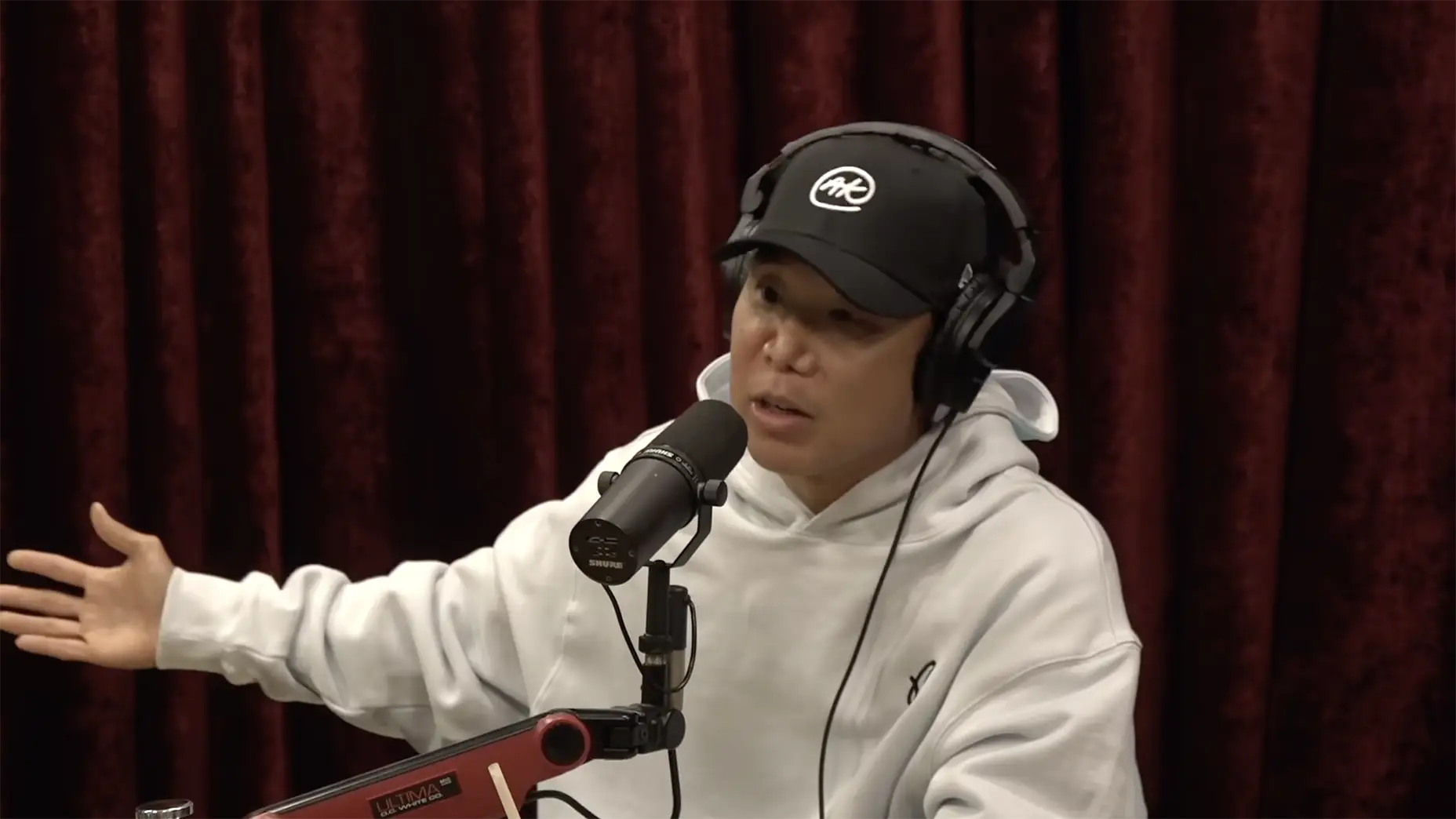
Ever since he returned to pro golf, and even before his return, Anthony Kim has planned for a full breakdown of his rise, fall and return in a forthcoming documentary. He has held back from (and during) interviews, always promising he would go deepest on that platform first. It’s the one that would suit him best and certainly benefit him most, and that was the case until this week when Kim joined Joe Rogan on the latter’s world-famous podcast.
For more than two hours, Kim sat with Rogan in his Austin, Texas studio, diving into the journey Kim’s life had taken to this point — or, as good as Kim can remember it. Rogan did as Rogan does, skimming over the cliff’s notes of Kim’s career and coaxing the conversation forward. The result was the one of the most revealing conversations Kim has ever shared.
It wasn’t perfectly transparent. There are gaps in Kim’s memory, he admits, from his many years of heavy alcohol and drug use, but we learned a lot more about his upbringing, what he saw in his parents, his introduction to marijuana as a 12- or 13-year-old, then to cocaine as a 15-year-old, carrying all the way to where Kim thinks his golf career goes now that LIV Golf has folded.
Let’s start with the early days, where Kim talks about watching his mother, a store-owner, get robbed at gun-point when he was 7 or 8 years old. Watching his mother and family struggle, Kim says, was a recurring motivation in his earliest golf days. But soon, those early golf days introduced him to a world he couldn’t steer away from.
When he was a pre-teen, Kim was introduced to marijuana, heavily influenced by the people around him at the golf courses he would play at. Kim says he was hanging out with men 20 or 30 years older than him, who were members of the country club he wanted to join.
“I was like man, that’s the guy,” Kim said. “That guy has a convertible Mercedes and he’s got four hot chicks with him and partying and drinking. And then he goes to this club that’s $100,000 to join and he gets to sign the bill and not even pay cash. That’s how much they respect him. One day I’mg going to get there.”
Hanging around that group of people, Kim said, introduced him to cocaine at 15 years old, which he would abuse frequently throughout his college career at Oklahoma. Kim recalled being suspended for multiple fall seasons, and eventually banished from Oklahoma for his substance abuse despite numerous meetings with the OU athletic department.
When Kim was in Norman, Oklahoma, he would have a friend from Los Angeles scoop out the center of a peanut butter jar and send him drugs in the jar “so I could have the best stuff for the party.”
Kim was constantly riding “false confidence,” making a fool of himself in a way he could never realize until he got sober.
Kim detailed his time on the PGA Tour, connecting performances at Q-School to sponsor exemptions and spending money immediately as he earned it, completely oblivious, for example, to the fact he had to pay taxes on those winnings. He first gave some to his mother before quickly buying the in-vogue vehicle: an Escalade with 24-inch rims. Next came a $60,000 necklace.
“It’s crazy how quickly it goes,” Kim said. “Like you go to he bar and then you lose track and you’ve bought 94 shots because you think you’re some boss. That confidence. Then you’re like, ‘Oh man, that was 12 grand. Who cares? I’ve got that.’ … That became regular to me.”
This was the mid-2000s when, as Kim put it well, “Thank god there was no social media.” He mentions throwing up on the 1st tee during an event, and nearly passing out during another, and going without sleep in a Dallas tournament because he was home and partying every night.”
But then his story turns on a few simple words:
When I was in rehab, I found something.
Kim has thanked his friend, Rick Solomon, for convincing him rehab was necessary. In 2023 or so, Kim says, his first rehab visit provided some alarming surroundings. He saw the other people around him, was judging their situations and it registered with him why he might need to be there, too.
“I’m embarrassed of my life, you know what I mean?” he said. “Like 10 years ago, I had a chance to win the Masters, and now I’m over here sitting with crazy people. And so I call my wife, and I said, ‘Hey, I don’t think this is for me. I want to give this my best shot, but I don’t think this is for me.’
“I said these people are insane and she asked me, she says, ‘You’re sleeping right next to them. What does that make you?’ It took me a few seconds to be like, hold on, did she call me f—king crazy? And I sat there for a second and I was like, ‘This is true.’”
It’s around that point where Kim’s story is at least a bit more publicly known. In 2024, he returns to public eye, committing to LIV Golf. He shared tiny notes about a forthcoming documentary and even that he battled depression and thoughts of suicide during his battle with addiction.
His body took a beating, too, over the years. He has undergone 10 surgeries, inclusive of a spinal fusion. His cocaine use led to him developing an autoimmune disease called vasculitis, which has weakened the bones on the right side of his face. Kim now has “like 40% vision in my right eye,” which keeps him from playing as quickly as he’d like.
To get through it all, he does roughly 90 minutes of stretching each morning, he says. He’s lost roughly 50 lbs. since coming back to pro golf. And somehow, it cannot be forgotten, Kim rallied to win the LIV event in Australia in the spring — and indelible moment that would have felt impossible for anyone to believe in, even as much as a few months prior. Kim stated, as he has on numerous occasions, that he didn’t think he’d be alive if it were not for his wife, Emily, and his daughter, 4-year-old Bella.
But where does it all leave him moving forward? LIV Golf’s demise has left Kim as a total free agent with no playing status anywhere. He remains interested, for at laest the next three or four years, in pursuing whatever remains of a pro career. He left Rogan with one prediction of sorts for what’s coming:
“I think I’m about eight months to a year from being good,” Kim said toward the end. “I think people will not believe what they see in eight months, to a year.
“What I’ve been doing is, I’ve been working, even though I have to take two steps back, score-wise, I’ve been working on things in my swing, and the way I’m processing information to be good in a year. It sucks when I’m not playing well, but I’m staying true to my plan.”
For more on his rollercoaster journey — and there’s plenty we didn’t get to here — check out the podcast below. It’s absolutely worth your time.
<figure class="youtube-facade" data-content="
“>
Disclaimer : This story is auto aggregated by a computer programme and has not been created or edited by DOWNTHENEWS. Publisher: golf.com