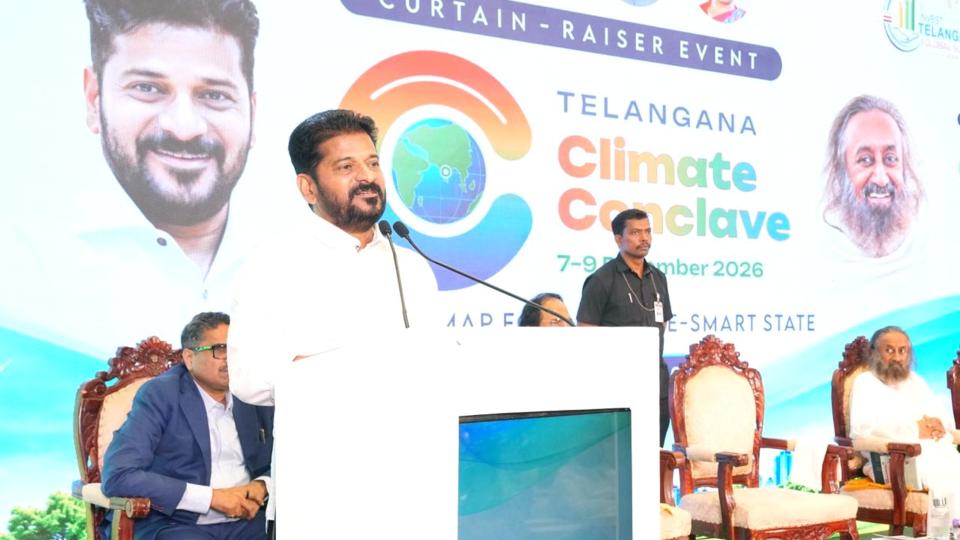
Hyderabad:Chief Minister A. Revanth Reddy on Friday said Telangana would neither replicate the Sabarmati riverfront nor follow the Gujarat development model, but draw on its own history and traditional water conservation systems developed by the Kakatiya rulers to guide its development.
Speaking at the curtain-raiser of the Telangana Climate Conclave 2026 in the city, Revanth Reddy recalled the contributions of Kakatiya rulers Recharla Rudradeva and Rani Rudrama Devi, particularly the chain of interconnected lakes developed for water conservation and distribution. He also invoked tribal leader Komaram Bheem’s slogan of “Jal, Zameen, Jangal” (water, land and forests).
The Chief Minister said nearly 700 lakes had disappeared over the years owing to encroachments and urban and corporate development and that his government was “desperately looking to find” them.
Defending the government’s drive against encroachments on water bodies, Revanth Reddy said influential persons would not be spared despite the criticism and legal challenges faced by the government.
“No MLA, MP or celebrity is spared – their houses, function halls or anything will come down according to the law,” he said, adding that he “enjoys” the legal battles as he believed he was doing the right thing.
He cited the restoration of Bathukammakunta, where women celebrated Bathukamma around the lake this year, and the removal of encroachments on water bodies across the city.
Revanth Reddy said families belonging to economically weaker sections affected by the lake restoration drive were being rehabilitated under the Indiramma housing scheme. Pollution around some water bodies had made living conditions difficult, he said, adding that the government would provide houses to affected families.
Inviting environmentalists and experts to participate in policymaking, the Chief Minister said, “You need not stand outside investment summits and government offices and protest. Come forward and give us your suggestions.”
Revanth Reddy called for changes in agricultural practices to conserve water, asking farmers to consider less water-intensive crops. While the state had food reserves sufficient for two years, available water resources had to be managed until the next monsoon, he said.
“With the water we have now, we have to live the next eight months,” he said. “The future of the state is on the shoulders of our farmers,” he added.
The Chief Minister suggested that farmers might have to forgo one crop rather than exhaust available water resources. He said the government’s objective was to ensure that agriculture was not a “dandanga” (wasteful activity) but a “panduga” (festival).
Revanth Reddy also called for climate considerations to be incorporated into urban planning. He questioned how cities could cope with cloudbursts when drainage and road infrastructure designed to handle 2 cm of rainfall could be overwhelmed by 40 cm of rainfall in two hours.
Outlining the government’s development approach, he referred to the Core Urban Region Economy (CURE), Peri-Urban Region Economy (PURE) and Rural Agriculture Region Economy (RARE), questioning whether any other state had adopted similar planning.
He recalled former prime minister Jawaharlal Nehru’s investments in education and agriculture, including the establishment of the IITs and IIMs, which, he said, had benefited generations.
Revanth Reddy also referred to the government’s initiatives to tackle food adulteration through TG SAFE, encroachments through HYDRAA and drug abuse through EAGLE.
The Chief Minister said industrial growth and environmental protection must go together and invited investors and experts to contribute to building a climate-resilient Telangana.
He said Art of Living founder Sri Sri Ravi Shankar and water conservationist Rajendra Singh, popularly known as the Waterman of India and chairperson of Tarun Bharat Sangh, had been invited to raise public awareness about conservation and ensure that such efforts were not perceived as “political campaigns”.
He also said “we didn’t want to sit inside four walls and make policies. Rather (we wanted to) get out into the real world and listen to real people that these policies affect to be able to make decisions that benefit them in the most efficient way possible.”
Disclaimer : This story is auto aggregated by a computer programme and has not been created or edited by DOWNTHENEWS. Publisher: deccanchronicle.com