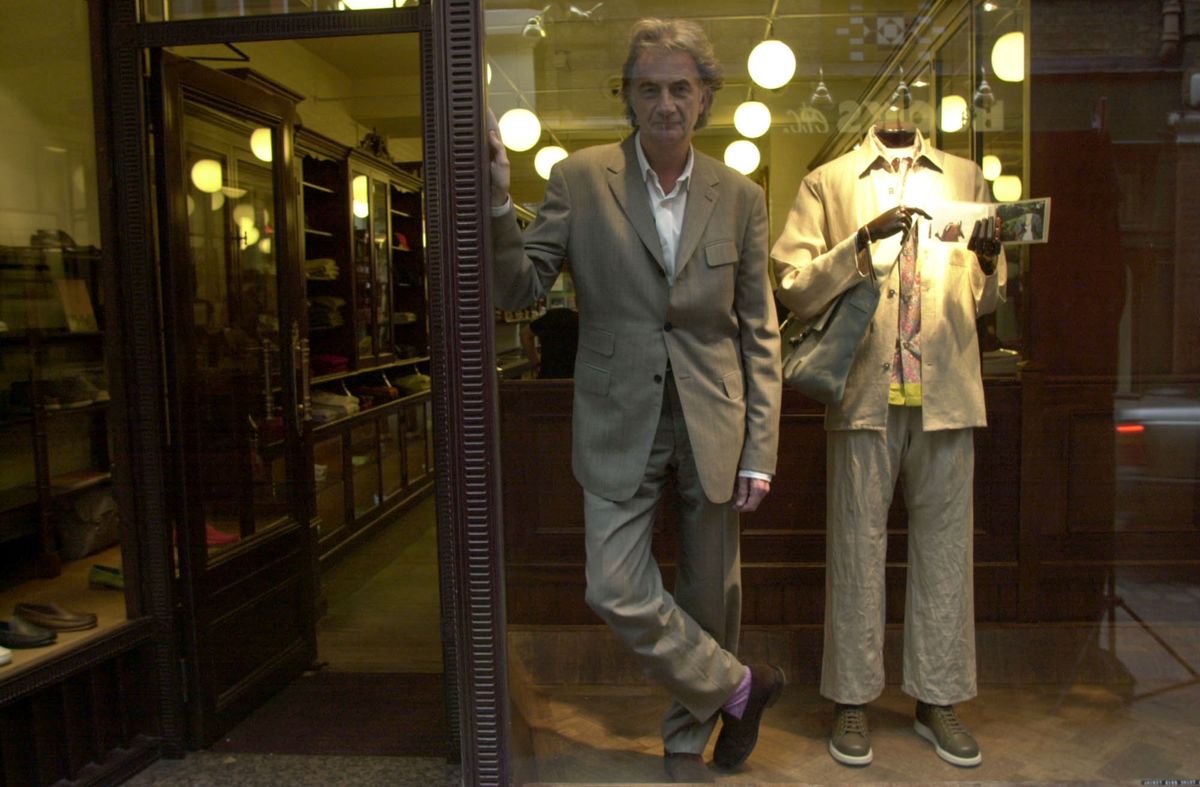
His clothes are sold in more than 60 countries and he’s dressed everyone from Hollywood stars to England footballers, with his latest collection wowing the fashionistas of Milan. But legendary designer Sir Paul Smith’s first show, 50 years ago, was at a mate’s flat in Paris – with his wife Pauline helping out, and music on a little cassette recorder
Sir Paul, 80, says of the 1976 event: “It was probably the only fashion show in the world where you had to ring the doorbell to get in, but it was rather nice. I think we had about 30 people in the audience and Pauline and I altered all the trousers and stitched the hems and took in the waist.”
Now fronting an empire worth £181million a year in sales and with collections gracing global catwalks, it’s a far cry from his beginnings in the Nottingham suburb of Beeston, as the youngest of three children. His father, a credit draper in the textile trade, was a founder member of the Beeston Camera Club and, aged 11, Sir Paul got a Paramount bicycle and his first camera, a Kodak Retinette with an eye-level viewfinder.
To see more of the stories you love from The Mirror and to find them easily in Google then make us your preferred source. Free and easy-to-do, just click on the link here to find more from The Mirror at the top of your feed.
Speaking on BBC Radio 3’s Private Passions, Sir Paul says: “You had to look very carefully in this tiny little rectangle of glass to actually set up the shot. That really taught me to look and see. A lot of people look, but they don’t see.” But his early dreams – from 12 to 18 – were of racing bikes, not fashion.
Sir Paul says: “My father quite rightly said, ‘that’s not a real job.’” Leaving school at 15 on a Friday with no qualifications – discovering later he had dyslexia – he started work on the Monday, in a textile factory job his dad found for him, earning £3 5s a week. Then, in 1967, at his 21st birthday party, he met Pauline Denyer, a Royal College of Art graduate, who’d moved from London to Nottingham to teach art
Six years his senior, he says: “I thought she looked fantastic, because she was so well-dressed and had beautifully cut hair, and she was from London. She’d got this sort of sophistication. Slowly, we got to know each other. Then my whole life changed enormously.”
Pauline had two sons from a previous marriage – as well as two Afghan hounds – but Sir Paul happily brought them all into his life. Admitting that, aged 21, it was an “enormous responsibility,” he says: “Luckily, she was earning a good wage. She really supported us at the beginning, and then I started doing a lot of freelance work.”
Pauline worked for a London fashion company, and Sir Paul credits her with teaching him what mattered about clothes. He says: “The level of importance that should be given to quality and cut, shape, proportion, how you make things. That level she set was really the reason why we’ve had this longevity.”
His first shop opened in 1970 in a windowless room on Byard Lane in Nottingham, paid for with £600 of savings. Sir Paul says: “It was entirely her [Pauline] that gave me the confidence to open this tiny shop. She kept saying to me, ‘you have so much energy, you have so many ideas – maybe you should try and have a little shop.’
Calling it Paul Smith Vêtements Pour Homme, he says: “The rather pretentious sort of sentence was just to try and be different really.”
Its first manager was one of the Afghan hounds, called Homer. He says: “Because the first shop was so tiny, it was very confrontational. When the customer walked in, they were literally in front of you and, of course, as the manager was an Afghan hound, it was always quite busy, quite full.”
In 1979, Sir Paul opened his flagship London shop on Floral Street in Covent Garden. He says: “I don’t know quite how, but we got very lovely actors coming in – Jack Nicholson, Harrison Ford, who is still a customer actually, lots of musicians. Crosby, Stills, Nash & Young and people like that.
“So, it sort of settled into being a sort of quite creative little hub, because in Covent Garden then, in 1979, everywhere was empty. There was only me, the Opera House and the Tube station. On a Saturday I used to shout, ‘Is there anybody out there?’ because there were no customers anywhere. Eventually, they did come, thank goodness.”
David Bowie became a good friend and customer – Sir Paul designed the T-shirt for his album The Next Day. He has also dressed Led Zeppelin’s Jimmy Page since the guitarist was about 18. He has made bespoke suits for Harrison Ford and Daniel Day-Lewis for years, and his client list now includes Leonardo DiCaprio, Andrew Scott and Tom Holland.
Sir Paul says: “We’ve been making clothes for the England squad over the years. I knew George Best well. People that became pals are Daniel Day-Lewis, Gary Oldman is a very good friend, so we do see him socially. But we always respect their privacy and they respect ours.”
At a party for his 50th anniversary at Paris Fashion Week, guests included Susan Sarandon, Jon Hamm, Sir Ian McKellen, Stanley Tucci and Bill Nighy. At its height, the company employed 1,200 people and ran 130 shops around the world, with a turnover of more than £200million a year.
Sir Paul became a Royal Designer for Industry in 1991, the UK’s highest design accolade, and the company won the Queen’s Award for Industry for export achievement in 1992. Made a CBE in the 1994 New Year honours, he was knighted on November 24 2000, at 11am and at 4pm he and Pauline were married.
Sir Paul, who’s had a home near Lucca in Italy for almost 40 years, has a view on how Brexit has affected the business. He says: “I’m not an expert and I’m not a political person at all, but when we were part of the community, there were lots of trading agreements which went away when we left.”
On forming closer ties with Europe, he adds: “I would imagine that it would really help.” The original shop on Byard Lane closed in 2017, but Paul Smith still has a flagship store in Nottingham, opened in 2005 in the Grade II-listed Willoughby House.
Appointed a Companion of Honour in 2020 – a reward for outstanding achievement limited to 65 people – that year Sir Paul launched a foundation to help young designers and entrepreneurs.
Aware of how tough the business is, he tells them: “Nobody needs another designer. The young students I met in 1967, they came from an art school where there were probably 60 students in fashion. Now there’s two and a half thousand students in that one university.”
Knowing that successful students can’t cut corners, he tells them: “You can still do it in this very old-fashioned way, where you just roll your sleeves up and actually do things in a more humble way. You don’t always have to be about lots of money and a flashy fashion show and shop somewhere.”
And he swears by individuality as the key to success. He says: “The reason why we are very confident and very happy that our business is really turning around is individuality.”
With no immediate intention of retiring, Sir Paul remains firmly attached to the look that made his name. He says: “It’s very wearable clothes, but with a little sense of humour, with a different colour buttonhole or button or something like that.” Proudly wearing the clothes he designs, he makes one startling admission, saying: “I steal them from the shop.”
*This interview can be heard in full on BBC Sounds.
Disclaimer : This story is auto aggregated by a computer programme and has not been created or edited by DOWNTHENEWS. Publisher: mirror.co.uk