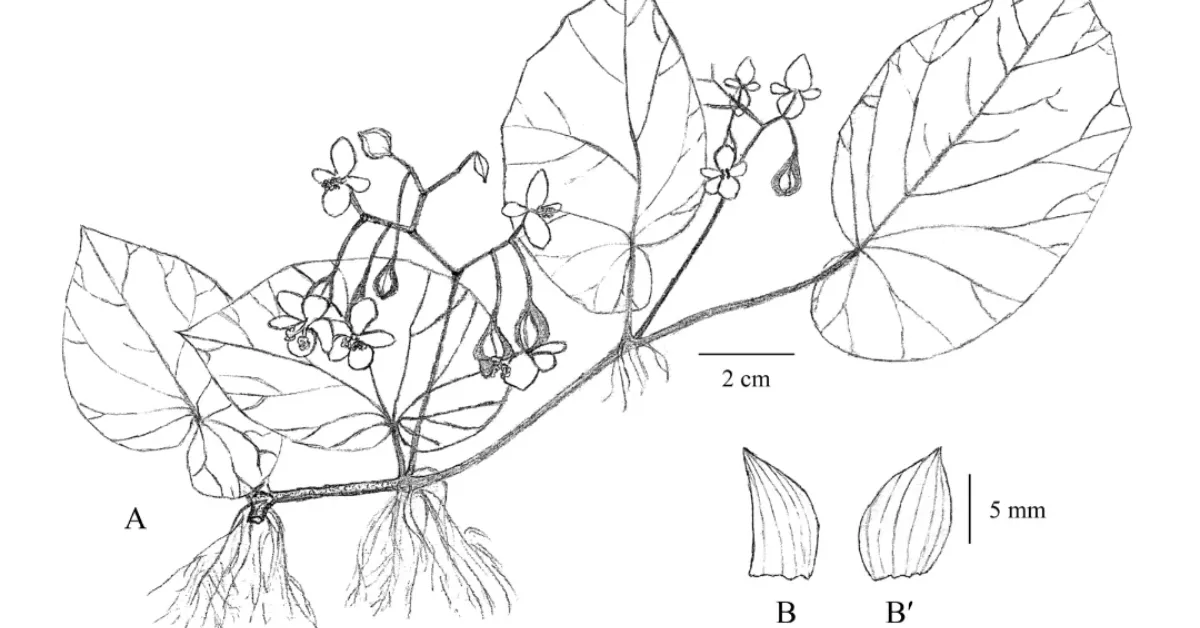
In November 2024, researchers exploring Arunachal Pradesh’s Siang River Valley came across a small flowering plant growing beside a mountain stream. With its creeping stems, dark green leaves and pale pink flowers, it could easily have blended into the surrounding vegetation.
But the tiny bumps on the underside of its leaves and the structure of its flowers held clues to something remarkable. The researchers had come across a plant species previously undocumented by science.
Nearly two years later, on 27 October 2026, their discovery was formally published in the peer-reviewed Edinburgh Journal of Botany.
Named Begonia siangensis after the river valley where it was found, the plant is the latest addition to Arunachal Pradesh’s rich collection of begonias. For the researchers, the discovery also highlights how much of the Eastern Himalaya’s plant diversity remains to be documented.
A closer look at a little wildflower
Researchers S Kishwan, T U Thackeray and N V Page from the Mumbai-based Thackeray Wildlife Foundation documented the plant growing beside a shaded, year-round stream between Bomdo and Jengging in Upper Siang district, approximately 600 metres above sea level.
Establishing that they had discovered a new species required careful work.
The team examined fresh and dried plant specimens, studied them under a microscope and compared their findings with preserved plant collections and botanical records from India, Myanmar and China.
Although the plant closely resembled another species, Begonia iridescens, several small differences set it apart. Its leaves lacked the distinctive silver markings of its relative, its undersides were covered with tiny raised bumps, and its female flowers hung downwards. Differences in its reproductive structures further helped establish its identity as a separate species.
Another discovery, with a name rooted in local culture
Earlier this year, another team of researchers documented a new begonia in a different river valley in Arunachal Pradesh.
Growing on steep, damp rock walls along the Keyi River in Keyi Panyor district, at an elevation of around 1,000 metres, was a small plant with a single light-green leaf and white flowers.
Researchers Dipankar Borah, Madhusudhan Khanal, Momang Taram and Neelam Gap documented the species, publishing their findings in the peer-reviewed journal Taiwania on 5 August 2026.
Interestingly, while the plant was new to science, it already had a name among local residents: ‘Kobiirhopu Baabrai’.
The researchers named it Begonia neelamorum in recognition of the Neelam clan of the Nyishi community, whose members helped them during their expedition.
The discovery offers a reminder of how local communities and their knowledge of the surrounding landscape can contribute to scientific exploration.
What else is waiting to be discovered?
Of the approximately 100 begonia species recorded in India, 58 have been documented in Arunachal Pradesh, giving the state the country’s highest concentration of these flowering plants, according to the October study.
Yet researchers still know very little about the geographical spread and populations of the two newly described species.
Both have been provisionally assessed as ‘Data Deficient’ using the International Union for Conservation of Nature (IUCN) criteria. In simple terms, scientists need more information to determine how vulnerable these plants are and what protection they might require.
So far, Begonia siangensis has been recorded at only one location.
#FloraAndFauna Another addition to Arunachal Pradesh’s floral diversity! The discovery of Begonia siangensis in Upper Siang highlights the Eastern Himalaya’s rich plant life. Kudos to the researchers for this valuable contribution. https://t.co/ydzQmqO2Uy
— MyGov Arunachal Pradesh (@MyGovArunachal) November 13, 2026
The researchers have recommended exploring similar streamside habitats across the Upper Siang Valley, particularly at elevations between 500 and 1,000 metres, to find out whether other populations exist.
These surveys could help scientists understand which habitats need greater conservation attention and uncover other plants yet to be scientifically documented.
For a region celebrated for its forests, rivers and remarkable wildlife, these two discoveries offer another reason to value even its smallest natural habitats.
After all, a little wildflower growing beside a mountain stream has shown us how much there still is to learn about India’s forests.
Sources:
‘Distinctive new wild flower, Begonia siangensis, discovered in Arunachal’s Siang Valley’: By Research Matters Staff Writer(s), Published on 7 November 2026
‘Begonia neelamorum (Begoniaceae sect. Monophyllon), a remarkable new species from Arunachal Pradesh, Northeast India’: By Dipankar Borah, Madhusudhan Khanal, Momang Taram, Neelam Gap, Published on 05 August 2026
‘A New Species Of Begonia (Begoniaceae, Sect. Platycentrum) From The Siang Valley Of Arunachal Pradesh, India’: By S. Kishwan, T. U. Thackeray, N. V, Published On 27 October 2026
Disclaimer : This story is auto aggregated by a computer programme and has not been created or edited by DOWNTHENEWS. Publisher: thebetterindia.com