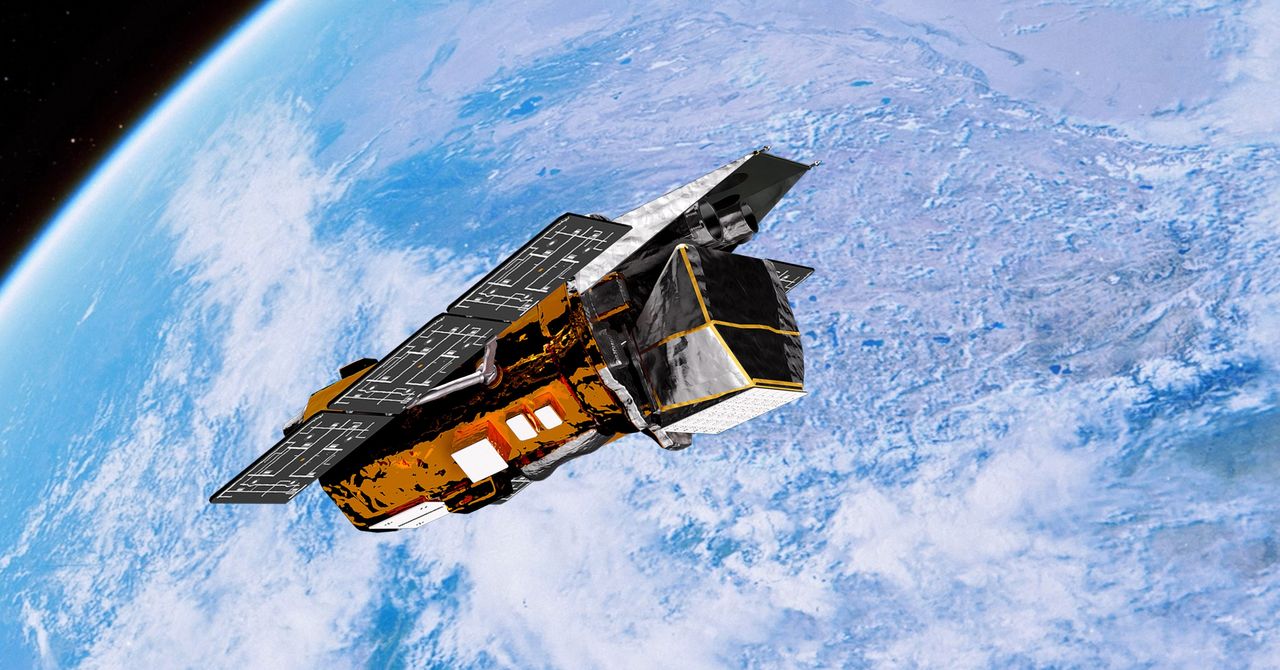
NASA’s Neil Gehrels Swift Observatory has concluded its scientific mission, which spanned just under 22 years. As its orbital altitude fell below 275 kilometers (171 miles), it could no longer continue stable astronomical observations, and it reentered the atmosphere on November 4 over North Sumatra, Indonesia.
Swift had been launched on November 20, 2004, as the Swift Gamma-Ray Burst Explorer, and it began operations the following month. In addition to a gamma-ray-burst alert telescope, it was equipped with ultraviolet and visible-light telescopes as well as an x-ray telescope, and was designed as a multi-wavelength observation satellite capable of rapidly pinpointing the locations of gamma-ray bursts—the most powerful explosions in the universe. In 2018, following the death of its first principal investigator, Neil Gehrels, NASA renamed the mission in his honor.
Tracking Gamma-Ray Bursts
The development of the Swift space telescope was driven by the difficulty of tracking gamma-ray bursts. “Swift was designed as a satellite dedicated to studying gamma-ray bursts, outbursts that came and went so quickly that no one could target them with large telescopes to learn more,” explains S. Bradley Cenko, the mission’s principal investigator at NASA’s Goddard Space Flight Center.
Swift detected a gamma-ray burst, pinpointed its location, relayed the information to other observatories, and then swiveled its telescope to capture images before the afterglow faded; this sequence of operations was usually finished in about a minute. Speed was particularly critical for short gamma-ray bursts, in which the emissions end in less than two seconds. Before Swift was launched, it was not possible to pinpoint the location quickly and accurately enough to observe the afterglow.
In May 2005, Swift quickly turned toward the gamma-ray burst GRB 050509B, which lasted only 0.03 second, and detected 11 x-ray photons. This was the first short gamma-ray burst for which an afterglow was detected. This observation corroborated long-standing theoretical models suggesting that short bursts are most likely caused by the merger of two neutron stars, celestial bodies with a mass comparable to the sun compressed to the size of a city.
Its flexible observation planning system is another reason why Swift was regarded as a versatile tool for astronomy. This is because astronomers could request target-of-opportunity observations, which allowed commands to be sent from the ground in as little as a few minutes.
It also allowed for the setup of monitoring programs to observe specific celestial objects for periods ranging from minutes to months, and it was possible to schedule observations of up to 75 distinct celestial objects per day. Furthermore, it played a role in sending alerts to other space- and ground-based facilities to coordinate additional observations.
Swift observed more than 2,000 gamma-ray bursts and more than 1,400 supernova explosions. It also witnessed stars being torn apart by black holes, monitored active galaxies, and conducted all-sky x-ray surveys; the data from these observations contributed to approximately 7,000 scientific papers. The entire dataset—including approximately 22 years’ worth of brightness measurements and more than 1.5 million images from ultraviolet and visible-light telescopes—is publicly available and amounts to about 12 terabytes.
Rescue Mission Attempted but Abandoned
The Swift observatory was circling in low Earth orbit. At this altitude even the outermost layer of the atmosphere creates air resistance on satellites. However, Swift lacked thrusters to maintain its orbit, and its altitude continued to drop.
As a result, its altitude—which was approximately 585 kilometers (364 miles) at launch—had dropped to about 363 kilometers as of June 18, 2026. In recent years, increased solar activity has caused Earth’s atmosphere to expand, causing the telescope to descend faster than initially predicted.
NASA engineers had long predicted that Swift’s altitude would drop to approximately 300 kilometers by the fall of 2026, at which point a recovery spacecraft would no longer be able to approach it safely. Consequently, NASA decided not to issue a standard request for proposals and instead asked three companies with which it had already signed technology development contracts to explore the feasibility of providing orbital services. In September 2025, NASA signed a $30 million contract with the space startup Katalyst Space Technologies.
The original plan was for the small satellite LINK to capture and dock with Swift using three robotic arms, raise its orbit to a safe operational altitude, and resume scientific observations. Since there was only one year to complete this task, Katalyst manufactured components in-house when suppliers could not meet their deadlines and streamlined testing procedures. LINK was launched on July 3, 2026, aboard a Northrop Grumman Pegasus XL rocket.
However, during in-orbit testing, a malfunction occurred in LINK’s attitude-control system, and it was determined that capturing Swift and raising its orbit would be difficult. In response, NASA and Katalyst announced on August 19 that the operation would be canceled, and the mission was redefined as an in-orbit demonstration.
LINK raised its orbit to align with Swift, deployed its three robotic arms, and simultaneously fired its three ion thrusters, successfully approaching the telescope to a distance of 12 to 15 kilometers (7 to 9 miles). Nevertheless, NASA announced that LINK would not approach Swift any closer during the remainder of its operational life in orbit. LINK subsequently reentered Earth’s atmosphere on September 25.
Following the decision to abandon the orbital raise, the Swift operations team announced a plan to continue observations for as long as possible in the time left. On August 26, they restarted the ultraviolet- and visible-light telescopes and the x-ray telescope—which had been shut down in preparation for the rescue mission—and successfully captured images of Tycho’s supernova remnant, located approximately 13,000 light-years away. But as the altitude dropped below 275 kilometers, the telescope was no longer able to maintain a stable lock on its target, and the scientific mission concluded with the final observation on October 20.
“Swift delivered an incredible, lasting return on investment for the nation, designed for a two-year primary mission but productive for more than 10 times as long,” said Sean Domagall-Goldman, director of the Astrophysics Division at NASA headquarters. To ensure it can continue to respond swiftly to cosmic phenomena even after Swift is gone, NASA is considering ways to utilize and expand its existing fleet of space telescopes.
This story was originally published in WIRED Japan and has been translated from Japanese.
Disclaimer : This story is auto aggregated by a computer programme and has not been created or edited by DOWNTHENEWS. Publisher: wired.com