When crises collide
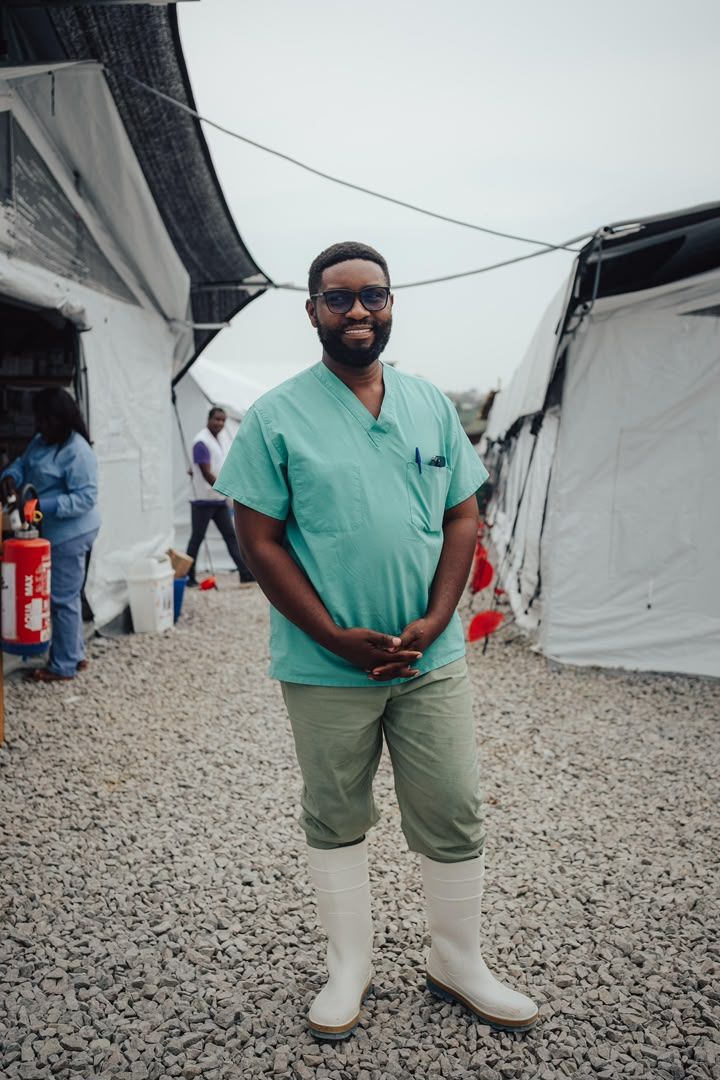
“The people here live in poverty and insecurity; every day is a struggle to survive,” said Congolese physician Alex Bonane Murutsi, who works at the Ebola treatment centre in Bunia where Vandamme did her field assignment. Murutsi started working in the MSF Ebola response after contracting the deadly Bundibugyo virus and fighting for his life for 18 days earlier this year.
“The epidemic makes their already difficult life even harder. For many, it’s hard to accept the prevention measures,” he said.
He has seen families resist safe burials and Ebola survivors face exclusion and stigma. Funerals traditionally involve a lot of touching, dancing around and washing the body of the deceased — rituals that are important to the local culture. Safe burials require isolating the body in a sealed bag to prevent viral transmission. Distrust in Ebola response workers and the inability to perform the traditional rites and say a proper farewell cause some families to hide deaths or resist safe burials.
As for survivors’ stigma, local populations do not always understand that recovered patients are no longer infectious, leading to fear and avoidance due to a lack of public information or misinformation. Even health workers can get a hard time from their own families, Murutsi explained, because they don’t always understand how they can safely work in a treatment centre.
“In the beginning, there was not enough communication. People didn’t always understand why certain measures were necessary,” he explained.
That mistrust sometimes turns violent. One of the soft-spoken doctor’s colleagues was working at a rural health post when a patient suffering from severe bleeding was brought in. The medical staff voiced their suspicion of Ebola, which infuriated the patient’s companions. They insisted the disease did not exist in their village and accused the health workers of bringing it there. The doctor was assaulted and had to flee.
But Dr Murutsi stresses that medical teams do not face hostility everywhere. In Bunia, there is more trust, partly because local health workers engage directly with the community.
“People know us and we take the time to explain why certain measures are important. You don’t earn people’s trust by simply telling them what to do; you have to talk to them,” he explained.
Anna Halford is acutely aware of the challenges of fighting Ebola in conditions of insecurity. The British aid worker coordinates MSF’s response to the outbreak across the DRC.
“The physical access to some of the affected areas is severely compromised,” she said. “This makes it extremely difficult to transport supplies and establish proper screening and surveillance.”
In some conflict-affected areas, violence and insecurity prevent health teams from reaching communities, leaving sick people with little or no access to Ebola testing and care. This also hampers contact tracing, which is crucial for fighting the virus. For every confirmed case, teams must quickly identify people who may have been exposed and monitor them for three weeks after their last known contact.
Halford, an experienced humanitarian who also helped tackle the largest-ever West African Ebola outbreak, emphasised that violence is not the only obstacle to taming the virus.
“Several areas not affected by armed groups are also seeing a rise in cases and struggling with the response,” she pointed out.
Supply routes are not only cut off by the risk of attacks, but also by the country’s weak infrastructure. Patients often have to travel for hours along bumpy roads to reach a treatment centre. Meanwhile, medicines and medical supplies often fail to reach remote villages in good condition.
This leaves front line health workers across the whole DRC without the basic protective equipment needed to safely treat suspected Ebola patients. Halford recently encountered this in a remote clinic far from the conflict-ridden East.
“In an area where, thankfully, numbers are still low, medical workers were forced to make do with makeshift protective gear designed for COVID-19 and flip-flops,” she said, expressing her frustration.
Responding to Ebola is an inherently complex and costly operation. According to the veteran field worker, the security risks act as a disease multiplier, further exacerbated by the crippling lack of funding that Congolese health services historically struggled with.
This longstanding problem has only grown worse in recent years, since international donations have sharply declined. Last year, the United Nations’ humanitarian emergency response plan for the Congo was funded by barely a quarter of the required amount.
Jeremy Konyndyk, who led the US response to the Ebola outbreak in West Africa in 2014 and now heads Refugees International, argued on the Zeteo media website that the dismantling of USAID played a role in the delayed detection. The US Agency for International Development (USAID) previously deployed rapid response teams, known as DART, to detect and contain outbreaks.
With them gone, the early warning system failed, allowing the virus to circulate undetected from February through May. According to him, the cuts also contributed to shortages of protective equipment and limited the capacity to analyse samples and conduct tests.
The collapse of USAID hit even harder because other donors — such as the United Kingdom, Germany, France, and Canada — cut back on aid almost simultaneously, according to epidemiologist Alain Casseus, head of the infectious diseases division of the leading medical charity Partners in Health.
As a result, the Congolese Ministry of Health and Africa CDC were initially left largely on their own to tackle the raging epidemic with limited staff and supplies.
The fragile Congolese healthcare system was quickly overwhelmed.
Early Ebola symptoms resemble those of malaria or typhoid, and infections were often misidentified in understaffed and poorly equipped health centres. After the outbreak was officially declared in May, it took months to bring the testing capacity up to the required level.
Halford is relieved that the international community has recently stepped up efforts to close the funding gap. In September, new pledges from G20 foreign ministers and major donors brought total global commitments since May to around $2.9bn.
“I’m delighted that there have been some donors, and the Congolese state itself, which have pledged and disbursed resources,” she said. “But for whatever reason, we are not seeing enough of the effect of those resources on the ground.”
That mismatch is apparently so striking that Javid Abdelmoneim, the international president of MSF, sounded the alarm earlier this month. In a scathing statement, he warned that the funds simply have not reached the front lines of the fight against Ebola.
“Despite the vast amounts of money provided for the response, many front-line responders are left trying to contain the outbreak with empty hands and empty pockets,” Abdelmomein said in an MSF statement.
“Our teams are often left speechless by the dysfunctions they witness. Six months into the response, this situation is simply unacceptable.”
Abdelmomein cites cases of untrained and unpaid health workers, ambulances unable to respond due to lack of fuel and phantom surveillance teams that exist on spreadsheets but are nowhere to be seen in the field.
Despite funding earmarked for this crucial work, a comprehensive system to detect infections and trace contacts is still lacking, Abdelmomein said.
“In Ituri, only nine percent of patients with Ebola disease treated by our teams had previously been identified as contacts by the surveillance system,” Abdelmomein added.
Halford, his coworker, claims there’s a serious lack of oversight of how pledged funds reach operations on the ground. But according to her, there’s no single explanation or culprit to point fingers at.
“This is not a criticism directed at the DRC government, which itself denounced that lack of transparency. Poor planning and oversight lead to many overlapping aid projects in one area, while others are left neglected,” she said.
Halford notes that the specific circumstances in DRC, where one of the deadliest viruses in the world strikes in a war-torn region with a historically weak health system, make an already difficult Ebola response extremely hard.
“Tackling Ebola requires everything, everywhere, all at once. It’s an uphill battle, but it is a collective responsibility to overcome these challenges in order to stop this devastating virus,” she added.
Disclaimer : This story is auto aggregated by a computer programme and has not been created or edited by DOWNTHENEWS. Publisher: aljazeera.com