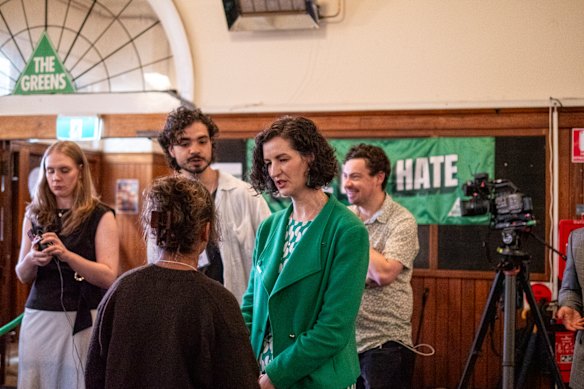
The Greens have made major gains and are likely to win a swag of seats across the inner city, riding a wave of anti-Labor sentiment and giving themselves a chance to form opposition in the next parliament.
At about 10pm, Nine had called five seats for the Greens, and the party had established a strong position in other seats once considered safe Labor territory. With nearly a quarter of all votes counted, the Greens recorded a 15.7 per cent primary vote, up 4.2 percentage points on their 2022 result.
Speaking to the party faithful at an election event in Docklands, Greens leader Ellen Sandell said “this is a turning point”.
“We have at least doubled our numbers in the parliament,” she said. “This is a turning point in the Green movement and in politics as a result. What we have seen tonight here in Victoria is the crumbling of the two-party system.
“We have won more seats than One Nation. It is wild the number of seats we are still in the hunt for.”
Greens candidate Campbell Gome unseated Labor incumbent Kat Theophanous in Northcote, polling 64.6 per cent of the two-party-preferred vote shortly before 10pm. Labor clung to the seat in 2022 by less than 200 votes, and it was one of the first seats to fall on Saturday night.
In Pascoe Vale, former local mayor Angelica Panopoulos unseated incumbent Anthony Cianflone, recording a two-party-preferred vote of 55.3 per cent by 10pm.
In Footscray, Greens candidate Elena Pereyra beat Labor incumbent Katie Hall. Pereyra, a former councillor who contested the seat in 2022, campaigned on a cost of living, climate and anti-data centre platform.
The count in Footscray, which Labor has held for 99 years, will be complicated, with 15 candidates on the ballot paper and preferences set to play a major role.
The Greens are also in a strong position in Richmond – which it won in 2022 – and is a chance in Preston and Prahran.
The 23 per cent of votes counted so far do not include postal votes, which tend to skew conservative and could threaten the Greens’ early success.
But with Labor suffering a 19.4 per cent hit to its primary vote, it raises the prospect of the Greens forming the next opposition.
“It’s possible,” said federal Greens senator Barbara Pocock. She said the Victorian election was a “disaster” for Labor, and the Greens were ready to step up.
“I have real, real confidence,” she said. “We’ll possibly have some significant increase in numbers and some new people who aren’t experienced, but that’s exciting, and I think our policy offering was really clear, and people have responded to hope and a progressive vision.”
Deputy leader of the Victorian Greens Sarah Mansfield wouldn’t be drawn on the prospect of forming opposition when pressed on the ABC.
“Let’s see what happens,” she said.
Former Victorian Greens upper house MP and political consultant Nina Springle said it was too early to tell, but “if it continues on the trajectory that is has been all evening, [forming opposition is] absolutely possible”.
But Springle said if the Greens wanted to be a “real replacement for Labor” they needed to broaden their appeal to voters outside the inner city by listening to suburban voters.
“To be a true opposition they’d definitely need to look to having a strong presence in the suburbs in a more substantial and enduring way.”
City of Yarra Greens councillor Sophie Wade said the party was a strong contender to forming the new opposition instead of Labor.
“We’ve got Ellen Sandell as a leader,” Wade said. “We saw what she could do the other night on the debate stage. She is absolutely up for being leader of the opposition, much more so than who we’ve seen recently.”
Wade said seats were in contention for the Greens that had never been on the radar before like Bellarine, near Geelong.
“I can’t wait to see the world where Ellen is the leader of the opposition,” Wade said. “I think that’s really exciting, I would welcome Victorians having a Green opposition.”
Stephen Donnelly, former assistant secretary for Victorian Labor, said the shifting demographics of inner-city voters would threaten Labor’s hold, including in seats like Preston.
“The Greens are putting up a serious challenge. They are upbeat about winning the electorate,” Donnelly said on the pro-Labor Socially Democratic podcast live show.
“But [suburbs] like Preston and Thornbury are also gentrifying … therefore making it far more challenging for Labor to hold the seat of Preston.”
Earlier on Saturday night Sandell said winning five lower house seats and making gains in the upper house would “be a record for the Greens”.
“It’s pretty extraordinary to even have the Greens competitive in places that are further out from the city, but we’ll just have to see what happens tonight.”
There was a festive atmosphere at the Greens election party at the Mission for Seafarers in Docklands, with volunteers and party members clad in various permutations of green.
“It’s a Green wave baby,” one volunteer said as positive results trickled in.
Sandell said despite the election of a conservative, Coalition government, the result was not an endorsement of the Liberals’ plans.
“I think it’s more a rejection of Labor that’s moved away from their values, and a rejection of politics in general that hasn’t been working for people,” she says.
“The Greens will be more important than ever if there is a Liberal government. We will be a very strong opposition to some of their worst plans to sell off our sewerage, to rip up treaty, to rip up renewable energy, to cut jobs, and I hope that we will be that bright spark of hope in the parliament for progressives and that strong opposition.”
Sandell also had to address an awkward moment when casting her vote on Saturday morning. Sandell posed for photos while making her vote, displaying her ballot paper which showed the Greens leader went against the party’s own how-to-vote card.
Sandell had preferenced the Animal Justice Party’s Naomi Jones third, despite her how-to-vote cards instructing voters to place independent Mohamed Yusuf in that position. The ballot she cast on Saturday also had Labor’s Davydd Griffiths in fourth, while her how-to-vote card had him further down the ticket at fifth.
Sandell said she preferenced the Animal Justice party higher than they were on the Greens how to vote cards because they aligned with her values.
“I was trying to wrangle my four-year-old, and I probably should have actually folded it [my paper] up, but look, we always tell people to preference according to their values,” Sandell says.
Read more on the Victorian election:
 Angus Delaney is a state political reporter at The Age. Email him at angus.delaney@theage.com.au or contact him securely on Signal at angusdelaney.31Connect via email.
From our partners
Disclaimer : This story is auto aggregated by a computer programme and has not been created or edited by DOWNTHENEWS. Publisher: www.smh.com.au