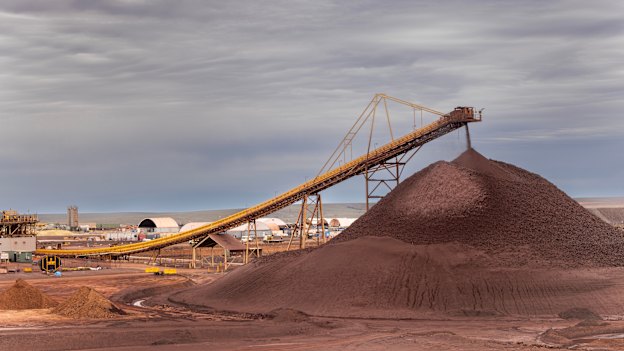
Dawn breaks over flat plains in the South Australian desert, lighting up red dunes and saltbush that stretch beyond where the eye can see. Soon, the early sun also glints off an arrow-straight highway carrying workers on their morning commute to Olympic Dam, a remote outpost poised to become the centrepiece of one of the biggest copper-mining provinces in the world – if a $26 billion mega-project goes according to plan.
In this quiet corner of the country, 560 kilometres north of Adelaide, the prospect of what mining giant BHP is describing as a “generational opportunity” is stirring undeniable excitement, bringing with it the promise of fresh investment and jobs. But for locals who have seen grand visions come and go before, optimism is tempered by experience. As one resident of the nearest town, Roxby Downs, puts it, people here are careful “not to be getting ahead of ourselves”.
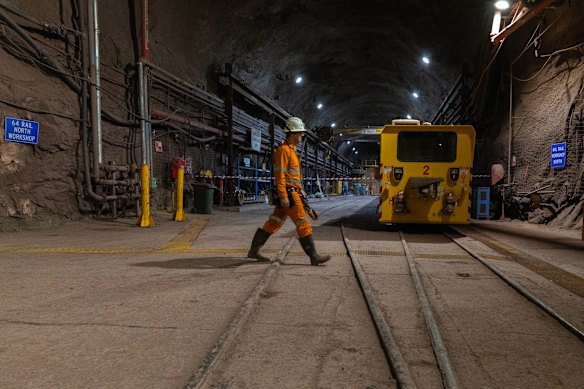
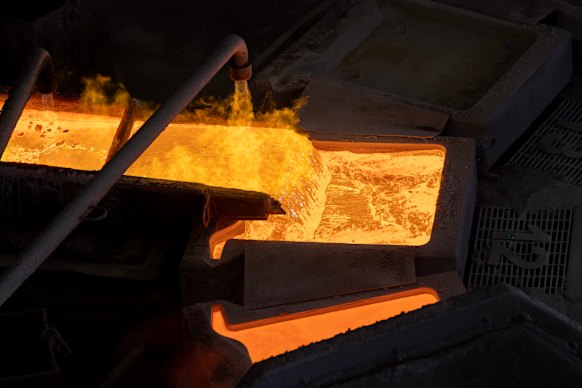
More than half a century has passed since Western Mining Corporation first sank a drill into this arid tract and hit an extraordinary orebody rich in copper, uranium, gold and silver. In the decades that came next, miners carved out a subterranean labyrinth of more than 700 kilometres of tunnels and haulage roads, plunging nearly a kilometre underground. On the surface, a sprawling industrial complex also took shape, with concentrators, a smelter and refinery built to transform crushed ore into pure copper sheets, making Olympic Dam Australia’s largest source of the red metal, producing more than 200,000 tonnes annually.
Yet, the operation would have been larger still by now, had a string of ambitious expansion attempts not buckled under the weight of formidable costs and complexity – most notably, a shelved $30 billion proposal to carve a giant open-pit mine into the site more than a decade ago.
The prize of the potential resource still buried here remains immense: an estimated 88.1 million tonnes of copper, 2.8 million tonnes of uranium oxide, 103 million ounces of gold, and 498 million ounces of silver. But unlocking it on a substantially greater scale has repeatedly proved elusive.
Now, Melbourne-based BHP, which has owned the site since 2005, is preparing another attempt.
With BHP’s revenues from iron ore — long Australia’s biggest export — plateauing and beginning a gradual decline, the company is racing to grow its stake in what it calls “future-facing commodities”. Chief among them is copper, the key ingredient in electrical cables. Driven by the global shift to clean energy, the red metal has become one of the most sought-after resources of the modern era, essential for rewiring power grids, expanding the build-out of renewables and manufacturing electric vehicles, which require four times as much copper as petrol-powered cars.
Against this backdrop, BHP executives last week told investors the company was developing a $US17.4 billion ($26.1 billion) proposal to more than double production volumes from its South Australian copper business – spanning Olympic Dam, the nearby Carrapateena and Prominent Hill mines, and the Ankata (formerly Oak Dam) exploration project – from 320,000 tonnes to 650,000 tonnes by 2040.
If such production volumes are achieved, the province would rank as world’s second-largest source of copper, rivalling the giant Escondida mine in Chile’s Atacama Desert, in which BHP also holds a stake.
Mining analysts say the strategic logic is compelling, and see potentially significant benefits of BHP’s ambitious Australian push, particularly as the outlook for iron ore becomes less favourable and global appetite for copper grows. Some believe the circumstances are more promising than during previous expansion attempts.
However, many also remain wary of the technical and financial hurdles that have tripped up Olympic Dam in the past and offer ample reason for caution.
Olympic Dam is an “enormous orebody” that BHP has long been seeking to expand, UBS analyst Lachlan Shaw says. But the site had proven a “challenging operation”, plagued by operational instability, complex metallurgy and a dependence on external infrastructure needs, such as reliable supplies of water and electricity.
For years, the operation generated returns on capital employed in the “low single digits”, Shaw says, before reaching 10 per cent in the 2026 financial year, helped by record-high commodity prices.
“While BHP is a good operator, we see challenges with its copper growth,” Shaw says, not least of which is the fact that still-to-be-approved investments in new projects remain at risk from rising inflationary pressures.
BHP plans to stage its investment decisions, with the first phase of spending not due for board sign-off until next year. Even so, Anna Wiley, the company’s asset president for Olympic Dam, insists the fundamentals are “different this time around” compared to previous attempts.
For a start, BHP now controls a much larger portfolio of copper assets across the region following its $9.6 billion takeover of OZ Minerals in 2023. That deal brought the Carrapateena and Prominent Hill mines under the company’s control, giving the company access to additional ore.
“There’s a number of things that are different,” Wiley says. “The first is that we have the broader South Australia province – three mines able to feed the central smelting and refinery.”
The second shift, she says, is BHP’s deeper understanding of the geology. “We have done about a million metres of drilling across the last five or six years,” she says.
The third difference is the proposed mining and processing configuration, which would allow BHP to be far less-selective in the quality of ore extracted from the underground mine. A proposed expansion of the site’s existing refining and smelting capacity will mean a greater variety of ore can be processed at Olympic Dam’s above-ground operations. Beneath the surface, meanwhile, BHP is planning a massive underground “block cave” – a mining technique that involves tunnelling under an orebody, causing it to collapse under its own weight. Commonly used in deep copper and gold deposits, block caving can allow miners to extract enormous volumes of ore at relatively low cost, but requires a significant upfront investment and considerable technical expertise.
Underpinning the overall push is BHP’s conviction that the world will need substantially more copper in the decades ahead. The company’s forecasts suggest demand for the metal will grow 30 per cent by 2040, just as large-scale new deposits are becoming harder to find. “What we do know about the market is that it will pull more copper through into it – we know it is growing over time,” says Wiley.
There is, however, one critical variable that sits outside BHP’s control: water. BHP’s SA copper business currently uses 60 million litres of water a day, more than half of which comes from the Great Artesian Basin. Expanding the smelting operation cannot proceed without new supply – “we are at capacity today”, says Wiley – while more water will also be needed to grow Olympic Dam. The SA government is due to make a final decision on a Northern Water infrastructure project, a $5 billion-plus infrastructure scheme that would desalinate seawater from the Spencer Gulf and pipe it inland to Olympic Dam and other industrial users.
It’s been nine years since the last time BHP flew analysts and investors into Olympic Dam and outlined a plan to expand production. Now, “we find ourselves back here again”, says Glyn Lawcock, head of metals and mining research at Barrenjoey. But could it be a case of third time lucky? This time, BHP has come armed with greater knowledge of the orebody complexity and economics a result of years spent mining and drilling in the southern area of the mine, Lawock notes, while its plan to pursue block-caving and to split the smelting process across two furnaces instead of doing it all in the one step addresses the problem of declining copper grades and higher sulphur content in its ore feeds. “We believe this time may be different,” he says.
The reporter travelled between Adelaide and Olympic Dam as a guest of BHP.
The Business Briefing newsletter delivers major stories, exclusive coverage and expert opinion. Sign up to get it every weekday morning.
Disclaimer : This story is auto aggregated by a computer programme and has not been created or edited by DOWNTHENEWS. Publisher: www.smh.com.au