
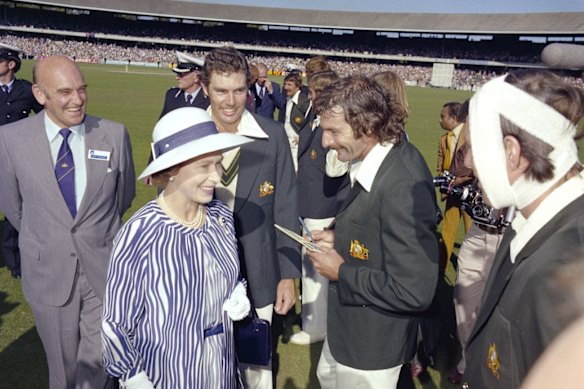
With his head wrapped in bandages like a mummy after being struck by a Bob Willis thunderbolt that left him with a broken jaw, Rick McCosker was dreading his first meeting with Queen Elizabeth II at the tea break on the final day of the Centenary Test in March 1977.
“I was a bit concerned that when she came down to me that she was going to pass by,” says McCosker, who was bowled for four, five days earlier at the Melbourne Cricket Ground when the ball ricocheted off his face and onto the stumps.
“After all, I was very ugly. But she was very gracious, and she asked how I was feeling and said that she was sorry that I had this injury and hoped that I’d recover well. She was [a] very gracious lady.”
Almost 50 years on from the 100-year anniversary Test, there’s still something that irks the former opening batsman, despite his heroics on day three when he emerged from the sheds to fend off Tony Greig’s England, helped Rod Marsh bring up three figures and set up Australia’s match-winning lead: he only scored 29 runs across the two innings.
“There’s more I would prefer to be remembered by other than that innings,” McCosker says. “When you look at the statistics of the game, I scored four runs in the first innings and 25 in the second. That’s not very many in the whole scheme of things. So, purely from that point of view, it was a pretty poor performance.”
Good luck finding a tougher marker. McCosker’s second-innings 25, having come to the middle at 8/353 and departed 54 runs later, proved invaluable in the context of Australia’s 45-run victory. When you consider he was also playing through a gruesome injury, his innings might go down as one of the most courageous in the game’s history.
“Rick was lean,” says former teammate Kerry O’Keeffe, who was asked to open in place of McCosker in the second innings. “He probably weighed 70 kilograms; 60 of that was his heart. Tough as woodpecker lips.”
At a time when the renewed focus on the Sandpapergate scandal has shone a light on the unpalatable realities of Australia’s win-at-all-costs methods from 2018, the memory of McCosker’s innings stands as a refreshing reminder of Aussie grit and the spirit of digging in for each other.
McCosker, who chaired Cricket Australia’s player-led cultural review following the Cape Town ball-tampering scandal, will be one of several members from the class of 1977 at the 150th anniversary Test at the MCG in March.
Just what the Australian XI will look like for the one-off clash against England is anyone’s guess. There are nine Tests scheduled before the MCG fixture, including an intriguing four Test home series against the Black Caps and a treacherous five-match series in India, where Pat Cummins’ men are aiming to become the first Australian side to win in the subcontinent since 2005.
Then there is the small matter of Australia’s ageing side, with champion batsman Steve Smith and the nation’s greatest wicket-taking off-spinner Nathan Lyon, who is set to be dropped from the squad, deep into their 30s. Quicks Mitchell Starc and Josh Hazlewood are also on the other side of 35. And with CA’s truth forum scheduled before the 150th Test, who knows what twists and turns will unfold.
McCosker said he hoped the crisis engulfing Australian cricket could be resolved before that occasion.
“I hope it goes away quickly and there’s some sort of resolution ASAP because it’s not doing anything good for the game,” McCosker said. “We need to move on from it.”
McCosker does not wish to pour fuel on the fire engulfing Australian cricket. But he does hope this generation understands the history awaiting Cummins’ men.
“I’m not close enough to the current players to know whether they’re really traditionalists, whether they will see it in the same light that we did. But I’m hoping they will,” he said.
While there may have been more unity among the team in McCosker’s era, it wasn’t all a bed of roses on the pitch – as the images of his swollen jaw in 1977 attest.
“I couldn’t hear much. I’m not sure what was said or not. But I know that ‘Greigy’ instructed the bowlers to bounce me, and I expected that,” McCosker said. “It was a Test match, and you have to expect whatever comes along. I wasn’t expecting any easy road. It was never going to be.”
McCosker, who hit four centuries and averaged a tick under 40 from 25 Tests and scored almost 9000 runs for the Blues, was inducted into the NSW Sport Hall of Champions on Monday.
“That’s not why we played, but it is good to get acknowledged,” he said.
McCosker said he could hardly believe the 50th anniversary of the famous 1977 Test was on the horizon, especially given so many members who took to the field at the MCG had died.
“It’s gone very quickly,” he said. “But the sad thing about it is that there’s a few who played that game who won’t be there. That’s life. But it’s just a tragedy, really, that we’ve lost a few guys.”
That list includes Marsh, David Hookes, Max Walker and Gary Gilmour, as well as Willis and Greig, who later became a household voice on Australian televisions on Channel Nine after joining forces with Kerry Packer to help establish the World Series Cricket in 1977.
“You miss those guys, and they’ll be missed during that match,” McCosker said.
McCosker’s heroics are unlikely to be repeated, with safety protocols now requiring batsmen to undergo head injury assessments after being struck.
“I wouldn’t be able to do it these days,” he said. “You wouldn’t pass the HIA test, and you wouldn’t be allowed anywhere near the game.
“But there was no reason why I couldn’t bat again at that time. And I wanted to. I needed to be out there to try and help Marshy get his hundred, and we needed more runs, so it was just the logical thing to do.”
News, results and expert analysis from the week in sport sent every Friday. Sign up for our Sport newsletter.
From our partners
Disclaimer : This story is auto aggregated by a computer programme and has not been created or edited by DOWNTHENEWS. Publisher: www.smh.com.au








