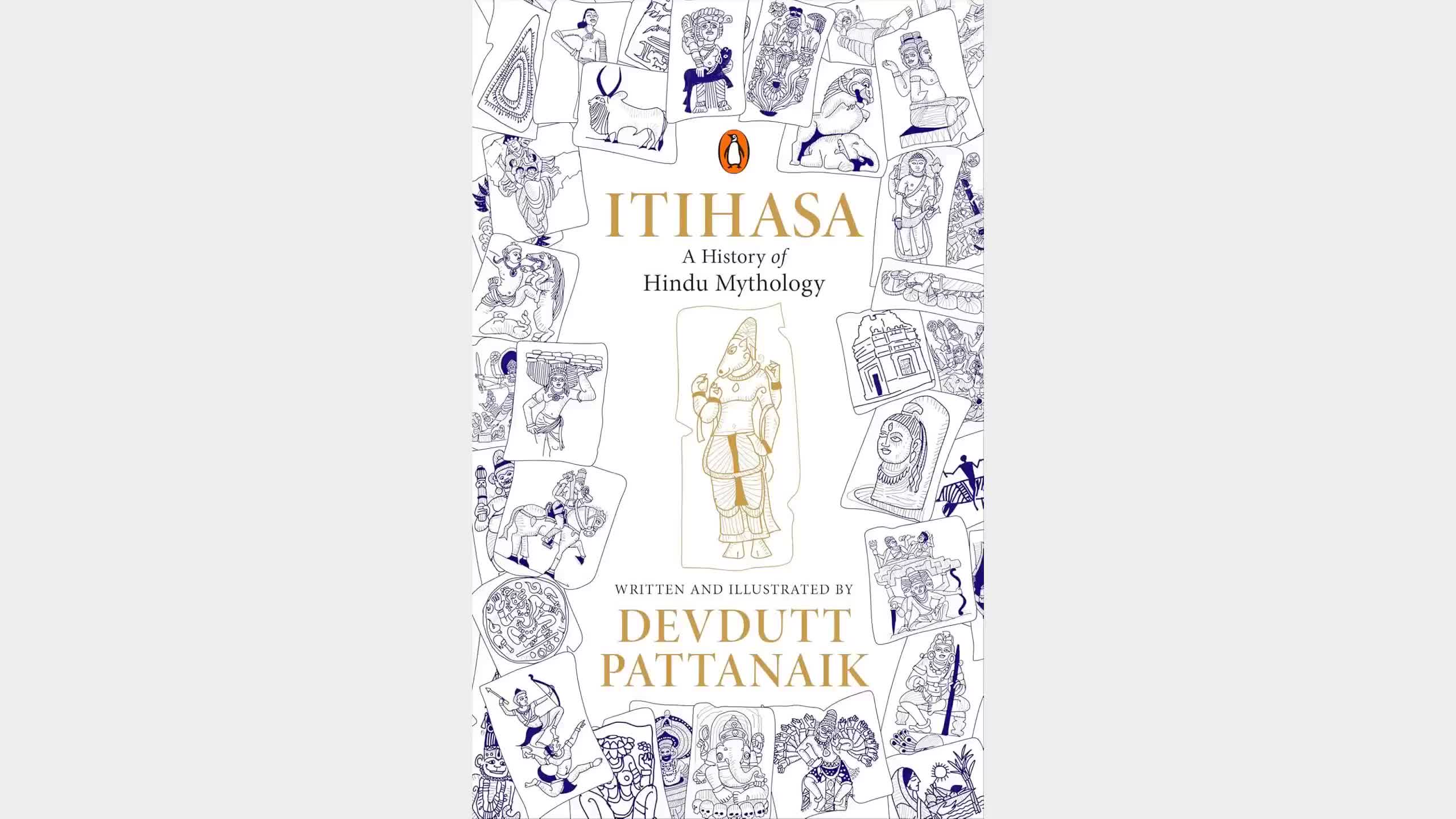
Mythology is often treated as something timeless, a collection of stories and beliefs that have remained unchanged across generations. But author Devdutt Pattanaik believes that this understanding misses an important part of the story: mythology itself has a history, and that history has been shaped by changing societies, economies and political realities.
In his book Itihasa: A History of Hindu Mythology, Pattanaik looks beyond familiar versions of the Ramayana and the Mahabharata to examine how stories, symbols and religious practices have evolved. He is particularly interested in what has been left out of conventional accounts, from household rituals and women’s traditions to the significance of animals, food and everyday objects.
“I realised that nowadays people are using the words history and mythology interchangeably. And they don’t realise that mythology has a history,” he says. “There was a time before the Ramayana was written, and a time after it was written. Even the Ramayana changes over time. The Mahabharata changes over time. What we think today is the Ramayana and Mahabharata is not what it was a thousand years ago.”
Pattanaik says he was struck by how much material remains outside popular understanding, including references in Vedic and Brahmana literature that are familiar mainly to scholars. “I was shocked at how much we don’t know. And the tragedy is that people who know less are very confident,” he says. His intention, he explains, was to put together “the history of mythology” for a new generation, while also examining “how history as a subject emerged” and how its own methods and interpretations have changed.
One of the most striking arguments in the book concerns the place of women in the making and transmission of religious traditions. Pattanaik points to the humble bangle as an object that carries a history far older and more significant than it is generally given credit for.
Drawing on archaeological observations and the work of historian Tony Joseph, he says bangles are a distinctive feature of the Indus Valley civilisation. Yet, he argues, their cultural significance has not been adequately recognised. “We live with bangles in India. We don’t think about bangles so much. We don’t realise that bangles don’t exist outside South Asia,” he says, distinguishing a bangle from a bracelet.
For Pattanaik, the bangle is not simply an ornament. It marks a woman’s passage through important stages of life and remains central to marriage rituals and domestic traditions. “The bangle is the most important jewellery in India. It marks your rite of passage. It tells you you are married,” he says, pointing to the continued importance of chudis in wedding ceremonies, even among women who otherwise dress in contemporary styles.
He believes that the focus on written texts and elite religious traditions has pushed many everyday practices out of historical narratives. “Indian Hindu philosophy really comes from the kitchen and the woman’s domain,” he says. “Hindus get their religion from mothers who do household rituals like vrathas. They decorate their home. They have been wiped out of our history, completely wiped out.”
He is equally critical of the tendency to recognise women in history primarily when they occupy positions of power or are associated with exceptional events. “Unless she holds a sword and she’s a princess, sorry,” he says. The ordinary mother, the woman who maintains household rituals, adorns herself for a festival or passes on a practice without necessarily knowing its origins, rarely receives the same attention.
“How do you capture pre-literate ideas? Not everything is written down in a text. And why should it be written down in a text?” he asks. For him, rangoli, household decorations, fasting, feasting and rituals passed from one generation to another are as much part of a religious tradition as its written scriptures.
This emphasis on everyday practices also informs his discussion of what he calls subaltern Hinduism, which he says has often been overshadowed by elite, scripture-centred interpretations. He argues that the educated Indian elite, particularly men, increasingly focused on philosophical texts under colonial influence, leaving other dimensions of religious life less examined.
“The real part of Hinduism is the feasting, the fasting, the rituals, the household rituals,” he says. “My household rituals will be different from your household rituals.” He suggests that a conversation between people from different regions and communities about what their mothers and grandmothers practised would reveal a vast and varied body of traditions that rarely finds its way into formal histories.
His examination of the buffalo is another example of how he approaches familiar religious symbols through social and economic history. Pattanaik questions why the cow has acquired such a dominant position in popular religious discourse when the buffalo has also been central to India’s agrarian and dairy economy.
He points to the buffalo’s presence in archaeological imagery and older literary references, including the Harivamsha, and examines the relationship between buffalo sacrifice, the goddess and the bull-associated god Shiva. “Every goddess will kill a buffalo. But she will marry a god who rides the bull, Shiva,” he says. “The Bhaisa is rejected. The Basava is loved.”
For Pattanaik, these connections suggest that religious stories cannot be separated from the lives and livelihoods of the communities that shaped them. He believes historians need to look beyond texts and connect mythology with disciplines such as botany, zoology, geology, metallurgy and technology. “Everything changes. Ideas change. It is not a static thing,” he says.
The book traces six major shifts through markers including bangles, horses, money, temples, mosques and passports. Pattanaik uses these to explore how changing material and social conditions influenced religious ideas and practices. The arrival of horses, for instance, is discussed alongside the emergence of new forms of patriarchy. The appearance of coins and expanding trade, he says, coincided with the growth of Buddhist and Jain traditions, monastic life and the culture of courtesans.
He also draws attention to the changing representation of women in religious spaces. Pattanaik argues that the emergence of temples brought a more visible presence of women in religious imagery, including as partners of male deities and as powerful figures in their own right. He contrasts this with what he sees as a later decline in the visibility of women in certain religious traditions.
His reading of these developments is deliberately challenging. He questions familiar assumptions about the relationship between religion and gender, including the idea that Buddhist and Jain traditions were necessarily more egalitarian towards women. He also argues that the modern idea of being able to convert to Hinduism is tied to more recent developments in how religious identity is categorised.
The difficulty, he says, is that mythology is frequently interpreted through contemporary ideological positions. Academics may dismiss it, while political narratives can use it to mobilise people. His suggested approach is to compare and contrast symbols across traditions and understand them within their larger cultural vocabulary.
“Symbols cannot be measured,” he says. “Historians are looking for signals, which means one meaning. But these are symbols, multiple meanings. They exist in a vocabulary. You can’t explain the elephant without understanding the lotus flower, without understanding the horse. They exist in an ecosystem.”
He illustrates this through the architecture of early Hindu temples in South India. The pyramidal structure of the temple, he suggests, evokes a mountain, while the figures of Ganga and Yamuna at the entrance carry geographical associations with the northern landscape. Such connections, he says, become clearer when symbols are read alongside geography and the movement of ideas.
Pattanaik is also wary of the assumption that rational enquiry alone can explain human behaviour. Science and technology can measure many things, he argues, but they cannot quantify emotions such as jealousy or insecurity. These are precisely the areas that mythology and storytelling have long explored.
“Curiosity takes us towards science. But insecurity takes us towards religion, mythology,” he says. “The world of emotions is what mythology captures.” He points to the centrality of jealousy in stories such as the Ramayana and Mahabharata, arguing that human emotions cannot simply be wished away through technology or critical thinking.
This, he believes, is also one reason stories continue to hold an appeal for younger audiences, even as technology becomes an increasingly dominant part of everyday life. Technology offers predictable outcomes, while mythology and ritual often ask people to participate without giving them an immediate or measurable answer.
“If you tell people to go to temples, they are asking why. You tell people to go on a pilgrimage, they say why,” he says. “People have not invested energy in understanding why these things exist.”
For Pattanaik, the answer is not to abandon science or rational enquiry, but to recognise that they do not explain every dimension of human experience. Stories, symbols and rituals offer ways of engaging with emotions, uncertainty and the need for belonging.
Ultimately, Itihasa is an invitation to look again at what is often taken for granted: the bangle worn by a bride, the rangoli drawn outside a home, the animal in a temple sculpture or the story passed down by a grandmother. These, Pattanaik argues, are not peripheral details. They are part of the history of how people have understood and practised their faith.
Disclaimer : This story is auto aggregated by a computer programme and has not been created or edited by DOWNTHENEWS. Publisher: deccanchronicle.com