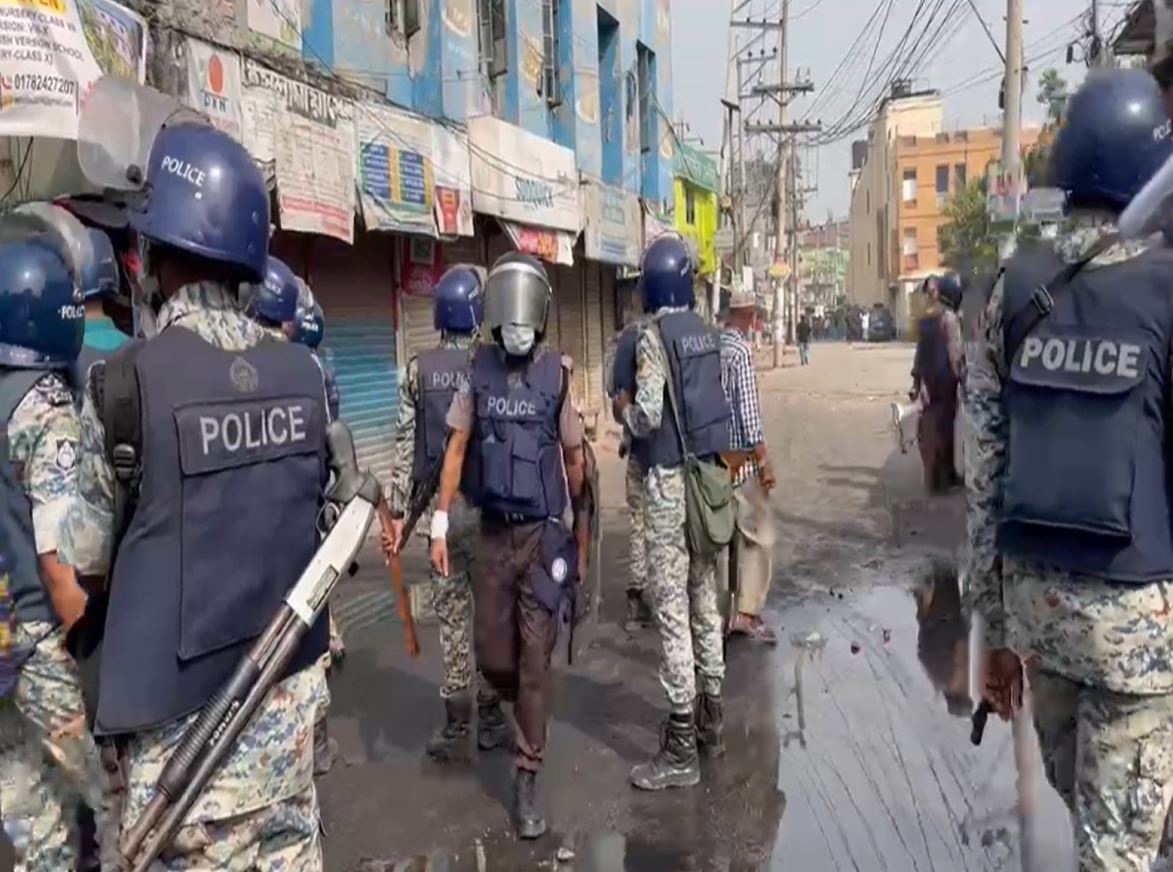
Two people, both associated with the Awami League, were killed and several were injured in clashes with workers of the ruling BNP on Sunday as a two-day nationwide lockdown called by ousted prime minister Sheikh Hasina’s party began.Violence witnessed in several parts of Bangladesh in recent days escalated as crude bomb explosions, arson attacks and road blockades were reported on Sunday.
The clashes took place despite heightened security arrangements, days after Hasina announced plans to return home on December 16. Bangladesh Home Affairs Minister Salahuddin Ahmed said he was briefed about two deaths but did not share further details. However, witnesses and local media reports identified the two victims as 30-year-old Ibrahim Sipahi and 40-year-old Nizamuddin Mridha.
Sipahi, an activist of the Jubo League, the youth wing of the Awami League party, was killed in clashes in Shariatpur’s Zajira upazila, near the southern end of the Padma Bridge, local media reported. According to witnesses, Sipahi was allegedly attacked by some sharp weapon.
Mridha sustained a bullet injury during clashes around the same location and died while being moved from a local hospital to a bigger facility nearly 90 km away in Dhaka, local media reported citing the police. The confrontation took place in the Naodoba and Bikenagar areas of Shariatpur early in the morning, with the two groups initially chasing each other before the clashes escalated into gunfire and crude bomb explosions, according to reports.
The violence disrupted traffic on the Padma Bridge and on the Dhaka-Bhanga Expressway for hours, leaving long queues of vehicles. Between 12 and 20 motorcycles belonging to BNP activists were set on fire, while a restaurant, a nearby eatery and a venue for a BNP rally were also vandalised, according to the Dhaka Tribune.
In a separate incident, in Pabna’s Bera upazila, more than 50 people, believed to be supporters of the Awami League, allegedly attacked a police station with weapons like spears and javelins, and hurled crude bombs, local media reported.
Police fired 12 tear gas shells and 123 rubber bullets to disperse the attackers. A police motorcycle was set on fire, and a passenger bus was vandalised, according to the Prothom Alo newspaper.
In Gopalganj, which happens to be Hasina’s home district, Awami League supporters and affiliated organisations staged processions and blockades at several locations, obstructing traffic on major roads, including the Dhaka-Khulna highway. A Grameen Bank branch in Muksudpur was also attacked and vandalised, with furniture and documents taken outside and torched, according to bdnews24.
The disruption forced transport operators to suspend services on several routes. Buses from Khulna and other southwestern districts resumed journeys to Dhaka through an alternative route via Jashore, Daulatdia and Paturia, bypassing Gopalganj, while services on 18 other routes remained suspended, The Daily Star reported.
Violence and disruptions were reported in at least 14 of Bangladesh’s 64 administrative districts, including the capital Dhaka, according to local media reports. Authorities deployed seven additional platoons of the Border Guard Bangladesh (BGB) overnight in Dhaka and six other districts.
The paramilitary force said 120 platoons were already on security duty, with drones being used for surveillance in seven districts, including Dhaka and Gopalganj. Police used tear gas shells and sound grenades to disperse protesters in Shariatpur, while security personnel were deployed at key installations and important locations in Gopalganj.
Home Minister Ahmed said the government had no immediate plan to deploy the army, describing the maintenance of law and order as a routine responsibility of law enforcement agencies. The violence came as the Awami League began its 48-hour nationwide lockdown on Sunday.
The party’s political activities remain banned in Bangladesh, a restriction first imposed in May 2025 under the interim government that succeeded Hasina’s 15-year rule, which ended in August 2024 following massive protests. The student-led protests had started over civil service job quotas but eventually escalated into a mass uprising against Hasina’s government amid allegations of misgovernance and corruption.
The ban on the Awami League was upheld by the Bangladesh Nationalist Party (BNP) government led by Prime Minister Tarique Rahman, which took charge after parliamentary elections in February this year.
Hasina has been living in India since fleeing Bangladesh. In November 2025, she was sentenced to death in absentia for crimes against humanity over the crackdown on protesters in 2024. Hasina has rejected the allegations.
Bangladesh has been seeking her extradition from India, while New Delhi has maintained that Dhaka’s request is being examined through a legal process. The issue has emerged as a source of tension between the two countries, with Dhaka insisting that Hasina be returned under a bilateral extradition treaty.
Hasina has said she intends to return to Bangladesh on her own and surrender before a court. Her lawyers had earlier approached the Bangladesh mission in New Delhi seeking a fresh passport and national identity card to facilitate her return.
The Bangladesh government rejected her request for fresh travel documents earlier this month, a development that was followed by renewed unrest in the country. Hasina now plans to return home on December 16, the day Bangladesh celebrates its victory over Pakistan in the 1971 Liberation War. She has also asked the Bangladesh government to arrange her air travel from New Delhi on the national carrier, her spokesperson said in a statement last week.
Disclaimer : This story is auto aggregated by a computer programme and has not been created or edited by DOWNTHENEWS. Publisher: deccanchronicle.com