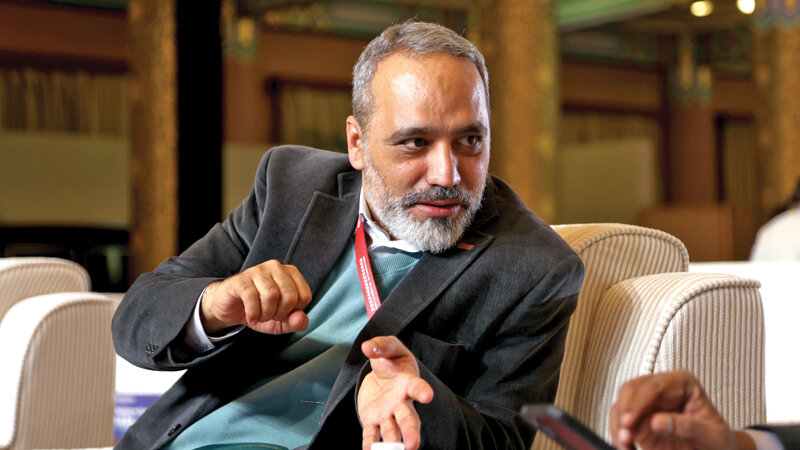
The CEO of Mehr Media Group, in an exclusive interview with Sri Lankan Media group Lake house, emphasized the role of media in public diplomacy, the need to counter one-sided narratives, and the importance of expanding media cooperation among Global South countries.
Regional Crisis & Diplomatic Messaging
In light of the escalating Middle East crisis—particularly the direct military and diplomatic tensions involving Iran, Israel, and the United States—to what extent do the Tehran Times and Mehr News function as strategic diplomatic tools to convey Iran’s red lines and state messaging to the global community?
We do not see the media as merely a tool for reporting news. The media is one of the main pillars of national power and one of the most effective tools of public diplomacy in today’s world. This role becomes even more important when West Asia faces complex crises and tensions. In such circumstances, the media has a greater responsibility to report facts, explain countries’ positions, and help international audiences better understand what is happening.
Mehr News Agency and the Tehran Times, with their different strengths and audiences, play an important part in this effort. Mehr publishes content in several languages, while the Tehran Times, as an English-language newspaper, gives us the ability to communicate directly with international audiences and media professionals.
Our approach is not simply to publish official statements when covering regional developments. We also seek to explain the historical, political, legal, and security-related background of events. For example, the recent war imposed on Iran cannot be properly understood without considering national sovereignty, international law, regional security, and the history of actions taken by the attacking sides.
We believe that Iran’s positions should be communicated to the world through accurate reporting, clear reasoning, and supporting evidence. Our aim is to help international audiences access different sources of information and points of view, rather than relying only on one-sided narratives and dominant Western media accounts. This allows them to assess developments with a better understanding of the facts.
Global Impact & Resolution
The ongoing conflict in the Middle East is no longer just a regional issue; it threatens global energy security, maritime trade routes, and economic stability for developing nations like Sri Lanka. Regardless of how this crisis began, humanity as a whole is paying the price. From Tehran’s perspective, what is the realistic diplomatic off-ramp or path forward to de-escalate this tragedy?
One of the important realities of today’s world is that security is no longer limited by national borders. Developments in one region can quickly affect energy security, international trade, supply chains, and economic stability in many parts of the world. What is happening in the Middle East today is not only a concern for the countries of this region. Developing countries in Asia, Africa, and Latin America are also affected by its consequences.
Sri Lanka is a clear example of this reality. Countries such as Sri Lanka, whose economies depend on international trade, energy imports, and stable shipping routes, can be affected by regional conflicts even when they are not directly involved. Higher energy and transport costs, disruptions to supply chains, and uncertainty in global markets can put additional pressure on their economies. From this point of view, regional crises are not only political or security issues; they are directly linked to people’s livelihoods and countries’ economic development. We believe that countries of the Global South should have a stronger voice in responding to such crises, because they often bear the economic and human costs of tensions in which they have played no part.
For this reason, we believe that the international community should adopt a responsible approach based on the shared principles of international law, rather than applying double standards when dealing with crises. It is not possible to speak of peace and stability while treating military threats, violations of national sovereignty, pressure, and sanctions as normal tools of international relations.
In our view, the first steps towards resolving the current crisis must include an end to military actions and other steps that increase tensions, respect for the sovereignty and territorial integrity of countries, and reliable guarantees to prevent such conflicts from happening again. Any diplomatic process must also be based on mutual respect, clear commitments, and recognition of the legitimate rights of all parties involved.
However, we believe that achieving lasting security in the region also requires addressing one of the main roots of instability: the presence and activities of powers from outside the region. By establishing and maintaining military bases, these powers often put their own interests and security concerns ahead of the priorities of regional countries. These bases do not necessarily serve the security of the region and its people. In many cases, they are part of the military and strategic plans of powers that pursue their own goals and interests thousands of kilometres away from their borders. A region that has become an arena for the military and geopolitical rivalries of foreign powers cannot be expected to achieve lasting peace and security.
An even more important issue is that some powers continue to view countries with strategic resources, especially energy resources, through a lens of dominance and exploitation. It is as if these countries and their economic resources are not seen as belonging to independent and sovereign nations, but rather as opportunities or tools for serving outside interests and gaining access to other countries’ resources. This approach goes against the principles of equal relations between countries and the right of nations to determine their own future. It cannot provide a sound basis for peace and international cooperation.
We believe that regional security must be ensured by the countries of the region themselves, through their participation and cooperation. The presence and intervention of foreign powers, especially when driven by one-sided policies and exclusive interests, do not help resolve disputes. Instead, they can increase arms competition and deepen mistrust. It is therefore essential to change this approach and recognise that regional countries, including Iran, are independent and sovereign states with legitimate rights. They must have a leading role in deciding their own future and shaping the region’s security arrangements.
The United Nations and other international bodies should also play a more effective role. However, they can only do so if they move away from double standards and apply the principles of international law equally to all countries.
We believe that lasting peace cannot be achieved by imposing the will of one side on another. Peace becomes meaningful when the security and rights of nations are recognised, countries’ national resources and interests are respected, and no country considers itself above international rules and responsibilities. Security in the Middle East will only be possible when the countries of the region can decide on their future and security arrangements without foreign interference or pressure.
The “Media War” & Counter-Narratives
You have frequently described the current information landscape as an active “media war” against Iran. During moments of acute crisis, Western mainstream media often frames Iran solely through the lens of security threats and sanctions. What concrete editorial strategies are Mehr News and the Tehran Times employing to dismantle this narrative and present what you consider the “true image” of Iran?
Today, international competition is no longer limited to the economic, political, or military fields. A major part of this competition takes place through narratives and efforts to shape public opinion. This is why we use the term “media war”. In many cases, a particular version of an event is presented before the public has had a chance to understand what actually happened. That version can then become the basis on which audiences form their opinions.
One of the major challenges facing the international media system is the high level of control over news production, distribution, and authority held by a limited number of major Western media organisations and news agencies. This does not mean that we overlook the professional capabilities of these organisations. However, it shows that equal access to international platforms and the opportunity to present different views remain limited.
At Mehr Media Group, we seek to reduce these limitations as much as possible by expanding our multilingual content, strengthening analytical journalism, making greater use of experts and specialists, and developing our relations with foreign media outlets.
Our approach is not limited to responding to other people’s narratives. We believe that we must take the initiative by producing independent narratives of our own. Presenting Iran’s scientific, cultural, economic, and social capabilities, covering different views on regional developments, and providing reliable information about events are all part of this approach.
We also seek to expand content cooperation with foreign media organisations and create opportunities for the mutual republication of news and reports. This helps ensure that content produced in Iran can reach audiences in other countries directly.
In our view, challenging a monopoly over narratives does not mean creating another monopoly. Our goal is to help build a diverse media environment in which no single media organisation or political group can claim the exclusive right to define the truth or interpret global events.
BRICS+ & Global South Cooperation
Following your participation at the BRICS and SCO media summits, where you advocated for an “independent media narrative,” how is Mehr Media Group actively collaborating with media outlets in Asia and the Global South to bypass Western news agencies and build a direct information bridge?
One of the strategic priorities of Mehr Media Group is to expand cooperation with media organisations in Asia, Africa, and Latin America, and to strengthen media relations through the opportunities offered by the Global South.
Our experience in recent years has shown us that media cooperation between countries should not be limited to exchanging news. We aim to build a lasting network of professional relations that can support joint content production, journalist exchanges, training programmes, mutual coverage of events, and the direct exchange of information.
Our active participation in media summits organised by BRICS and the Shanghai Cooperation Organisation (SCO) should also be seen in this context. These meetings provide opportunities to engage with media executives from different countries, identify areas of common interest, and turn international contacts into practical cooperation projects.
In recent years, we have expanded our cooperation with media organisations such as China’s Xinhua News Agency, Russia’s TASS and Sputnik, Malaysia’s Bernama, TV BRICS, Indonesia’s ANTARA News Agency, Qatar News Agency, and several other Asian media outlets. Signing cooperation agreements, exchanging content, and pursuing joint media projects are among the steps we have taken in this direction.
However, we believe that building a more balanced international media order requires us to move beyond agreements and formal meetings. Cooperation becomes meaningful when it leads to joint productions, regular contact between editorial teams, better systems for exchanging content, and direct access to one another’s news sources.
Our view of BRICS and the Shanghai Cooperation Organisation is not limited to politics or economics. These groups also have significant potential for cultural and media cooperation. We believe that an active media network among their members and partners can strengthen the diversity of voices in the international media landscape and reduce dependence on traditional, centralised news distribution channels.
Organizational Structure & Editorial Independence
Both Mehr News Agency and the Tehran Times operate under the Mehr Media Group, which is owned by the Islamic Development Organization (IDO)—an entity closely tied to the state and the Supreme Leader’s Office. For an international audience, how do you reconcile this organizational structure with the principles of editorial independence, especially when covering domestic challenges or internal public debates within Iran?
Mehr Media Group operates within its organisational structure under the ownership of the Islamic Development Organization. We see no need to hide this structure or create uncertainty about the nature of our organisation. Transparency about ownership and the organisation’s media mission is part of the responsibility that every media organisation has towards its audience.
However, we believe that three different aspects should be distinguished when assessing a media organisation: its ownership structure, its institutional mission, and its professional processes for producing and publishing content. These three areas are not necessarily the same thing.
We believe that a media organisation, while carrying out its broader mission and working within its institutional framework, must remain committed to the professional principles of journalism. These include accurate reporting, fact-checking, media ethics, and accountability to the audience. In the end, a media organisation’s credibility is measured by the quality of its content and the trust it builds with its audience over time.
At Mehr Media Group, our aim is to strengthen the professional capabilities of our editorial teams while remaining committed to the organisation’s mission and identity. We also seek to create opportunities to cover a range of issues and subjects within the framework of our media responsibilities.
It is also important to recognise that media independence cannot be judged by a single standard or organisational model. In many countries around the world, major media organisations have different ownership structures, funding sources, and institutional missions. What matters is that these structures are transparent and that the media organisation follows professional standards in its work.
We welcome critical discussion and the presentation of different points of view. We believe that a media organisation seeking to earn international credibility must be able to build a relationship with its audience based on trust, transparency, and continuous dialogue.
AI, Tech Barriers & the “Crisis of Truth”
You previously warned of a global “Crisis of Truth,” driven by disinformation and emerging technologies like AI-generated deepfakes. Today, with synthetic media being weaponised in modern conflicts—and with Iranian media outlets facing strict algorithmic restrictions and bans on Western social media platforms—how is Mehr Media Group countering these technological barriers to reach international audiences?
We believe that the world is facing one of the most serious challenges in the history of media: a challenge that can be described as a “crisis of truth”. The development of artificial intelligence, the creation of fake images and videos, the manipulation of media content, and the widespread spread of false information have made it increasingly difficult for audiences to tell the difference between real and fabricated content.
This challenge becomes even more serious during crises and military conflicts. False information can be used to influence public opinion, increase tensions, and even shape political and security developments.
In our view, responding to this challenge requires more than simply using more technology. Media organisations must work on three responsibilities at the same time: developing their technological infrastructure, strengthening fact-checking systems, and maintaining professional standards of journalism.
At Mehr Media Group, we see artificial intelligence not as a replacement for journalists and their professional judgement, but as a tool that can improve our ability to produce, process, translate, and distribute content. However, the use of this technology must always involve human oversight, careful attention to accuracy, and respect for ethical principles.
In addition, restrictions on access to some international platforms and algorithm-related barriers are among the challenges Iranian media organisations face when trying to reach global audiences. We believe that access to international communication platforms and the ability to publish content freely should not be limited by political considerations or unilateral restrictions.
Our strategy is to develop several communication channels at the same time. This includes strengthening our websites and multilingual infrastructure, building direct cooperation with foreign media organisations, exchanging content, and taking part in international media networks. In other words, reaching global audiences should not depend on just one or two platforms.
Ultimately, we believe that an audience’s trust remains the most important asset of any media organisation in the age of artificial intelligence. Technology can increase the speed and reach of information, but it cannot create credibility and trust on its own. Trust is built through accuracy, transparency, accountability, and commitment to the truth. These principles must remain at the heart of every media organisation’s work.
Disclaimer : This story is auto aggregated by a computer programme and has not been created or edited by DOWNTHENEWS. Publisher: tehrantimes.com