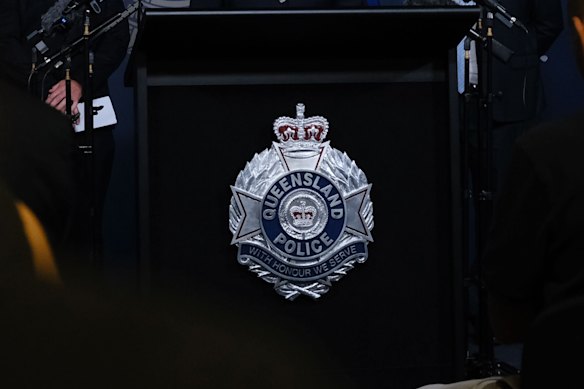

Queensland police quietly watered down their transparency scheme years ago, likely halving the public visibility of employees disciplined over serious matters including allegations of domestic violence.
Four years after a damning women’s safety-focused inquiry urged an overhaul, analysis by this masthead shows complaints against domestic violence-accused officials are most likely to sit unresolved.
As the state’s corruption watchdog voiced frustration that police have not created the integrity unit recommended by the inquiry, and about a “reduction in quality” of how complaints are handled, the portion resulting in no further action has climbed.
For more than a decade, Queensland police have publicly declared action taken to stand down, suspend or dismiss officers and other staff members over misconduct matters – even at an early investigative stage.
But in 2021, their approach changed. The agency’s proactive disclosure scheme, involving a media statement laying the allegations and action taken, has since 2021 stopped reporting all but matters where charges have been laid.
This masthead has for months collated and analysed all such statements from January 2016 to November 2026 – a figure of more than 300. A high-water mark of 48 landed in 2019 alone, followed by 38 in 2020.
Fewer than half involved charges being laid. That year also saw a peak in disciplinary action related to domestic violence allegations against police service employees disclosed through the release scheme, with 10 notifications.
The following year, in 2021, the only notifications involved matters where charges had been laid, and the total number of notifications fell by two-thirds to 13. In the years since, only matters involving charges have been disclosed.
In response to a series of question from this masthead, a police spokesperson said only that the agency changed its process in 2019 to “publicise matters involving suspensions or stand-downs once criminal proceedings had commenced”.
“The decision to release information into the public regarding criminal and disciplinary proceedings against members of the service is driven on the principles of transparency, accountability and public interest expectations,” they said.
In 2022, a commission of inquiry into police responses to domestic violence made damning findings about a culture of sexism and racism in the force, and made a new civilian-led police integrity unit one of its priority recommendations.
Discipline outcome data reported in police annual reports since has specifically singled out allegations of unprofessional conduct by officers involved as a respondent in a domestic violence matter.
Further analysis by this masthead of the data has revealed that category features the highest portion of allegations left open or unresolved at the time of the last three annual reports.
The portion of allegations finalised with “no further action” – where an investigation clears an officer or finds no basis for disciplinary action – has climbed from 55 per cent in 2022-23 to 72 per cent in 2025-26 despite similar allegation numbers.
Meanwhile, use of the “local management resolutions” that the inquiry criticised – now called “professional development strategy” – has lifted back to 8 per cent from a post-inquiry low of about half that.
Tim Prenzler, a University of Sunshine Coast criminology professor called on to give expert advice to the inquiry on the adequacy of Queensland’s police conduct and complaints system, said the data showed these remained “largely opaque”.
“It is still not possible to obtain a complete picture of complaints dispositions, and associated misconduct matters, and obtain an accurate picture of integrity levels amongst police,” Prenzler told this masthead in a statement.
“Keeping in mind that formal complaints typically represent the tip of the iceberg of people’s dissatisfaction with police.”
He said the integrity unit recommended by the inquiry was still required and noted many other calls had also “fallen by the wayside” with the previous Labor government and current LNP administration both prevaricating.
Maiwar Greens MP Michael Berkman, a vocal continued proponent of the integrity unit, agreed. “We can’t trust the police to investigate police, especially in matters of domestic and family violence,” he said.
The police spokesperson said annual report data was a point-in-time measure and did not mean open or unresolved complaints would remain so, and the Crime and Corruption Commission may also have oversight of officer-involved domestic violence allegations.
Now more than four years since the tabling of the inquiry’s report calling for the integrity unit to be running before the 2024 election, and the Crisafulli government is also yet to detail its plans for the body other than to say it is still considering its implementation.
In a statement to this masthead, a spokesperson for Attorney-General Deb Frecklington reiterated the government was still considering establishing the unit “after Labor spent years failing to take meaningful action”.
A cross-government working group including the corruption watchdog and other relevant departments has met only twice – back in April – since the election, CCC chair Bruce Barbour said this month.
The independent oversight body meant to monitor and publicly report on progress toward reforms recommended by the inquiry and Women’s Safety and Justice Taskforce which sparked it was wound up last year and its work not replicated since.
Start the day with a summary of the day’s most important and interesting stories, analysis and insights. Sign up for our Morning Edition newsletter.
 Matt Dennien is a reporter at Brisbane Times covering state politics, parliament and the public sector. He has previously worked for newspapers in Tasmania and Brisbane community radio station 4ZZZ. Contact him securely on Signal @mattdennien.15Connect via email.
From our partners
Disclaimer : This story is auto aggregated by a computer programme and has not been created or edited by DOWNTHENEWS. Publisher: www.smh.com.au