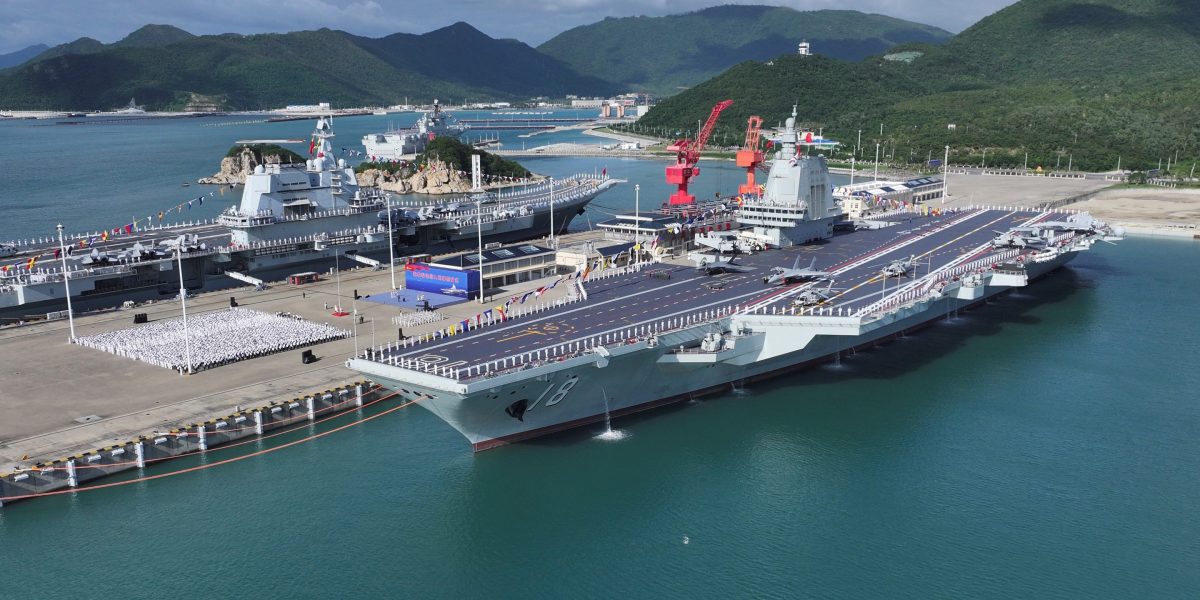
The world’s second largest economy also has the second largest defense budget as China spends heavily to modernize its military, but a new report casts doubt on how effective a bunch of shiny new weapons will be in an actual war.
Official statistics show China’s defense budget for 2026 is about $277 billion, up 7% from the prior year. But Beijing is widely seen as lowballing its numbers, and the Pentagon estimated that 2024’s actual spending, for example, could be up to 63% higher.
Still, China has become the world’s largest shipbuilder and now has the biggest navy at more than 400 ships, or a third bigger than the U.S. fleet. China also has stealth fighters, advanced long-range missiles, and the world’s largest ground force.
China also has a defense industry that is producing advanced weapons systems at mass and scale, resulting in formidable military capabilities, a report from the Center for Strategic and International Studies said.
“Yet military capabilities do not directly translate into battlefield effectiveness, which includes the capabilities that militaries generate from converting resources into fighting power,” it added.
The think tank argued that China suffers from “peace disease” as it has not fought a major war since its border dispute with Vietnam nearly 50 years ago, “and it performed relatively poorly in that conflict.”
To make up for its lack of combat experience, the People’s Liberation Army has observed other wars, including the current U.S. war against Iran and Russia’s invasion of Ukraine. The PLA has also conducted peacekeeping missions, anti-piracy patrols, and training exercises.
But CSIS pointed out exercises are no substitute for combat. In addition, they are often scripted, predictable, or not difficult enough, with falsified training.
“As one Chinese military scholar bluntly noted, ‘the situation of accurate training needs to be improved,’” the report said, adding that another scholar warned there is an “insufficient ‘smell of gunpowder’ in training.”
Even Chinese studies have dismissed heavily scripted pilot training as “nanny-style,” according to the report, which described a risk-averse culture where one mistake can end a career.
Based on interviews with observers, researchers also said the PLA’s air force is far better at hitting stationary targets than mobile ones. In fact, the PLAAF played a minimal role in the border war with Vietnam and last shot down a manned aircraft in 1967.
“Because of its inexperience, the PLAAF’s knowledge of flying and war is more theoretical and derived from training exercises than for the United States, Israel, Russia, or many other air forces around the world, many of which have flown in some sort of conflict,” CSIS said.
In addition to China’s lack of combat experience, researchers highlighted other vulnerabilities, such as the PLA’s dual command structure that’s split between a military officer and a political commissar.
Corruption is also an issue in the military’s ranks, and while President Xi Jinping has sought to root it out, his purges have also ousted experienced officers while leaving weaker commanders with less initiative who depend more on centralized decision making.
To be sure, the U.S. military has its own drawbacks. CSIS noted it lacks recent experience fighting a major power as it has fought against insurgent groups and smaller powers like Iraq and Iran.
Aircraft and ships are also decades old, with recapitalization plans hampered by chronic delays and cost overruns. Politics and corruption have also slowed weapons procurement.
The war against Iran has proven costly as well. Supplies of high-end munitions and interceptors have been drained, exposing deficiencies in a defense industrial base that doesn’t have the capacity to rapidly expand production.
And while the U.S. isn’t engaged in major combat operations right now, defending commercial shipping from Iranian attacks in the Strait of Hormuz requires round-the-clock operations of dozens of ships and aircraft.
The high tempo prevents those forces from being deployed elsewhere, like in Asia to deter China, and will eventually result in an expensive maintenance bill.
The U.S. is now approaching a “dangerous moment” for defense spending, according to a new report from the Brookings Institution, which warned that rising outlays on Medicaid, Medicare, Social Security, and interest on the $40 trillion national debt are squeezing the military’s share of federal spending.
Defense spending accounted for 2.8% of U.S. GDP in 2026 and is expected to remain at approximately 3% through 2030, nearing the lowest share since the post-World War II drawdown.
“The newly elected Congress—which controls the purse strings—faces difficult fiscal choices that will persist into the next presidential administration,” the report said. “Now, there is little headroom in the budget to increase defense spending to meet the proliferating defense challenges … Something will have to give. The advocates of a robust military and American global leadership should prepare to make the most of limited budgetary resources.”
Disclaimer : This story is auto aggregated by a computer programme and has not been created or edited by DOWNTHENEWS. Publisher: fortune.com