By Galit Altstein
Israeli Prime Minister Benjamin Netanyahu has asked the country’s president, Isaac Herzog, to grant him a pardon from corruption charges, seeking to end a long-running trial that has bitterly divided the nation.
Netanyahu submitted a request for a pardon to the legal department of the Office of the President on November 30, the prime minister’s office said in a statement. Herzog’s office called it an “extraordinary request”, carrying with it “significant implications”.
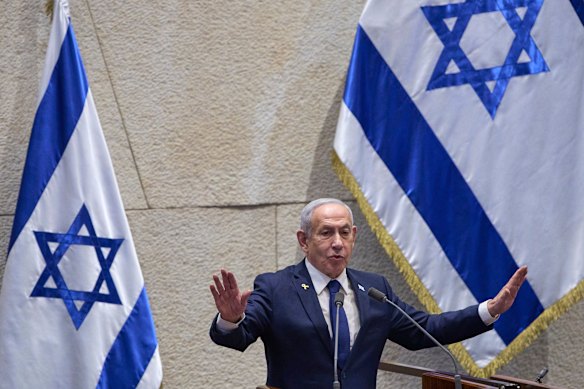
Prime Minister Benjamin Netanyahu is seeking a pardon from Israel’s president, Isaac Herzog.Credit: AP
The move follows recent headline-grabbing interventions by US President Donald Trump, who used an Israeli parliament appearance in October to appeal to Herzog, saying: “Hey, I have an idea, Mr President, why don’t you give him a pardon?
“Cigars and champagne, who the hell cares about that?” he followed up.
Netanyahu is the only sitting prime minister in Israeli history to stand trial, after being charged with fraud, breach of trust and accepting bribes in three separate cases, accusing him of exchanging favours with wealthy political supporters. He hasn’t been convicted of anything.
In a video statement published shortly after the appeal was made public by the president’s office, Netanyahu said that the trial was “undermining national unity” and that “a pardon would help Israel tap new opportunities with the US”. He stopped short of admitting to any of the charges and expressed confidence in his future acquittal if the legal proceedings continued.
What is Netanyahu accused of?
The charges span three cases consolidated into a single trial that began in 2020. Netanyahu, who denies all the charges, says they’re part of an orchestrated witch-hunt by those who can’t beat him at the ballot box.
The most prominent case, and the only one in which Netanyahu, 76, is accused of bribery, is known as Case 4000.
It evolved from an investigation by the Israel Securities Authority into Bezeq Israeli Telecommunications Corporation Ltd, Israel’s largest telecommunications company, and Saul Elovitch, who was then its controlling shareholder. While the probe originally focused on other matters, it soon became evident that enterprises connected to Elovitch – who also controlled Walla, a popular news website – benefited from favourable government regulation.
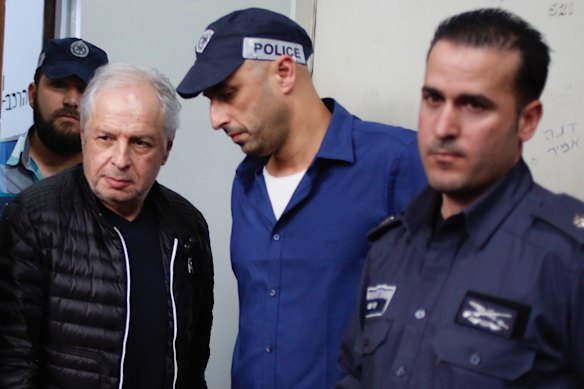
Bezeq telecom shareholder Saul Elovitch arrives at the magistrate court in Tel Aviv, Israel, in February 2018.Credit: AP
Seeking the motive, investigators questioned Walla’s chief executive officer, who testified that he had received endless demands from Elovitch and his wife, Iris, for favourable coverage of Netanyahu and his wife, Sara.
The prosecution claims that Netanyahu and Elovitch had formed a “give and take” relationship: the Elovitchs made great efforts to fulfil demands for more positive coverage of the Netanyahus, and the prime minister used his authority to promote Elovitch’s business interests and “attended several times to his regulatory affairs”.
Saul and Iris Elovitch were indicted for bribery and obstruction of justice.
Netanyahu argued that seeking positive media coverage is a normal part of his job and that no favours were offered in exchange for it. Even before his testimony, which started in December 2024, the judges in the case indicated the bribery charge would be hard to substantiate and called on the prosecution to drop it, but the latter refused, and the accusation stands.
What are the other two cases?
In the second case, known as Case 1000, Netanyahu was indicted for fraud and breach of trust for receiving luxurious gifts from Hollywood producer Arnon Milchan, an Israeli, and Australian billionaire James Packer in connection with his role as prime minister.
According to prosecutors, Milchan introduced Netanyahu to Packer, and the two gave gifts to the prime minister and his wife – including cigars and cases of champagne delivered courtesy of Milchan – worth an estimated 690,000 shekels ($319,000) over the course of five years, starting in 2011.

Netanyahu also allegedly received gifts from Australian billionaire James Packer. Credit: AAP, AP
During those years, Netanyahu is alleged to have approached US government officials to help Milchan obtain a US entry visa and to have promoted the extension of tax benefits relevant to him. He’s also accused of acting to assist Milchan with regulations concerning a merger of two local TV giants to make a potential investment viable for the producer.
Netanyahu disputed the quantities of gifts he received and the motives behind them. He said in his testimony that Milchan was a very close friend, that he hadn’t acted in his favour, and that he wasn’t even aware that some of the policy matters named in the indictment concerned him.
Packer is not accused of any wrongdoing
In the third case, known as Case 2000, Netanyahu is accused of fraud and breach of trust for promising benefits to Arnon Mozes, the controlling owner of publishing powerhouse Yedioth Ahronoth, whose eponymous daily paper is one of the country’s most popular.
The police stumbled upon the evidence during another inquiry involving a former chief of staff to Netanyahu. On his phone were recordings of meetings held between Netanyahu and Mozes. In them, Mozes offered to steer coverage in Netanyahu’s favour and, in turn, asked that the prime minister promote legislation that would curb Yedioth Ahronoth’s largest competitor, Israel Hayom, a newspaper owned by Sheldon Adelson, who has since died, and his wife, Miriam.
The prosecution alleges that Netanyahu had no intention of obliging but pretended to in the hope of gaining favourable coverage ahead of an upcoming election. Netanyahu, the prosecution said, conveyed a message that bribery is a legitimate tool, thereby breaching public trust in elected officials.
Mozes was charged with offering and promising a bribe in the ongoing case.
What impact has the trial had on Israeli politics?
Because no political party has ever won a majority in the Knesset, Israel’s parliament, the country has almost always had coalition governments. After Netanyahu’s 2019 indictment by the attorney-general, the reluctance of Israeli parties to join coalition governments with his Likud party contributed to a period of political instability. Either because no party could form a coalition or no coalition was stable for long, Israel had five general elections from 2019 to 2022.
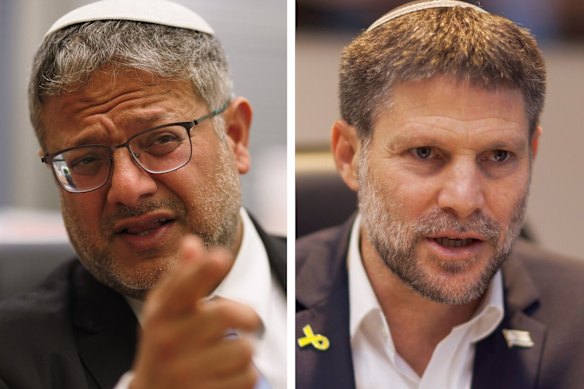
National Security Minister Itamar Ben-Gvir and Finance Minister Bezalel Smotrich have been subjected to targeted financial sanctions and travel bans by Australia.Credit: Bloomberg
After an election at the end of that year, Netanyahu formed the current government with the only parties willing to partner with him, those representing Israel’s ultra-orthodox Jews and two led by hardliner nationalists, Bezalel Smotrich and Itamar Ben Gvir. The inclusion of these two made the government the most right-wing in Israel’s history.
How has Netanyahu’s government moved against state institutions?
Over the past three decades, the Israeli right has expressed growing resentment of the power of Israel’s Supreme Court, which has acted as a brake on populist legislation and protected the rights of minorities, including Arabs. Israel has no constitution granting the court such power. It created it for itself in the 1990s, and said it would measure legislation against Israel’s Basic Laws, which together form the closest thing the country has to a constitution.
Netanyahu had generally distanced himself from the complaints, praising Israel’s independent judiciary. But when the legal system came after him, he accused it of pursuing him because of political differences, in an attempt to overthrow the right from power. This paved the way for forces within his government to seek to weaken the Supreme Court’s and the legal establishment’s power through a series of legislative changes.
The planned judicial overhaul triggered mass protests by Israelis who argued that the changes would undermine the country’s democracy. Some members of Israel’s security establishment say that Hamas read the protracted infighting over the plan as weakness and that it was a factor in the group’s decision to launch its October 7, 2023, attack on Israel when it did, provoking the war.
After that, the government temporarily shelved its initiative. But in March, it resumed the effort, passing a law in the Knesset increasing the role of politicians in selecting judges.
Can Netanyahu be pardoned?
Following his Knesset appeal, Trump wrote to Herzog on November 12, urging him to “fully pardon Benjamin Netanyahu, who has been a formidable and decisive War Time Prime Minister”.
“Netanyahu has stood tall for Israel in the face of strong adversaries and long odds, and his attention cannot be unnecessarily diverted”, Trump wrote.
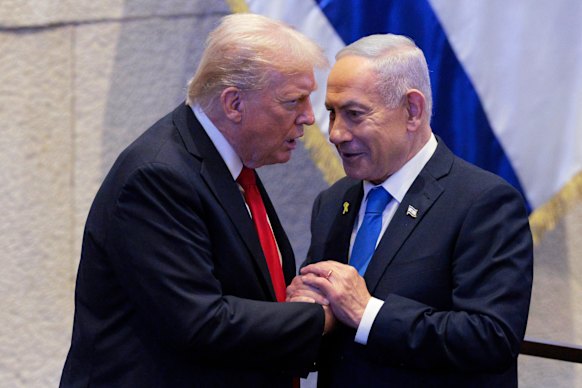
Donald Trump with Benjamin Netanyahu at the Israeli Knesset in October.Credit: AP
But the path to a pardon is complicated. It can only be granted by Israel’s president, but it is typically for those already convicted. A pre-emptive presidential pardon has only been granted once in Israel’s history – by Herzog’s predecessor and father, Chaim. He extended the concession to a group of Shin Bet officials under police investigation for the killing of two Palestinian bus hijackers in the 1980s.
But that was part of a package deal in which the head of the agency agreed to step down.
Netanyahu has repeatedly rejected the idea of resigning and, in 2022, turned down an offer of a plea bargain that involved acknowledging lesser wrongdoing in exchange for staying out of politics for seven years.
In October, he announced that he plans to run in the next election, which must be held by October 2026. Though his ruling coalition has lost much of its public support since coming to power, his party still polls better than any other in opinion surveys.
When is Netanyahu’s trial expected to end?
There’s no set date for the trial’s conclusion, and estimates are that it will last several more years. As of late October, Netanyahu was still being cross-examined by the prosecution, and that’s expected to continue for several more months. Still ahead are hearings on Case 2000, an opportunity for Netanyahu’s lawyers to ask him questions to clarify or repair points made in his cross-examination, the testimony of defence witnesses and the submission of written and oral closing arguments. Even after the judges reach a verdict, Netanyahu can appeal to a higher court, which would also take time.
What happens if Netanyahu is convicted?
It’s unlikely Netanyahu’s trial will wrap up during his current term, though he could be prime minister again after the next general election. There’s no precedent in Israel for the trial – let alone the conviction – of a sitting prime minister. One of Netanyahu’s predecessors, Ehud Olmert, was tried, convicted and jailed on corruption charges, but only after leaving office. He was released in 2017.
Under Israeli law, if a prime minister is convicted of a crime involving “moral turpitude” and all appeals have been exhausted, his or her term is automatically terminated. The government becomes a transitional government until a new one is sworn in.
Most Viewed in World
Disclaimer : This story is auto aggregated by a computer programme and has not been created or edited by DOWNTHENEWS. Publisher: www.smh.com.au