
When the Polish and German governments meet on Monday for annual political talks in Berlin – the first since Friedrich Merz became chancellor – the headlines are likely to be dominated by Ukraine.
Amid growing US pressure for a peace deal with Russia, Warsaw and Berlin will want to send a signal of support for Kyiv and of unity between central Europe’s largest – and militarily strongest – countries.
But below the surface, the bilateral relationship is increasingly tricky. Poland, long considered the junior partner, no longer sees itself in an inferior role. This is not only because of its economic success since the fall of communism in 1989, but because it has avoided German policies that it sees as missteps, namely on migration and relations with Russia.
“Poles have become more self-assured, especially in relation to Germany as it has always been a reference point,” says Dr Agnieszka Łada-Konefał, vice-director of the German Institute of Polish Affairs, who co-leads a study of Polish-German relations.
This year the study, which has tracked mutual sentiment for the past 25 years, showed a near record level of aversion on the Polish side, with only slightly more Poles having a positive view of Germans than negative. It is in sharp contrast to how Germans view Poles, with the study recording its lowest ever percentage of people expressing negative views of their eastern neighbours.
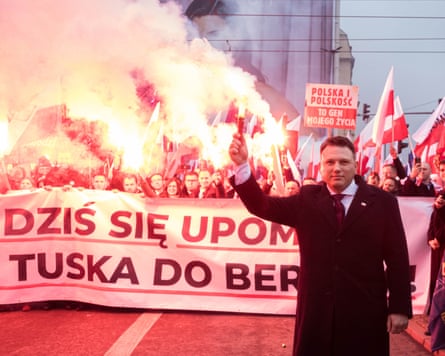
Łada-Konefał says the Polish mood was fed by years of anti-German rhetoric from the previous, conservative-populist Polish government of Law and Justice (PiS), which regularly portrayed its rivals – particularly Poland’s liberal prime minister, Donald Tusk – as Berlin’s agents involved in anti-Polish collusion. The surging far-right Confederation alliance also regularly alleges Tusk’s servility to Germany.
“But … these [comments] fell on fertile ground: somewhere in the Polish soul … there were deeply dormant uncertainties about Germans … and that is why these emotions began to resonate,” she says.
The overpoliticisation of the relationship has also made it difficult for Tusk’s government to reset it without securing a meaningful concession from Germany first, leaving it too passive to shape its own narrative.
“The aspect of PiS as defender of Polish identity against Germany and the accusation that [Tusk] represents the ‘hidden German tendency’ is a salient distinction in Polish politics, however unjust and exaggerated that might be, so any actions will inevitably be viewed through that prism,” says Dr Ben Stanley, an associate professor of social sciences at the SWPS University in Warsaw.
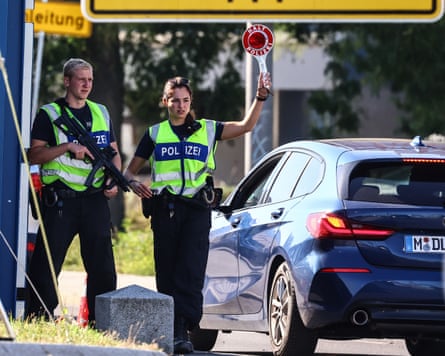
Hopes were briefly raised this year after Merz chose to make his second foreign trip to Poland, but then – facing domestic pressure from the far-right Alternative für Deutschland on migration – he clashed with Warsaw over border controls, a sensitive topic for many Poles.
Many Poles still hold a grudge about Germany’s slow response to the Russian invasion of Ukraine, and are frustrated that peace talks appear to involve Berlin more than Warsaw, analysts say.
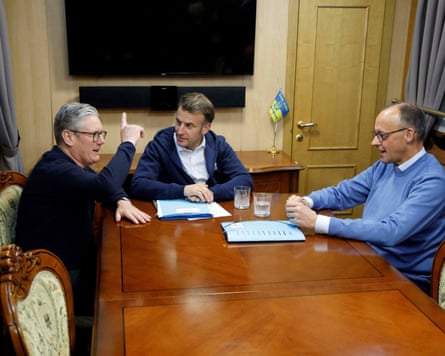
Prof Aleks Szczerbiak, of the University of Sussex, recalls that during a recent joint trip of Polish, German, French and British leaders to Kyiv, Merz, Macron and Starmer rode together in a different carriage to Tusk.
While the reasons behind it were operational, the symbolism of the solo ride during a tense presidential campaign in Poland was “terrible”, Szczerbiak says, and was exploited by Tusk’s rivals to claim he was “in the second class” when it came to driving European foreign policy.
Szczerbiak says Germany’s push for Poland to have “a more central role” in talks would send a better signal, by reflecting its importance as Ukraine’s neighbour, a logistics hub and home to 1.5 million Ukrainians.
But it is the legacy and the memory of the Nazi German invasion of Poland in 1939 that remain most difficult tensions to resolve. Polls show 58% of Poles expect Germans to do more to compensate their country.
In 2022, the Polish parliament almost unanimously adopted a motion stressing Poland had never been properly compensated, dismissing Berlin’s argument that a communist government had waived the rights to reparations in the 1950s.
A report, produced under the PiS government, calculated them at €1.5tn (£1.3tn), three times Germany’s debt-heavy 2026 budget. Arkadiusz Mularczyk, a former minister who led the work, says it was a “conservative” estimate and compares it to €2tn paid by the federal republic in investment in East Germany after the reunification.
Tusk’s government distanced itself from the demand, but urged Berlin to “think creatively” instead, particularly about the 60,000 living victims of the war. Polish media reported that an offer of a one-off payment of €200m – €3,300 per person – had been rejected by Warsaw last year as insufficient.
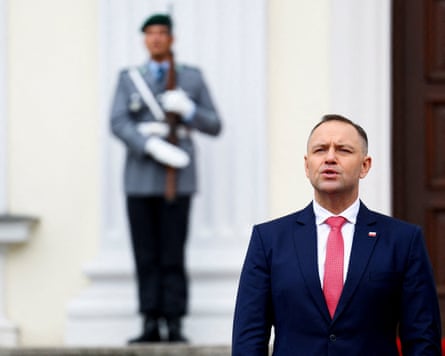
Poland’s new president, Karol Nawrocki, also signalled his backing for the issue during a recent Berlin trip, suggesting a German investment in the Polish army as part of the settlement.
But when Mularczyk offered to brief Germany’s ambassador to Warsaw, Miguel Berger, on the report last week, the diplomat dismissed the debate as stoking “division that only helps Putin”.
The question of ownership of Nazi-looted artefacts also looms large over the relationship, with a long list of artwork and other items wanted by Poland and regularly surfacing in German collections or controversial auctions. Monday’s meeting in Berlin will reportedly see a “historical return” of a number of valuable items looted during the war, Polish media reported on Sunday.
A much-awaited memorial to the Polish victims of Nazis in Berlin is, however, yet to fully materialise. A temporary memorial stone was unveiled this summer, but the ultimate monument is yet to be designed or be budgeted for.
In a sign of intent before Monday’s meeting, the two parties making up the German government proposed a Bundestag resolution calling for the works to be accelerated. But the patience with politics is running thin on the Polish side.
“While Germany has been a hot topic in Poland for years … in Germany, Poland has been and remains a cold topic, or … more accurately, a overlooked topic,” says Prof Robert Traba, a vice-chair of the advisory council of the Foundation for German-Polish Cooperation, who warns of “asymmetry” of knowledge.
In 2018, he led a review of 40 German history handbooks, and discovered only two mentioned the Warsaw uprisings of 1943 and 1944, and none covered the Nazi German occupation of Poland under the General Government.
Traba explains that for Germans, the postwar reckoning was “all about Franco-German and German-Jewish reconciliation”.
“The space for Polish-German reconciliation, and sensitivity to this issue, hardly exists,” he says. The westward focus of the new German republic meant “the relationship with the east was for years ran from a position of certain superiority”, irking Poles even further.
Traba says in that sense the temporary memorial in Berlin inadvertently captures the politics of Polish-German relations well. “They are … more of a provisional arrangement, not a genuine relationship between two extremely important partners and neighbours in Europe who could give European politics a new direction,” he says.
“That is why I am talking about this momentum we need; an emphasis on saying: we want it done differently.”
Disclaimer : This story is auto aggregated by a computer programme and has not been created or edited by DOWNTHENEWS. Publisher: theguardian.com



