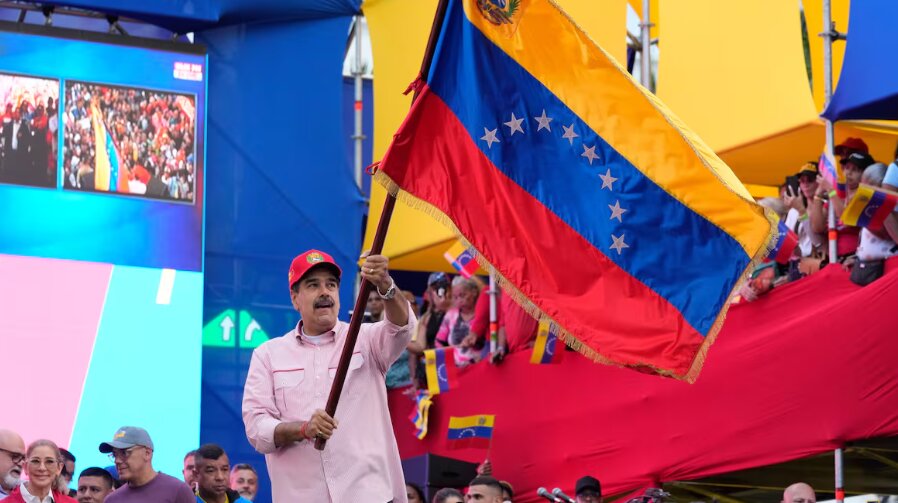
GOA, India – Six months have passed since Venezuela concluded its national elections, yet Western capitals continue to behave as though the ballots were still being counted. Their critiques, statements, and carefully staged condemnations have not diminished; if anything, they have intensified.
This persistence underscores that the debate was never about the electoral process, never about democratic procedure, and certainly never about Venezuelan citizens exercising their constitutional rights. The fixation is geopolitical.
Western powers cannot bring themselves to accept that Venezuela conducted a peaceful electoral cycle, consolidated internal stability, and moved into a post-election phase that is markedly calmer and more orderly than the chaotic dramas Western media predicted.
The question now being asked in diplomatic circles — “Why discuss the election six months later?” — exposes the hollowness of Western narratives. The reason they cling to the election is because it was never about democracy; it was always a pretext.
Long before a single Venezuelan stood in line to vote, think tanks in Washington, London, and Brussels had drafted their accusations. “Fraud,” “dictatorship,” and “illegitimacy” were scripted in advance, ready for release irrespective of what the Venezuelan people decided. In this narrative, Venezuelan sovereignty is always provisional; it is recognised only when aligned with Western strategic interests. Any departure from expected obedience is treated as a crisis.
The roots of this hostility go back two decades. When Hugo Chávez reclaimed control of PDVSA, reoriented oil revenues toward mass social programmes, and ended the era of foreign corporate dominance in the Orinoco Belt, he disrupted one of the most lucrative energy extraction systems in the Western hemisphere.
For this act alone, Venezuela became the target of a multidimensional siege. Sanctions, financial blockades, the freezing of assets, the seizure of CITGO, the encouragement of coup attempts, diplomatic isolation — all of these were instruments in an economic war waged openly, unapologetically, and often proudly.
Trump said it plainly: “It’s all about the oil.” John Bolton, freed from the constraints of office, confirmed in his memoir that Trump repeatedly asked why the United States was not “getting Venezuela’s oil.” The mask occasionally slips, revealing the naked imperial logic beneath.
Sanctions, declared “devastating” and “indiscriminate” by UN Special Rapporteur Alena Douhan, triggered tens of billions of dollars in losses. Hospitals struggled, machinery corroded from lack of imported components, electricity grids broke down, and medicines disappeared.
Western governments then pointed to the very crises they themselves manufactured as evidence of governmental incompetence. This circular logic — strangulate a country, then blame it for gasping — is the signature method of modern coercive diplomacy.
Europe’s posture in this period was no less cynical. The European Union, which maintains close and uncritical relations with autocratic partners across the Middle East and Africa, suddenly discovered a moral ache for Venezuelan democracy — conveniently around the same time it was scrambling to replace Russian oil and gas in 2022.
Politico and Financial Times both reported internal EU discussions about softening sanctions and “re-engaging” with Caracas, the diplomatic euphemism for resuming energy cooperation. Principles were firm when Europe’s storage tanks were full; they became negotiable when winter approached and Russian supplies were cut.
This shifting Western posture stands in stark contrast to how Latin America itself understands the Venezuelan question. The hemisphere today is not the hemisphere of the early 2000s. Mexico has insisted consistently on non-intervention and the inviolability of Venezuelan sovereignty.
Brazil under Lula da Silva refuses to rubber-stamp Western accusations without independent verification. Colombia under Gustavo Petro recognises that sanctions, rather than Venezuelan governance, produced one of the largest migration flows in recent regional history.
CARICOM states maintain respectful and balanced relations with Caracas, informed by geographic proximity, economic necessity, and the memory of PetroCaribe assistance. The geopolitical consensus that once enabled U.S. domination in the region has evaporated.
Beyond Latin America, Venezuela’s global alignments create powerful deterrents. China continues to purchase Venezuelan crude, rehabilitate refineries, and restructure bilateral debt. Russia maintains strategic military and energy cooperation and views Venezuela as part of a wider effort to counterbalance Western dominance.
Iran’s fuel shipments, delivered through waters monitored by the U.S. Navy, marked one of the most daring acts of Global South solidarity in recent memory. Turkey has become an important commercial partner; India purchases Venezuelan crude through intermediated channels. These relationships form a web of resilience around Venezuela that the U.S. cannot easily breach.
This is where OPEC enters the story with renewed force. Venezuela holds the world’s largest proven oil reserves, and despite sanctions, its production is rising. From the nadir of around 400,000 barrels per day, production climbed to approximately 780,000 barrels per day in 2023 and crossed one million barrels per day by mid-2025, with exports frequently exceeding 900,000 barrels per day.
The impending OPEC+ shift toward quota allocations tied partly to reserve capacity — expected to take shape by 2027 – means that a restored Venezuelan oil sector will become increasingly influential.
Western policymakers know that if Venezuela regains its full productive potential, it will not merely recover economically; it will reshape global energy politics in ways that further weaken Western leverage.
What Western analysts consistently underestimate is the internal cohesion that the Bolivarian project retains. Despite hardships, the governing coalition remains anchored in a strong social base, particularly among the working class, rural communities, and those who remember the oligarchic order that preceded the Bolivarian era.
The armed forces, traumatised by the 2002 U.S.-backed coup, have undergone deep political consolidation and will not support any destabilisation attempt. Civilian militias, formed as part of a deterrence strategy, add strategic depth that no foreign military planner can afford to ignore.
The opposition, once touted as a democratic alternative, has fractured under the weight of its alignment with foreign agendas and its inability to present a national project.
This is why six months after the vote; Venezuela looks more stable than its critics expected — and far more stable than Western governments are willing to admit. Streets are calm, political institutions function, regional cooperation is intact, and foreign investment from partners in Asia and the Middle East is expanding. The Western narrative remains frozen in a past that Venezuelans have already left behind.
What remains, then, is the deeper political question: does a Global South nation have the right to determine its own political trajectory, control its own resources, and choose its own allies without punitive intervention? Venezuela answers yes. This “yes” is not an ideological slogan.
It is a claim rooted in international law, in the UN Charter’s insistence on sovereign equality, and in the lived experience of a country that has survived the most extensive sanctions regime imposed outside wartime.
Western governments may cling to the election as a rhetorical weapon, repeating accusations that carry diminishing relevance. But the geopolitical environment has changed. The unipolar moment that once allowed Washington to orchestrate regime change at will is gone.
Today, Venezuela moves within a world marked by multipolarity, South-South cooperation, and the erosion of Western economic authority. Its strategy is not confrontation for its own sake, but a long-term doctrine of deterrence, diversification, and strategic patience.
Whether Western capitals accept this is irrelevant does not really matter. The reality is already established: Venezuela will chart its path on its own terms. The era in which others dictated its destiny has ended.
Disclaimer : This story is auto aggregated by a computer programme and has not been created or edited by DOWNTHENEWS. Publisher: tehrantimes.com