Dan Johnson,West of England correspondentand
Sophie Woodcock
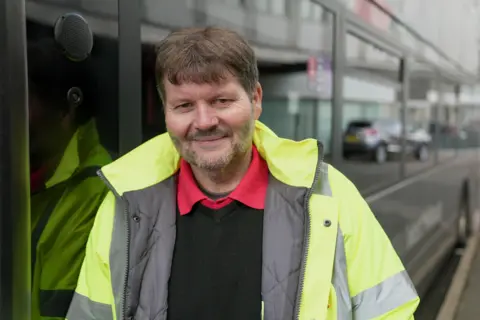
“Would I catch a bus? No, not out of choice now,” says Andy Collett. “I feel much happier using my own car.”
His sentiment isn’t unusual among passengers. But Mr Collett is a bus driver.
“It can be very intimidating,” he says. “I’ve been assaulted twice, spat at numerous times, and I’ve had incidents of broken windows – it’s just part and parcel of the job, unfortunately.”
He describes a “lawlessness” among some of the travelling public – mostly younger people – which he believes has got worse in 38 years of driving Birmingham’s bus routes.
The BBC has spoken to passengers, transport staff and other bus drivers in the West Midlands about what they say is a growing national trend of antisocial behaviour on public transport.
The British Transport Police recorded 40,034 incidents of antisocial behaviour in 2024-25, an increase of 24% on the previous year.
Buses are the most commonly used form of public transport but they’re also where passengers feel least safe, according to a recent Transport for the North survey.
 BBC/Andy Alcroft
One incident gives Mr Collett flashbacks.
“I was attacked by about 30 schoolkids,” he says. “I had cuts, bruises. They actually bent the fingers back on my hand when I was trying to hold [the door] to stop them getting on the vehicle.”
Mr Collett now mostly trains other drivers, warning them of the dangers. When he does get shifts behind the wheel, he tries to avoid routes known for antisocial behaviour.
Chelmsley Wood in the West Midlands is a snapshot of this national problem. Its interchange has suffered vandalism and graffiti, while drivers have been threatened and buses damaged.
Security camera footage shows masked teenagers aiming barrages of fireworks at buses over Halloween and Bonfire Night.
Passenger Emma Banks, 52, says she has witnessed a similar incident.
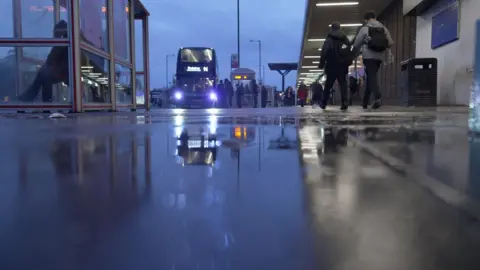
“They [were] hitting the bus. I’ve got learning difficulties and sometimes it does scare you,” she tells me on a cold evening, waiting in the interchange.
Ms Banks says she regularly sees overcrowding and people smoking on buses.
She can’t drive so relies on public transport but, tonight, Ms Banks doesn’t feel confident enough to catch the bus.
“I’ll be getting a taxi because I know that I’ll get home safely.”
A Public Space Protection Order has been imposed at Chelmsley Wood to stop gatherings of young people and to require the removal of masks and hoods. But 17-year-old Elle Furlong says she’s still afraid.
“They smash windows, purposely pull the fire alarm, light their lighters on the chairs. It’s just horrendous.”
The probability of becoming a victim of crime on public transport is very low – Transport for West Midlands estimates one crime for every 50,000 bus journeys. But perceptions can outweigh statistics and drive people like Ms Furlong away.
“If I can walk it, I’ll walk it. If it’s far enough, I’ll get an Uber. If it’s really far, I’ll get my dad to drop me off. I avoid buses at all costs,” Ms Furlong says.

 BBC/Andy Alcroft
The drivers have no choice but to carry on with their jobs, although many are afraid to speak openly about the risks. Even trade union officials have refused to go on the record.
“You come to work not knowing what you’re going to face,” says a driver who asks to remain anonymous. “It can cause a lot of anxiety and stress. I go home sometimes and just want to break down and cry because it’s a horrible job.”
They describe the daily grind of disrespectful teenagers, aggressive drug addicts, even passengers defecating on the bus. Then there’s the racial abuse.
“You have to hold back. I’ve known a few drivers who have kicked off, but then they’ve lost their job because of it.”
I saw for myself what drivers and passengers are facing when I sat on the top deck of the 94 from Chelmsley Wood, shortly after the school bell. A group of kids soon boarded without paying.
“I’ve been driving buses for 33 years and it’s changed,” driver Neil Evans says through the screen protecting his cab. “Society has changed. No one cares anymore. They just walk onto the bus and do what they want, when they want, how they want, and nothing’s done about it.”
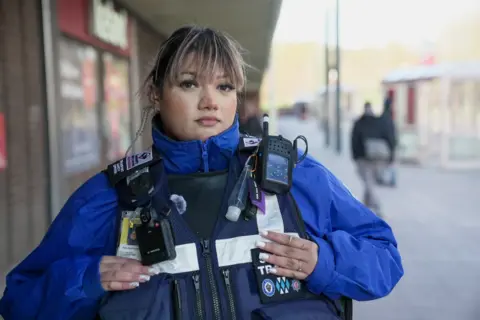
Today, Mr Evans has backup. Esha Sheemar is one of 13 Transport Safety Officers (TSOs) patrolling the West Midlands. She warns the kids if they don’t behave they’ll be thrown off the bus.
TSO roles were introduced in 2019. They are not police officers, but they have limited powers to tackle issues on public transport.
 BBC/Andy Alcroft
Across the bus station, Ms Sheemar’s colleague Lee Clarke has spotted a face from their most-wanted list: a 13-year-old accused of vandalising a bus shelter. The boy’s details are taken but he is allowed to get on the bus, as Mr Clarke’s limited powers mean he’ll need to pass the case to police officers.
TSOs are funded by the Combined Authority and belong to the West Midlands Safer Travel Partnership, which includes West Midlands Police, British Transport Police, as well as bus and train companies.
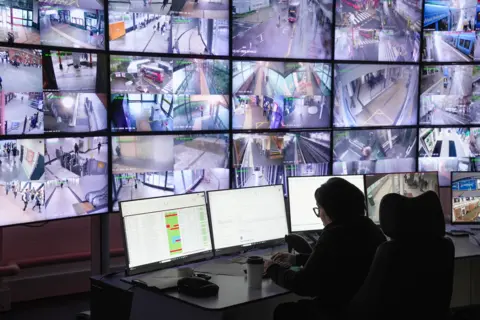
At its control room in the city centre, hundreds of screens flicker with security camera images from stations and interchanges across the region’s roads and rail lines; they can even get live pictures from most of the buses.
Kerry Blakeman is head of security for the West Midlands Safer Travel Partnership and says they have access to more than 5,000 fixed cameras. He says his staff capture about 30 incidents each day, although he is keen to stress millions of journeys are safe and uneventful.
“We are trying to do our best to keep the travelling public safe. Behind each camera is an operator looking out for your safety whilst you travel around the bus, train and tram network.”
Last summer, a teenager was filmed threatening people at Chelmsley Wood bus station with a machete. He was identified and sentenced to six months in juvenile custody.
The footage of the firework attacks has been handed over to West Midlands Police – and efforts to trace the hooded youths are ongoing.
 BBC/Andy Alcroft
Bus driver Bryan Cook recently called police after being threatened with a weapon while working. It was one of four times in the past three months that he’s phoned for assistance while driving the 72 bus to Chelmsley Wood.
On this chilly evening, he takes his chance to tell the TSOs how their timetable fails to match that of the vandals. “Where are you on the weekends? Where are you on school holidays?” he asks.
TSO Mr Clarke starts to reply, but the driver has more to say.
“We’re the ones getting threatened, we’re the ones getting stuff thrown at us, broken windows. Where are you lot?”
Mr Clarke emphasises the importance of reporting incidents so patrols can be targeted in problem areas.
“We keep telling everyone. No one does anything,” says Mr Cook, in exasperation.
It outlines the challenge for a small team covering such a large area. The number of TSOs doubled a year ago and is set to rise to 25 across the West Midlands. Some areas have similar teams – and others have piloted them – but many places are uncovered, relying on the police. Bus routes can be especially vulnerable.
The anonymous bus driver questions the effectiveness of Transport Safety Officers and urges more support from their employer.
“They [management] know what goes on. Do they care? I don’t know. Doesn’t feel like it, to be fair.”
National Express West Midlands told the BBC that all reports of antisocial behaviour or crime are “fully investigated to ensure perpetrators are held accountable, to identify any learnings, and to provide support for those affected”.
It added that antisocial behaviour “will always be a subject we need to keep challenging and working on”.
The UK government’s recent Bus Services Act allows local authorities to apply for extra powers to deal with issues such as smoking, vaping and fare evasion, the sort of problems TSOs can tackle already on trains.
The legislation also requires bus drivers to receive training in dealing with antisocial behaviour and spotting the signs of harassment and abuse faced by women and girls.
The Department for Transport told the BBC that abuse of passengers and staff is “unacceptable” and pointed to the new powers the Bus Services Act will give to help tackle antisocial behaviour.
Transport for West Midlands promises greater use of drone cameras and AI technology, capable of recognising known troublemakers and even identifying concealed weapons. It recently launched a campaign prioritising the safety of women and girls.
Mr Blakeman insists his team is having a positive impact but says he recognises passenger confidence is fragile.
“I respect why some members of the public wouldn’t feel comfortable travelling, but I want them to know that we’re actually doing everything we can behind the scenes.”
Back on the 72 bus, Mr Clarke is trying to restore Mr Cook’s faith. He promises someone will make contact to explain their role and discusses the most efficient way to flag issues.
The West Midlands Safer Travel Partnership is regarded as a model of good practice. And yet, this frosty exchange reveals a clash of perspectives – one that speaks of “intelligence-led tasking” and “visible reassurance”; the other of lone working under the stark reality of sustained abuse and the risk of attack.
Mr Cook sums it up like this: “Two weeks ago I had two windows broken on my bus, I got threatened with a knife – and that’s all in a day’s work”.
Disclaimer : This story is auto aggregated by a computer programme and has not been created or edited by DOWNTHENEWS. Publisher: BBC