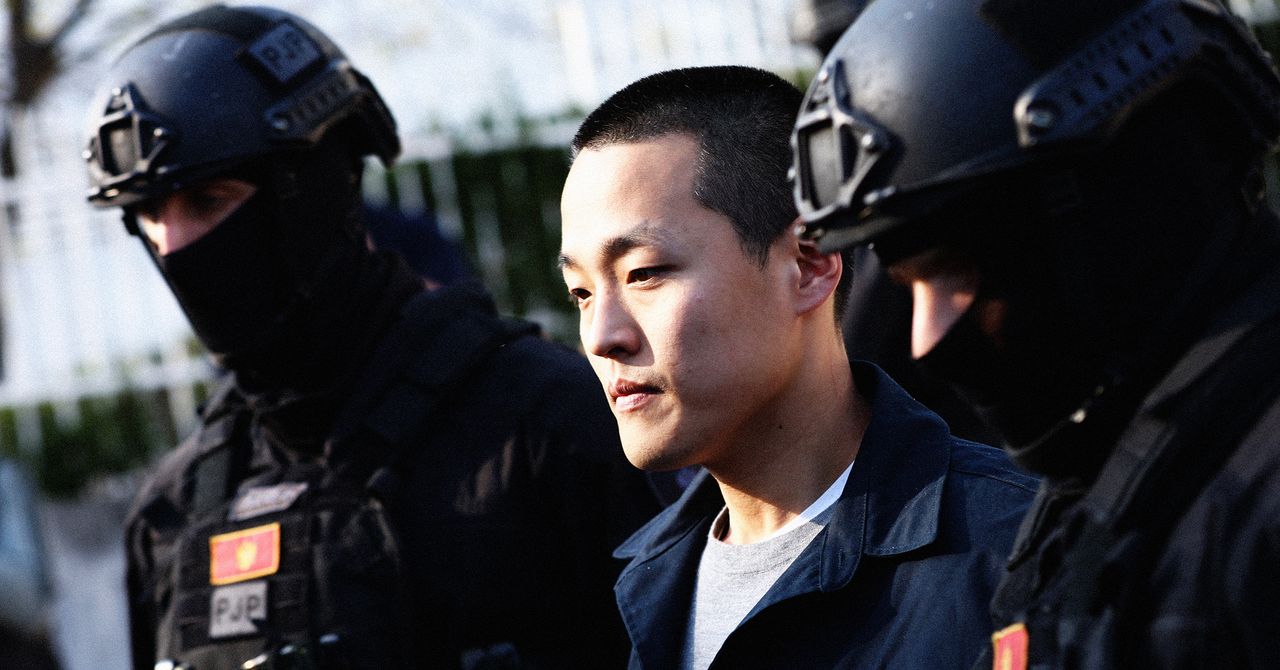
South Korean crypto entrepreneur and prosecuted fraudster Do Kwon was sentenced to 15 years in prison by a US federal judge in the Southern District of New York on Thursday.
Kwon cut a solemn figure as he was escorted into the courtroom by US Marshalls, his head bowed. He wore a bright lemon-colored prison jumpsuit over a long-sleeve shirt, with cuffs around his waist and hands.
In August, Kwon pleaded guilty to defrauding investors who purchased crypto coins issued by his company, Terraform Labs. In May 2022, the abrupt collapse of those coins wiped out $40 billion and sent the crypto economy into a tailspin that bankrupted numerous other companies.
“Kwon’s fraud was colossal in scope, permeating virtually every facet of Terraform’s purported business,” US prosecutors wrote in a recent court filing. “His rampant lies left a trail of financial destruction in their wake.”
Given the chance to address the court on Thursday, Kwon said he took sole responsibility for the fraud. After thanking his former coworkers and supporters, some of whom had gathered in the public gallery, he became emotional. His lawyers, to his left and right, rubbed his back.
The offenses to which Kwon pleaded guilty carry a maximum sentence of 25 years in prison. Before the hearing, prosecutors had petitioned for a twelve-year prison term. But the presiding judge, Paul Engelmayer, ruled that a more punitive sentence was required in order to deter future crypto fraudsters.
“This case will be there as a reminder of breaking bad and what happens,” Engelmayer told the courtroom. “To the next Do Kwon, if you commit fraud, you will lose your liberty for a long time.”
Kwon started Terraform in 2018, alongside cofounder Daniel Shin. Two years later, the company announced plans to launch TerraUSD (UST), a stablecoin whose value was supposedly pegged to the US dollar by way of an algorithm. The algorithm would effectively tie UST to a second coin issued by the firm, LUNA. A dollar’s worth of LUNA could be exchanged for a dollar’s worth of UST, and vice versa. If UST were to ever slip below $1, traders would be incentivized to buy LUNA until the target value was restored.
“It was an intriguing and very novel mechanism,” Noelle Acheson, an analyst who previously worked at the crypto brokerage Genesis, told WIRED last year. “Many smart people believed it would work.”
In May 2022, the price-balancing system belched. When traders sold large quantities of UST, it slipped from its dollar peg, leading to a panicked sell-off that drove the price practically to zero. In a now-infamous tweet, Kwon tried to stop the selloff, writing, “deploying more capital—steady lads.” But the value of UST and LUNA plummeted, wiping $40 billion from the market.
The contagion from the incident contributed to the collapse of hedge fund Three Arrows Capital, followed by crypto lenders Voyager Digital, BlockFi, and Genesis. In a roundabout way, it created the conditions for the destruction of crypto exchange FTX, by causing lenders to recall hundreds of millions of dollars in loans to FTX’s sister company. The sister company repaid the loans using FTX customer funds, deepening the hole in the exchange’s balance sheet.
After the crash, Kwon fled his penthouse in Singapore for the Balkans. In March 2023, he was arrested by authorities in Montenegro after trying to use a fake passport to board a plane to the UAE, which does not have an extradition treaty with the US. A fight then ensued over which country—the US or Kwon’s native South Korea—would be allowed to extradite him.
In April 2024, Kwon was tried in absentia in the US over civil charges brought by the US Securities and Exchange Commission, which alleged that he had misled investors about the prospects and stability of Terraform’s coins. The civil jury found Kwon liable.
In December 2024, Kwon was extradited to the US to face a criminal trial, before signing a plea agreement with the US Department of Justice.
Though Kwon was not required under the plea agreement to admit to all the allegations outlined in the DOJ’s indictment, he conceded to lying about UST’s capacity to automatically “self-heal.” In public, Kwon had repeatedly asserted that coin holders could rely on Terraform’s algorithm to return UST to its $1 price point in the face of market volatility. But in reality, he had privately struck a “gentlemen’s agreement” with a trading firm, whose job became to artificially drive the price of UST back towards dollar parity by trading large quantities of the coins.
“I misled many inventors into believing UST was a lot less experimental than it was,” Kwon wrote in a letter to the judge ahead of his sentencing. “Looking back, I cannot comprehend my own hubris.”
When deciding on Kwon’s sentence, Judge Engelmayer was required to weigh—in addition to the details of Kwon’s crimes—various extraneous factors that contextualized his offense, including his character and personal history, whether he had taken responsibility for his crimes, and the likelihood he might break the law again.
“The judge can take really everything about a person’s personal life and crime into account in a holistic way,” says Rachel Maimin, a partner specializing in white collar defense at Lowenstein Sandler, who previously worked as a US prosecutor. “Because nobody is entirely defined by their one crime.”
In making his final written plea to the judge ahead of sentencing, Kwon walked a fine line between appearing appropriately contrite while subtly minimizing the extent of his fraudulent conduct.
“There’s a really thin line that has to be navigated,” says Jarrett Wolf, a former US prosecutor who now runs Wolf Global, a law firm specializing in crisis management. “He’s trying to attribute the losses to mistakes in an effort to minimize culpability. But the fact of the matter is—as the government points out in its indictment—this case is not about mistakes, it’s about lies.”
Ultimately, Kwon couldn’t dance around the magnitude of the losses suffered by investors. “You really can’t get away from the seriousness of the crime,” says Maimin. “The government doesn’t describe every crime as being colossal.”
On Thursday, some of Kwon’s victims addressed the court. One investor, Tatiana Dontsova, reported having fallen into a “state of deep depression” after a large investment in LUNA came to be worth just $13; she is now homeless, living on the streets of Tbilisi, Georgia. Another individual, who had invested his family’s $190,000 life savings into UST, said his wife filed for a divorce shortly after the collapse. “I could not imagine that a person I’d never met could destroy my life so completely,” he said.
His prison sentence now confirmed, Kwon will be kept in a temporary facility until the Bureau of Prisons decides upon a long-term placement.
Under his plea agreement, Kwon will be allowed to submit a request to be transferred to South Korea after serving half his sentence. But on his return to Korea, he stands to be re-tried on similar charges. Local prosecutors have previously said they would seek a 40-year prison term.
A recent submission by the defense offered an indication as to what an extended future behind bars might look like for Kwon, the one-time crypto wunderkind. “He spends much of his time in a loop of regret, replaying what might have been,” the filing states, “still jotting code by hand in his jail cell when he wakes in the night.”
This is a developing story. Please check back for updates.
Disclaimer : This story is auto aggregated by a computer programme and has not been created or edited by DOWNTHENEWS. Publisher: wired.com