HOKKAIDO, Dec 12 (News On Japan) –
Northern Japan was hit by warning-level blizzards and whiteout conditions on December 12th, with heavy snow, violent winds and subzero temperatures disrupting transport across wide areas while recovery continued in communities already damaged by last week’s powerful earthquake.
[embedded content]
In Rumoi, Hokkaido, a sudden whiteout developed on the morning of December 12th as accumulated snow was whipped into the air by strong winds, rapidly reducing visibility. Drivers were forced to switch on headlights, and commuters headed to schools and workplaces bundled against the severe cold. In Ishikari, Hokkaido, a whiteout occurred during driving, creating tense and hazardous moments on the roads.
Sapporo has been experiencing heavy snowfall since December 11th, with snow accumulation reaching 31 centimeters by noon on December 12th. Temperatures remained extremely low throughout the day, with the reading at 1 p.m. falling to minus 5.7 degrees.
In Akita City on the morning of December 12th, heavy snow obscured visibility and pedestrians braced against the cold with hoods pulled tightly over their heads. At 8 a.m., during the morning commute, temperatures stood at minus 2.2 degrees with 3 centimeters of snow on the ground. Many people’s hands and faces turned red as icy winds blew across the streets. Fallen objects on roadways further heightened the danger, forcing drivers to steer carefully around obstacles.
Amid the severe weather, a train derailed and overturned in deep snow. At around 5:10 a.m. on December 12th, a train operating in Kita-Akita City left the tracks and overturned onto an embankment from a height of about five meters. No passengers were on board, but the driver suffered bleeding from the face and body pain and was taken to hospital. The Akita Nairiku Jukan Railway, known for its scenic snow-viewing line, said police found several leaning trees near the tracks and are investigating whether the train struck a fallen tree.
In Nagano Prefecture’s Hakuba Village, the snowfall was welcomed by skiers and snowboarders awaiting the start of the winter season. Along the route from Aomori City to Sukayu, vehicles moved through deep roadside snow, and the Sukayu hot spring area recorded snowfall approaching 1 meter 50 centimeters. One person clearing snow from the back of a truck said, “They said even the daytime high will be below zero today. It’s really cold, and it’s worrying to think how much worse it will get.” Temperatures in Sukayu remained in the minus-10-degree range, with a piercing, frigid wind sweeping across the area.
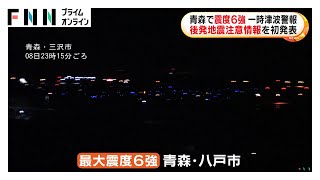
Five days after Aomori Prefecture’s Hachinohe City recorded a maximum seismic intensity of upper 6, the region is now facing harsh midwinter cold, with temperatures dropping to minus 4.1 degrees. In Mutsu City, rubble from the earthquake has begun to collect snow, which reached 2 centimeters by December 12th. Meanwhile, a hospital damaged by the earthquake has partially reopened inpatient wards. At Mutsu General Hospital, ruptured sprinklers led to flooding, forcing 36 inpatients to be transferred to other facilities within the prefecture. Rapid restoration work allowed part of the inpatient ward and suspended surgeries to resume on December 12th.
Winter preparations are also accelerating in Hachinohe, where home improvement stores have set up full snow-readiness sections and customers tested insulated gloves and other cold-weather goods. Northern Japan’s cold air mass is expected to persist through December 13th, with forecast snowfall reaching 40 centimeters in Hokkaido and 50 centimeters in the Tohoku region. Severe freezing conditions are expected to continue.
Snow and sleet are also possible in Tokyo over the weekend beginning December 13th. In Minakami, Gunma Prefecture, where 13 centimeters of snow had fallen by 1 p.m., blizzard conditions raged as drifting snow intensified. One resident said, “Summer heat is tough, but winter is hard work too. The snow and wind are strong. It was a blizzard. Since this morning, visibility was zero.”
Road signs were completely obscured by blowing snow, and Minakami used its snow-melting water pipes for the first time this season. In Tokyo’s Odaiba district, winds as strong as those from a typhoon swept across the waterfront, forcing people to lean forward as they walked and making it difficult to push strollers. Central Tokyo registered 9.3 degrees at noon, but wind chill made conditions feel even colder.
Temperatures are expected to drop further over the weekend from December 13th, with potential snowfall in Tokyo if readings fall below forecasts. The capital’s minimum temperature is expected to reach 2 degrees on both Saturday and Sunday, with rain forecast to begin on Saturday night and sleet predicted in mountainous areas on Sunday, prompting calls for continued caution.
Source: FNN
Disclaimer : This story is auto aggregated by a computer programme and has not been created or edited by DOWNTHENEWS. Publisher: newsonjapan.com