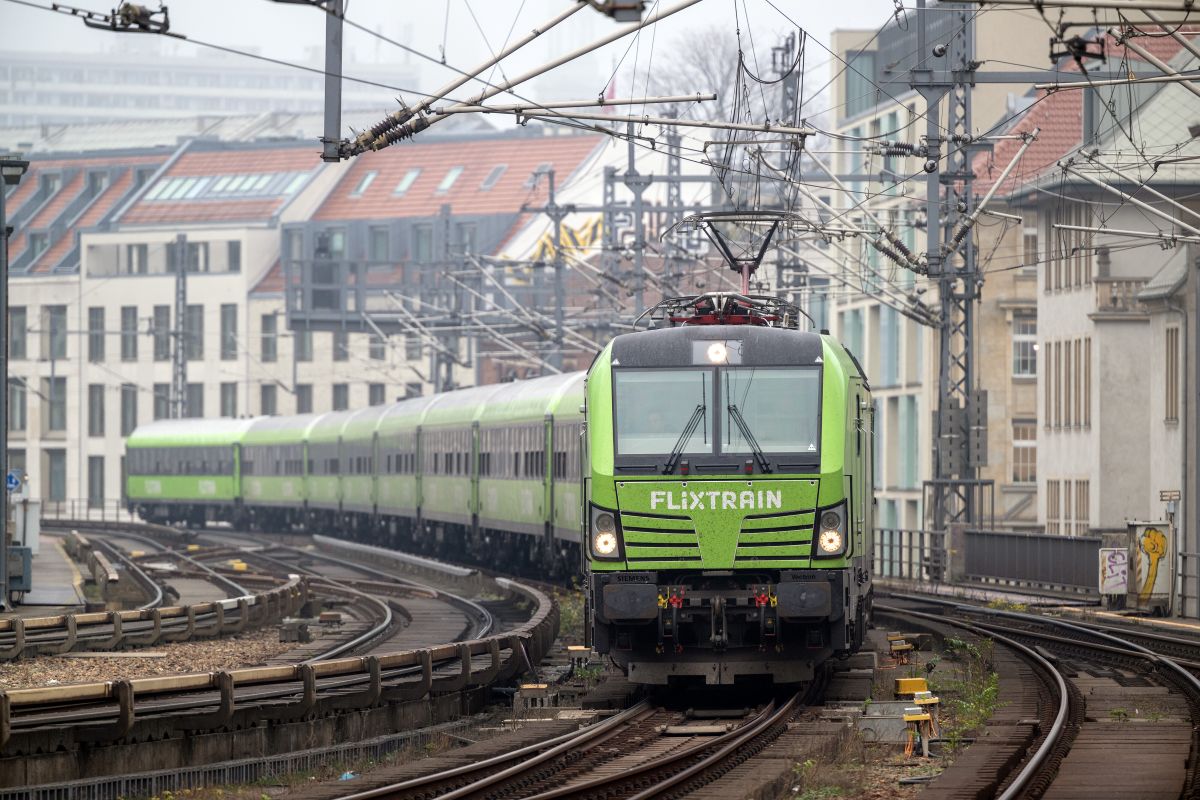
Germany’s budget railway operator, known for its limegreen trains, has announced plans to buy 65 new trains in the coming years and expand its coverage in the country and beyond.
Deutsche Bahn’s primary competitor on the German railways, Flixtrain, has ordered 65 new long-distance trains, which it plans to put into operation by 2028.
What’s more, Flixtrain has big plans for expansion. Deutschlandfunk reported that Flixtrain ultimately aims to make around 650 destinations accessible across Europe. That’s up from around about 50 destinations in Germany that it currently services.
The company also recently announced plans to expand routes into the Netherlands.
More lime green trains
Flixtrain’s 65 new long-distance trains are expected to be put to use gradually, starting in 2028.
In May, the company announced a massive expansion of its long-distance connections, adding that it had put in an order with the Spanish manufacturer Talgo for up to 65 trains based on the new ICE-L design. It should initially receive 30 new express trains with the option to buy 35 more.
Flixtrain co-founder and CEO André Schwämmlein told the German Press Agency that the first vehicles are in production, and they are on schedule.
“The ramp-up will of course take some time,” Schwämmlein said, leaving open when the last vehicle would be delivered.
A flix train passes through a residential zone in Germany. The budget railway provider is planning a massive expansion. Photo: picture alliance/dpa | Soeren Stache
So far, Flixtrain’s fleet consists of 15 used trains that have been modernised.
Until the new trains are operational, the company wants to expand the frequency on its existing connections with other used trains. In this way, Flixtrain has said it plans to double it’s total seating capacity over the next two years.
READ ALSO: Deutsche Bahn vs Flixtrain – The pros and cons of Germany’s train operators
For passengers, this would mean a significant expansion of the existing long-distance train services around Germany. Flixtrain suggests it would then operate “a two-hour interval on the major connections.”
Flixtrain is one of Deutsche Bahn’s few competitors for long-distance train transport in Germany, with the bigger provider currently holding a market share of around 95 percent in this segment.
More connections to Germany’s major cities
Currently Flixtrain focuses primarily on passenger transport between Germany’s major metropolitan regions. Its trains run from Berlin to North Rhine-Westphalia or to the southwest, as well as between Hamburg and the capital.
The budget railway brand, which belongs to the Munich-based travel platform Flix, wants to expand its German connections going forward, including by adding the busy Berlin-Munich route in the medium term.
READ ALSO: What’s the best way to travel between Berlin and Munich?
For travellers, navigating Germany with a combination of Flixtrains and Deutsche Bahn services can often be cheaper, and occasionally more convenient, than connections limited to the use of one or the other.
For example, travellers going from Berlin to Nuremberg can take a direct ICE train with a travel time of around three hours. Or, they can take a Flixtrain from Berlin to Erfurt, and then an ICE or regional train on to Nuremberg in under four hours. In this case, the trade-off is an extra hour of travel time with a transfer for a significantly cheaper ticket.
You may occasionally find combination tickets in the DB Navigator app that allow you to book the entire journey on one ticket. But note that you’ll still need to pay for your Flixtrain ticket separately.
With reporting by DPA.
Disclaimer : This story is auto aggregated by a computer programme and has not been created or edited by DOWNTHENEWS. Publisher: thelocal.de