By Staff writers
The Australian sharemarket fell for a third straight day after a mixed session on Wall Street, as US investors digested a raft of economic data that did little to clear uncertainty about where interest rates may be heading.
The S&P/ASX 200 finished down 13.7 points, or 0.2 per cent, at 8585.20, with all 11 industry sectors in the red bar materials, which were boosted by gold stocks. The losses come after the ASX lost 0.4 per cent on Tuesday. The Australian dollar was trading at US66.18¢ at 4.12pm AEDT.
“While the labour market reports were soft, the data need to be treated with caution following the [US] government shutdown,” said ANZ analysts Brian Martin and Daniel Hynes. “Uncertainty surrounding the timing of the [Federal Reserve’s] next move is unlikely to be resolved until the data flow normalises next year.”
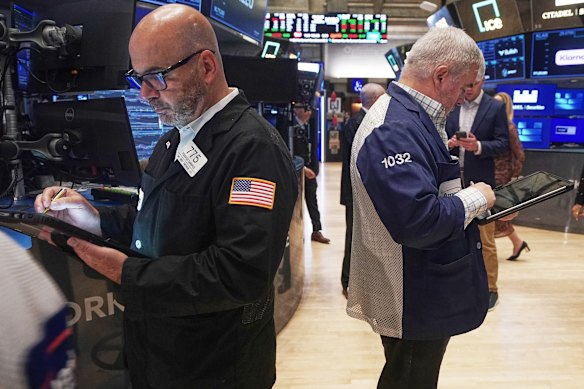
Wall Street remains in the dark over the direction of interest rates.Credit: AP
Miners and energy stocks were driven in both directions by some dramatic moves in the commodities market, with crude oil rising from the lowest level since 2021 after President Donald Trump ramped up pressure on Venezuela with a blockade of tankers, while signs of a swelling global glut continue to hang over the market. At the same time, gold edged toward a record high, iron ore futures ticked up, copper gained and platinum rose for a fifth day to hit the highest level since 2011.
Energy stocks fell after expectations that companies are pumping more than enough oil to meet the world’s demand had sent down the price for a barrel of benchmark US crude below $U56 per barrel, while Brent settled at $US58.92, before it was ticking up again in the afternoon. Local oil and gas giant Woodside Energy lost 2.4 per cent while Santos dipped by 1.2 per cent. Ampol, Australia’s biggest oil refinery, lost 1.4 per cent.
On the other side of the spectrum, gold miners rallied after the price of the safe haven strengthened overnight. Northern Star jumped 3.8 per cent, Evolution Mining climbed 4.5 per cent and Newmont finished 1.2 per cent higher. Iron ore heavyweights BHP (up 0.4 per cent), Fortescue (up 1.6 per cent) and Rio Tinto (up 0.8 per cent) all advanced. Palladium miners Zimplats and Southern Palladium jumped higher, closing with gains of 3.4 per cent and 6.1 per cent, respectively.
Interest-rate-sensitive tech stocks lost ground, with WiseTech Global down 2.1 per cent, data centre operator Next DC down 2 per cent, and family tracking app Life 360 shedding 1 per cent.
Financial stocks were also weaker, with Commonwealth Bank – the biggest stock on the index – falling 0.8 per cent while its next-biggest rivals Westpac (down 0.1 per cent) and National Australia Bank (down 0.5 per cent) also retreated. ANZ Bank finished unchanged.
Consumer staples were pulled down by Treasury Wine Estates and Graincorp. Penfolds maker Treasury Wine slumped 9.3 per cent after announcing a sharp cut to its profit outlook for the first half of the financial year due to ongoing weakness in China and the United States.
Australia’s largest grains company Graincorp slid 15.4 per cent after it said it sold its struggling GrainsConnect Canada business at a loss of $5 million to $10 million, and predicted a fall in grain volumes for the 2026 financial year.
Gaming giant Star Entertainment rallied 9.5 per cent after announcing Bruce Mathieson Jnr will step down as executive chairman just one day after taking the position. Soo Kim, the chairman of the Star’s major investor Bally’s, will replace him, with Mathieson to now become the company’s chief executive.
On Wall Street overnight, the S&P 500 slipped 0.2 per cent and remained a bit below its all-time high set last week. The Dow Jones dipped 0.6 per cent, while the Nasdaq composite rose 0.2 per cent.
Treasury yields eased a bit, following a larger initial drop, after one report said the US unemployment rate was at its worst level last month since 2021, but employers also added more jobs than economists expected. A separate report, meanwhile, said an underlying measure of strength for revenue at US retailers grew more in October than economists expected.
The mixed data initially sent Treasury yields lower in the bond market. The knee-jerk reaction seemed to be that the reports could encourage the Federal Reserve to see the slowing job market as the biggest threat to the economy, rather than high inflation, and cut interest rates further in 2026. But yields quickly recovered and then drifted up and down.
What the Fed does with interest rates is a top driver for Wall Street because lower rates can give a boost to the economy and to prices for investments, even if they also may worsen inflation.
Artificial-intelligence technology stocks were mixed. Oracle rose 2 per cent, having posted sharp losses last week, even it reported stronger profits than expected. But CoreWeave, which rents out access to top-of-the-line AI chips, fell 3.9 per cent.
Questions remain about whether all the spending underway on AI technology will produce the kind of profits and productivity that will make it worth the expense.
Shares of Warner Bros Discovery lost 2.7 per cent amid reports the company is planning to reject Paramount Skydance’s hostile takeover bid due to concerns about financing and other terms.
After deliberating and reviewing the Paramount bid, the Warner Bros board still views the company’s deal with Netflix as offering greater value, said sources close to the deliberations, who asked not to be identified discussing confidential information. Paramount’s shares dropped 1 per cent, while Netflix rose 0.9 per cent.
with AP, Bloomberg
The Market Recap newsletter is a wrap of the day’s trading. Get it each weekday afternoon.
Most Viewed in Business
Disclaimer : This story is auto aggregated by a computer programme and has not been created or edited by DOWNTHENEWS. Publisher: www.smh.com.au