
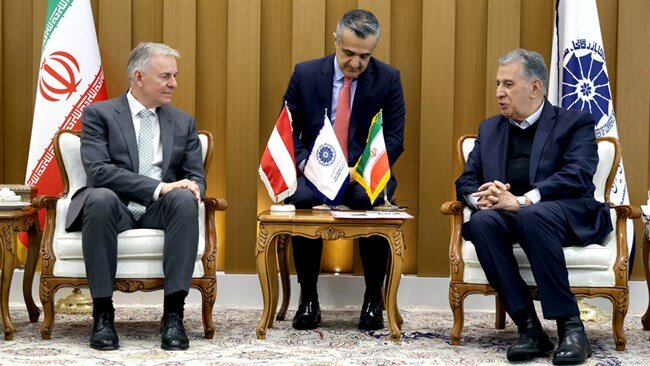
TEHRAN – The head of the Iran Chamber of Commerce, Industries, Mines and Agriculture (ICCIMA) has urged Austria to facilitate the issuance of business visas for Iranian traders, saying easier travel would help revive bilateral economic ties weakened by sanctions.
Speaking at a meeting with Austria’s ambassador to Tehran, Samad Hassanzadeh said trade between the two countries had fallen to minimal levels due to sanctions but expressed hope that cooperation could expand under Vienna’s new diplomatic representation.
Hassanzadeh said Iran offers significant potential in mining, agriculture, food production, medical equipment, pharmaceuticals, steel and petrochemicals, while Austria has strong capabilities in water treatment, recycling technologies and advanced industrial solutions.
He said Iran was keen to pursue joint projects with Austria in renewable energy and green initiatives, water resource management, soil technologies, knowledge-based services, artificial intelligence, greenhouse production and agriculture.
Referring to past cooperation in the petrochemical sector, Hassanzadeh said Iran has become a global exporter of high-quality petrochemical products and has built strong domestic capacity in engineering services and refinery and petrochemical construction, adding that sanctions had helped strengthen local industry.
He said political restrictions and sanctions had weakened private-sector ties between the two countries and called on the Austrian embassy to help remove barriers, particularly by easing the issuance of commercial visas. Hassanzadeh also formally invited Austrian trade and academic delegations to visit Iran.
Austria’s Ambassador to Iran Friedrich Stift, said sanctions have hindered Austrian companies interested in working with Iran, especially in financial transactions.
He said bilateral trade totaled 130 million euros last year, a figure he described as far below Iran’s economic potential as a regional power.
Stift noted that around 60,000 Iranians and people of Iranian origin live in Austria, including doctors, architects, engineers and political figures, creating a solid base for scientific and commercial exchanges.
He said the Austrian embassy, which was temporarily closed during the recent 12-day conflict, would resume accepting visa applications for both business and non-business travelers from Jan. 4.
As previously reported by the International Affairs Department of the Iran Chamber of Commerce, Industries, Mines and Agriculture, trade between Iran and Austria reached $220 million in 2024, marking a five percent increase from the previous year.
The report notes that bilateral trade between the two countries, which stood at $1.2 billion in 1970, has significantly declined over the decades due to international sanctions and geopolitical tensions.
Austria’s exports to Iran rose by six percent year-on-year to $190 million in 2024, while Iran’s exports to Austria remained unchanged at $30 million.
Austria’s main exports to Iran included industrial machinery, medical equipment, and chemical products. In contrast, Iran’s primary exports to Austria consisted of petrochemical products, pistachios, dried fruits, and Persian carpets.
The report described Austria as a pragmatic and low-conflict partner with strong potential for collaboration, particularly in technology and energy. However, sanctions, EU pressures, and competition from China were identified as major obstacles to expanding bilateral ties.
It concluded that unless sanctions are lifted and cooperation deepened, only modest trade growth is expected through the end of 2025. Nonetheless, the report emphasized that easing restrictions could pave the way for broader engagement in key sectors such as engineering and infrastructure.
EF/MA
Photo: ICCIMA Head Samad Hassanzadeh (R) and Austria’s ambassador to Iran Friedrich Stift
Disclaimer : This story is auto aggregated by a computer programme and has not been created or edited by DOWNTHENEWS. Publisher: tehrantimes.com





