For years, tokenisation in India has existed in a strange limbo, discussed in policy and industry forums, tested quietly by institutions, and debated endlessly by lawyers and technologists. Yet, it re

Published: December 19, 2025 2:04 PM IST
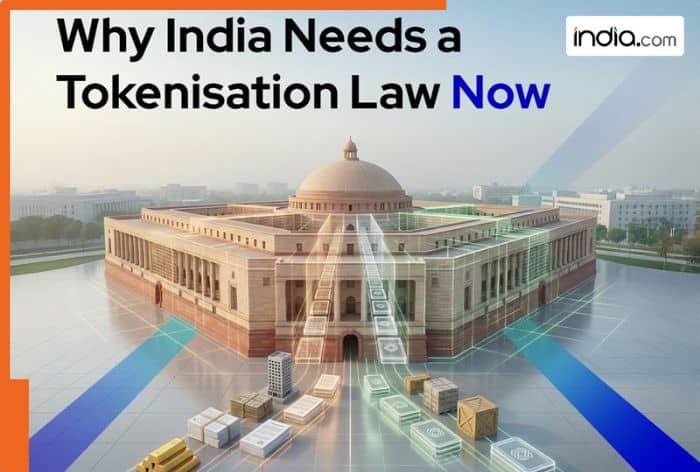
For years, tokenisation in India has existed in a strange limbo, discussed in policy and industry forums, tested quietly by institutions, and debated endlessly by lawyers and technologists. Yet, it remained absent from formal legislative conversation. That changed recently, when Member of Parliament Raghav Chadha called for a dedicated tokenisation bill during a parliamentary address.
This was not a passing remark or a technology endorsement. It was a recognition that India’s financial system is approaching a structural inflection point: assets are increasingly digital, but the legal and regulatory framework governing ownership, custody, and enforcement is still designed for a paper-first world.
That acknowledgment matters more than it appears.
Tokenisation is a market-structure issue, not a crypto debate.

Much of the public discourse around tokenisation has been clouded by its association with cryptocurrencies. The parliamentary proposal cuts through that confusion. Tokenisation is not about speculative tokens or unregulated markets. In its regulated form, it is about representing real-world assets i.e. gold, bonds, funds, commodities, real estate—in a digital form, while preserving the same principles that underpin India’s capital markets i.e. clear ownership, regulated custody, and investor rights, with additional benefits like stronger auditability and faster settlement.
Global regulators have already recognized this distinction. The UK has legally classified digital assets as property. The European Union has created regulated pathways for tokenized securities under MiCA. Singapore and Japan allow tokenized instruments within tightly governed exchange and custody frameworks.
India, despite being one of the world’s largest savings and investment markets, still lacks a clear statutory answer to a foundational question: what is a tokenized asset under Indian law?
Raghav Chadha’s proposal brings that unresolved question into the legislative spotlight.
Why legislative clarity matters now
Tokenisation is already happening in practice. Assets are being digitised, fractionalized, and distributed using new technologies. What is missing is not innovation, but legal certainty. Without clear statutory definitions:
- Investors rely on platform credibility rather than enforceable rights
- Regulators are forced to respond reactively
- Courts lack explicit guidance when disputes arise
A tokenisation bill is not about accelerating adoption. It is about reducing ambiguity and reallocating risk away from investors and back into market structure.
This is a point that industry leaders have made consistently over the years. Sudeep Chatterjee, CEO of STOEX, has long argued that “tokenisation only creates value when it mirrors the discipline of traditional market infrastructure, i.e. clear custody, allocated backing, independent audits, and enforceable redemption rights. Without those elements, digitisation merely shifts risk rather than removing it.”
Parliamentary recognition of this reality signals that these arguments are no longer confined to industry circles.
What a serious tokenisation framework must address
If India moves toward legislation, the challenge will not be speed – It will be precision.
A credible tokenisation framework must clearly establish:
- Legal ownership – whether a token represents direct ownership of an asset or a contractual claim
- Custody and vaulting standards – who holds the underlying asset and under what regulatory oversight
- Audit and disclosure requirements – independent verification of backing and circulation
- Investor rights and remedies – redemption, transferability, and enforceability in case of disputes
These are not novel demands. They are the same principles that underpin India’s existing securities and commodities markets today. Tokenisation simply requires them to be expressed in a digital-native legal form.
As Tapan Sangal, a long-time market-infrastructure specialist, has consistently highlighted: “Once assets are tokenised, questions of ownership, tracing, and enforcement do not disappear. They become more important. Courts must be able to freeze, recover, and adjudicate claims over digital representations of assets just as they do with physical or dematerialized ones”.
Why this moment should not be underestimated
India rarely sees moments where industry readiness, regulatory logic, and political voice converge. This is one of them.
Raghav Chadha’s call for a tokenisation bill does not prescribe a specific model. Instead, it does something far more important: it acknowledges that tokenisation is no longer a fringe experiment and ignoring it creates more systemic risk than regulating it thoughtfully.
From a market-infrastructure perspective, this is the correct starting point. As platforms like STOEX focus on building regulated, exchange-grade design for real-world assets, legislative clarity becomes the missing link between innovation and investor protection.
The real takeaway is simple and consequential. India is no longer debating whether tokenisation belongs in its financial system. It is beginning to ask how it should be governed.
When that shift happens, policy often follows faster than markets expect.
Also Read:
Disclaimer : This story is auto aggregated by a computer programme and has not been created or edited by DOWNTHENEWS. Publisher: india.com