
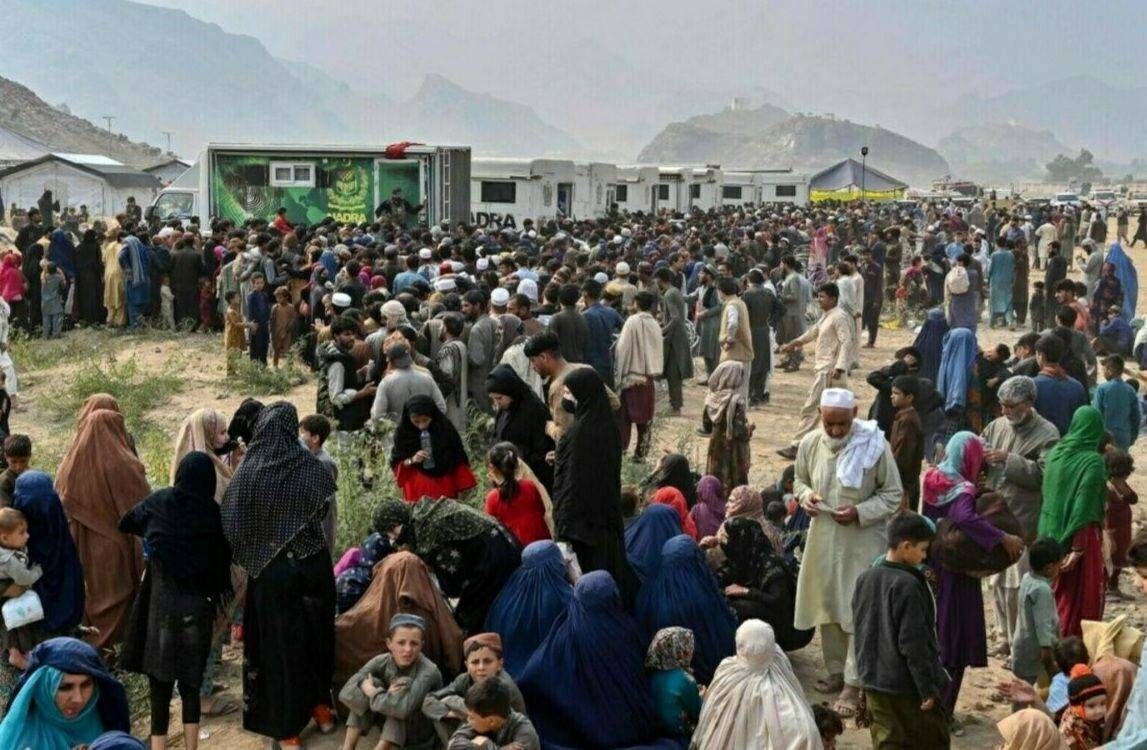
TEHRAN – In the first nine months of 2025, more than 1.7 million Afghan refugees have returned from Iran to Afghanistan, the United Nations High Commissioner for Refugees (UNHCR) reported in a press release on October 27.
Returns to Afghanistan continue at Dogharon, with early biometric enrolment underway: During the reporting week, nearly 120 buses carrying an estimated 4,700 returnees crossed the border, alongside 18 voluntary returns under the Voluntary Repatriation (VolRep) program.
Following the headcount slip expiry on 20 March 2025, the Government of Iran launched a regularization/return scheme for the two million affected Afghans. Slip holders must undergo government assessments to determine whether they are allowed to remain.
Daily returns rose sharply in mid-June, with July 4 registering over 39,400 returns in a single day. Since then, the trend has declined.
Between October 19 to 25, the average daily returns were 2,800, representing a four percent decrease compared to the 2,900 in the previous week. Nevertheless, the current level remains above the first quarter of 2025, when the daily average was approximately 2,300.
As of 25 October, over 1.5 million Afghans returned from Iran since March 20, and over 1.7 million since the beginning of the year, bringing the total returns from both Iran and Pakistan in 2025 to some 2.3 million.
UNHCR reiterates concern that many Afghans —regardless of status—face serious protection risks in Afghanistan due to the current human rights situation, especially women and girls.
Returns by documentation status
From October 19 to 25, headcounted slip holders made up 19 percent of total returnees, with 16 percent of total deportees being headcounted slip holders. Looking at the broader period since March 20, approximately 53 percent of total returnees and 50 percent of total deportees are headcount slip holders.
Monthly deportations in 2025
July 2025 recorded the highest monthly deportation figures in the past three years, with a total of 373,000 individuals deported.
During the reporting period from September 19 to 25, over 13,400 individuals were deported, 47 percent of whom crossed through the Islam Qala border point and 53 percent through the Zaranj border point. The proportion of deportees out of the total returns in the reporting week was 17 percent.
Return profiles (since March 20)
Since the beginning of 2025, there have been significant shifts in the proportion of returnees traveling as families rather than individuals.
The percentage of family returns rose substantially from 14 percent in Q1 to 41 percent between April and 12 June. During the conflict period from June 13 to 24, family returns increased sharply to 62 percent, continuing to rise to 80 percent after the ceasefire on June 25. In October, 21 percent of returnees were travelling as families.
Returns assisted by UNHCR Afghanistan
UNHCR Afghanistan has scaled up its response capacity at the Islam Qala and the Zaranj border crossings. The first line protection and humanitarian response delivered by UNHCR teams includes protection assistance, referrals to specialized services, transportation, and core relief items. Cash assistance is also provided by UNHCR’s supplier HesabPay, ensuring that returnees can access emergency cash assistance immediately on arrival, and avoiding the need to travel to the nearest UNHCR encashment Centers.
In addition to the cash assistance, UNHCR supports the returnees with emergency relief items including blankets, plastic sheet, kitchen set, jerry cans, hygiene kits, and hot meals in Islam Qala. From 27 June to 15 September, over 25,900 returning households covering 181,200 Afghan returnees were supported with Core Relief Items (CRIs), and 165,600 received hot meals. Some 30,100 returnees were assisted with transportation from Islam Qala and Zaranj to the main provinces of return.
According to the report, Afghanistan is facing a deepening humanitarian crisis, fuelled by a deteriorating human rights situation, prolonged economic hardship, recurring natural disasters, and limited access to critical services. The large-scale return of 2.3 million Afghans from Iran and Pakistan in 2025 has further strained resources.
The recent earthquakes in eastern Afghanistan have compounded vulnerabilities. An estimated 498,800 people are in need of humanitarian assistance. In response, the OCHA-led multi-sectoral Eastern Region Earthquake Response Plan was launched, targeting around 456,000 people in high-intensity impact areas, particularly those whose homes were severely damaged or destroyed.
Some 139.6 million dollars is required to deliver life-saving assistance over the next four months (September–December 2025). As part of the inter-agency response, UNHCR has prioritized three key areas based on identified needs: needs assessments to guide interventions, emergency shelter and essential items, and protection support for the most vulnerable, including recent returnees.
Global investment essential for sustainable return of refugees
Iran’s UN envoy to Geneva, Ali Bahreini, has called for the international community’s investment in infrastructure, employment, education, and other services to improve conditions in Afghanistan for the sustainable return of refugees to their home countries.
Addressing the 116th Session of the Council of the International Organization for Migration (IOM) on Wednesday, the official said, “Forced displacement has increased due to conflicts and increasing global instability.”
However, “the severe pressure on host communities and the lack of international aid have made it impossible for this situation to continue indefinitely,” Bahreini made the remarks in reference to Iran’s generous hosting of millions of Afghan citizens for more than four decades, despite unlawful sanctions, IRNA reported.
Highlighting that “Iran reserves its sovereign right to return unauthorized nationals,” the representative also urged senior IOM officials to pay a visit to Iran’s border areas to get first-hand information and find real common solutions.
The latest global migration developments, as well as policies and cooperation for effective management of international migration, were discussed in the IOM meeting.
IOM lauds Iran’s services to Afghan refugees
In October, the Senior Advisor to the Director-General of the IOM, Kim Eling, appreciated the efforts of the country in hosting and providing services to Afghan refugees.
Commending the country’s efforts in hosting Afghan nationals, Eling said that the reduction in the amount of aid from donor countries is the main challenge for the United Nations in advancing projects.
The Iranian official, for his part, underlined that “despite unilateral coercive sanctions, Iran has provided significant services to foreign nationals.”
Iran hopes donor countries carry their share of responsibility by allocating appropriate aid to projects being implemented in the country, the official added.
Delivering a lecture, meeting the High Commissioner for Refugees, Filippo Grandi, as well as the Special Representative of the United Nations Secretary-General (SRSG) for Disaster Risk Reduction, Kamal Kishore, are among other plans for the Iranian official.
The Executive Committee of the High Commissioner’s Program (ExCom) meets in Geneva annually to review and approve the agency’s programs and budget, advise on international protection, and discuss a range of other issues with UNHCR and intergovernmental and non-governmental partners.
MT/MG
Disclaimer : This story is auto aggregated by a computer programme and has not been created or edited by DOWNTHENEWS. Publisher: tehrantimes.com








