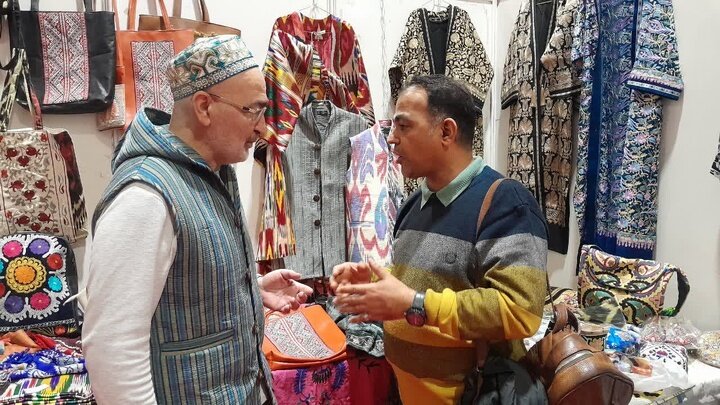
TEHRAN – Uzbek artist and carpet researcher Farrokh Manhal said on Thursday that deep historical and cultural links between Iran and Uzbekistan provide a strategic basis for expanding cultural diplomacy and markets for Iranian handicrafts in Central Asia.
Speaking on the sidelines of the 17th International Festival of Tribal Culture in Iran’s Golestan province, Manhal said that in Uzbekistan, Iranian identity is widely viewed as a shared historical root rather than a foreign affiliation, creating strong public receptivity to Iranian culture, Miras Aria reported.
Manhal underlined that he has consistently observed respect and interest toward Iranians, adding that many Uzbeks consider cultural ties with Iran an integral part of their historical identity.
He pointed to Uzbekistan’s position as a major global producer of cotton and silk, saying this has underpinned long-standing traditions in textiles and weaving. He cited atlas fabrics, velvet, and silk embroidery as prominent products, noting that silk needlework in Uzbekistan is produced using natural dyes and high-quality techniques.
Manhal added that traditional arts such as woodturning, traditional furniture making, miniature painting, calligraphy, and gold and silver jewelry in Uzbekistan have been influenced by Iranian artistic schools and reflect a shared civilizational background.
He then highlighted the historical role of cities including Samarkand, Bukhara, Khiva and Kokand as centers of Iranian settlement and culture, and said dynasties such as the Seljuks, Khwarazmshahs and Timurids emerged from the same civilizational geography.
According to Manhal, recent years have seen fewer barriers to cultural exchanges, with eased visa procedures and joint exhibitions enabling greater participation by Iranian artists in Uzbek cities, supporting broader cultural and economic ties.
He said that at recent exhibitions, Uzbek artists were more often buyers of Iranian handicrafts than sellers, indicating strong demand and market potential for Iranian products.
Manhal also pointed to cultural and linguistic affinities between Iran’s Golestan province and parts of Uzbekistan, particularly similarities between Turkmen Sahra and the Khorezm region, which he said could support cooperation in cultural and sporting exchanges.
He added that longstanding professional contacts with the head of Uzbekistan’s handicrafts organization have contributed to closer institutional cooperation with Iran’s Ministry of Cultural Heritage, Tourism and Handicrafts. Under a recent protocol, he said, Uzbek authorities have prioritized the use of Iranian specialists in historical restoration projects, citing shared architectural and cultural foundations.
The festival was held from Dec. 16 to 19, with participants from Iran and abroad, including Kazakhstan, Uzbekistan and Tajikistan.
AM
Disclaimer : This story is auto aggregated by a computer programme and has not been created or edited by DOWNTHENEWS. Publisher: tehrantimes.com