The Wallabies’ recent tour of Europe may have been a bust as far as on-field results, but a friendly meeting between the team’s star players and some heavyweight young talent at a freezing training session in Paris may still see the tour bear fruit for Australian rugby in the long-term.
With the temperature gauge nudging zero degrees, a Wallabies training session at the Institut National du Sport in Bois de Vincennes was attended by six young guests, who’d been invited as part of a wider Rugby Australia strategy to strengthen connections to Australia’s diaspora of players spread around the globe.
Those players come in all shapes and sizes, but most of the Parisian onlookers were of the same giant ilk. Puffer jackets only accentuated the already giant dimensions of a quartet who later posed with Joseph Aukuso-Suaalii and captain Harry Wilson for a picture: Braxton Asi (Stade Francais), PJ Poutasi (Montpellier), Ave Ma’alo (Lyon) and Lehopa Leota (Racing 92).
Aged between 19 and 22 and weighing between 125kg and 143kg, all four are props who have moved to Europe to join academies of major French club teams. And these ‘lost boys’ are far from alone.
A group of 30 Australians who emerged in schools and junior rep pathways in Sydney and Brisbane can now be found in France, where they have been recruited to play in the under 21 “Espoirs” competition. (The Espoirs comp also allow for four u/23 players on the field).
There has never been a bigger group of young Australian talent housed in French academies, and they now represent almost a third of the approximate 90 Aussies playing rugby offshore.
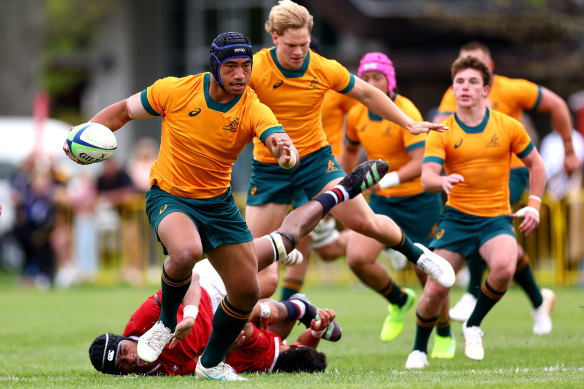
Heinz Lemoto on the charge against New Zealand for the Australia under 18sCredit: Getty Images for Rugby Australia
It was these well-funded academies of major French clubs that made headlines this year by poaching outstanding cross-code star Heinz Lemoto (Toulouse), and giant 17-year-old prop Sio Kite (La Rochelle).
Ten others also played for Australia at a junior age group level, and though many of the 30 weren’t first-choice stars of junior rep teams, their vast physical dimensions still made them targets of French clubs: over half of the group are tight forwards.
And though still housed in academies, several of the youngsters have already debuted in the prestigious Top 14 competition. Asi, Ma’alo and Leota – all tighthead props – have played several games in European rugby, and 23-year-old former Trinity College front-rower Malachi Hawkes is at star-studded Toulouse.
Why are they there? The biggest factor, both push and pull, is a rule in French rugby where players earn “JIFF” status (Joueurs Issus des Filières de Formation) by spending three years in the academy system of a club.
An overseas player with JIFF status is highly valued by the clubs, therefore, because they are not counted as a “foreign player” in multi-layered French pro rugby, where there are restrictions of how many overseas players can be at a club. JIFF status is for life, too, and not extinguished by departing or playing Test rugby elsewhere.
So with an increasing number of youngsters heading to France, RA are responding – some would argue belatedly – by formalising a system of ongoing connection to all the departed talent with the ultimate goal of bringing them home. It had been done before but in a more ad-hoc manner.
Hence the sideline snaps in frigid Paris.
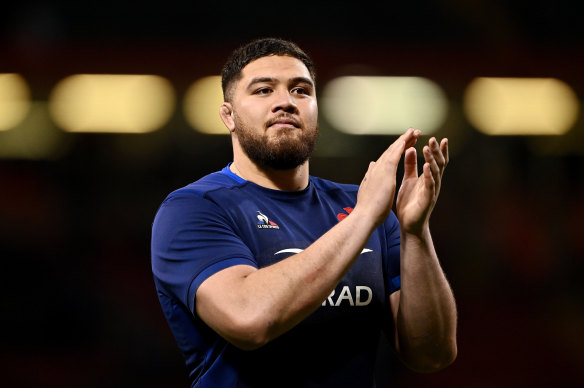
French forward Emmanuel Meafou, who hails from Sydney.Credit: Getty
“The key thing for us is that whilst we do quite a lot of the heavy lifting and the development of players through Super Rugby clubs and our pathway programs, they can exit early, and so we don’t see that fundamental development phase from 18 – even down to 16 – through to 23,” Rugby Australia high-performance boss Peter Horne explains.
“So there’s a real need for us to reconnect. A lot of these kids are only eligible for Australia. It’s just that they happen to have exited out of Australia at a stage where we might have had them in the formative years, but so we need to stay connected.
“I think a lot of the players do want to come home at some stage, or play for Australia, it’s just that they took a different journey.
“So it’s just really staying involved, not only just showing that they’re important, and that as Australians there’s an opportunity, but when they’re ready, to genuinely have discussions around them returning, and working with our Super clubs to look at availability and to connect with them.”
While former “Espoirs” players like NSW lock Miles Amatosero returned from Clermont to pursue a Wallabies dream, others famously have not, due to the lure of superior salaries and/or the chance to play for France.
Giant Sydney-raised lock Manny Meafou “felt let down” by a lack of opportunity in Australian rugby and elected to stay and declare eligibility for Les Bleus via five-years of residency. The 142kg lock is now a starter in the France national side.
Hawkes is in the danger zone for Australian rugby. The versatile hooker and prop, who played for the Sylvania Bulldogs, Trinity and Australian schools before moving to France in 2020, was pursued by RA earlier this year to come home but re-signed with Toulouse until 2027, and became eligible for Les Bleus this year.
The 23-year-old was unable to attend Wallabies training in Paris due to club training, so Horne flew to Toulouse for a day instead. Horne also watched Leota, who is a giant tighthead prop at Racing 92 and has drawn comparisons with his now club teammate in Paris, Taniela Tupou.
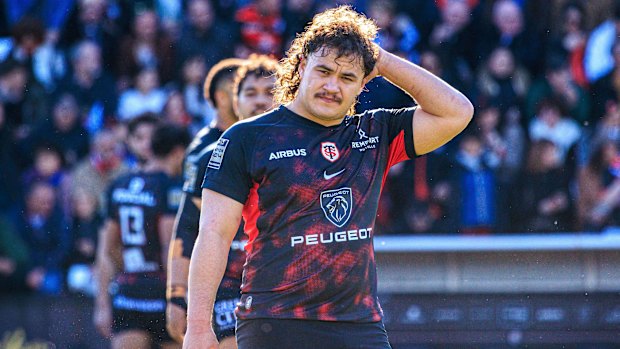
Former Sylvania Bulldog Malachi Hawkes playing for Toulouse in the Top 14.Credit: Alamy Stock Photo
Four locks are 196cm or taller, including two – Ted Condon and Aiden Stait – who are both 203cm and 130kg-plus.
“The reality is many of them have a certain somatotype [body shape] that the French love, in which big is great, and even bigger is better,” Horne said.
“We have a number of our players that we try to retain, but it’s hard to retain everyone in a certain group. And they do go early. So the idea is to keep them tagged. They’re really getting put into pro rugby pretty early, so they’re actually becoming quite exposed to the high end of the game.
“We obviously do need the Will Skeltons of the world, and everyone’s journey is slightly different, and we want to make sure that if you’re Australian, you’re interested and you want to play in Super Rugby, you want to go home or you’ve got an aspiration to play in a gold jersey, then we stay in contact.”
While the departure of young, talented ‘bigs’ sparks an instinctive concern, some argue the situation is not to be feared and can provide a massive benefit for Australian rugby if handled well. At no cost to RA and Super clubs, young tight forwards (who would otherwise be part-timers in Super academies and playing club colts or grade in Australia) can spend three years being developed in French rugby, where scrummaging and forward play are key tenets of faith.
Tighthead props are so valued in France, they’re often among the highest-paid players at a club.
But 130kg front rowers don’t grow on trees in Australia, and prop depth at elite level is already shallow. So the obvious key is RA not losing them for good, and thus the increased time and investment being put into the connection strategy. Game vision of all players is also collated and analysed.
The other upside of a rising superstar like Lemoto being in France is it meant he stayed in rugby, and did not take up one of several contract offers in the NRL.
‘We obviously do need the Will Skeltons of the world.’
RA high performance boss Peter Horne
The 18-year-old had not yet travelled to France by the time the Wallabies were in town but RA are keen to keep the Australian under-18 star under the wing. Some bullishly argue Lemoto is good enough for incoming Test coach Les Kiss to pick the explosive 109kg back-rower next year, which would capture him as a Wallaby and fend off rivals.
Horne said they are considering picking the outstanding No.8 from Toulouse for the Junior Wallabies (which is not a capture team) in the World Rugby Under-20 Championships in Georgia next year. But that’s a thorny issue, given it could further encourage others to take the French option too.
“You’d take that into consideration and whether we want to do that or not, but there are some players that are generational talent,” Horne said.
Along with Schmidt and former Fiji coach Simon Raiwalui, Junior Wallabies coach Chris Whitaker is part of a group of French-speaking Australian rugby figures who have played and coached in French rugby, and will look to serve as mentors to the rookies – and pros as well.
“It’s super important,” Whitaker says. “Heinz is obviously an extremely high-quality player, and there are lots of other talented young boys over there.
“It’s tough for an 18/19-year-old guy to move to another country, and they probably don’t speak the language and it may be all a bit overwhelming. We are there to help them with whatever they may need around their clubs or whatever, just be someone they can turn to.”
Whitaker would naturally love to have a player like Lemoto, and probably a few big other big boppers, too. But he is also wary.
“You have to be careful about that, I guess,” he said. “There are some talented players but at the same time you don’t want to disadvantage or dissuade in any way the kids who are staying and doing their development at home in the Australian system.”
RA produce weekly reports and analysis of the 30 Espoirs players, and indeed, all Australian players overseas.
Schmidt, Horne and even a holidaying Kiss also met with Australian players currently playing in the UK, like Josh Kemeny and James Ramm, to keep connected and discuss the prospect of returning home. There are also plans for further meetings with senior and academy players in France, Wales and England next year.
And so too the meetings that probably matter most – the ones with star Wallabies.
“Everyone has heroes, right? So the opportunity for some of those young guys to meet Wallabies like Harry and Joseph was great,” Horne said.
“That photo, there’s Harry and you’ve got another young Queenslander from Brothers, Braxton, to the right of him.
“They were such genuine kids, such good kids. They were really, really interested in engaging. And we want to make sure that’s a good experience for them.
“But we need to do it more collectively, and more often.”
Most Viewed in Sport
Disclaimer : This story is auto aggregated by a computer programme and has not been created or edited by DOWNTHENEWS. Publisher: www.smh.com.au