On an unseasonably mild winter’s day, people are gathering at Le Piétonnier, the pedestrian zone in the heart of Brussels. Tourists buy mulled wine and churros at the Christmas market outside the Bourse, the old stock exchange, now repurposed as a beer museum. A few people drink coffee on cafe terraces. Up and down the length of the 650-metre-long space, people come and go, bikes and scooters weaving in and out of the crowds.
Next year, this scene will look somewhat different: bikes and scooters will be banned from this 18,000-sq-metre pedestrian zone for most of the day. People on two wheels will be allowed to ride only between 4am and 11am. At all other times, they must dismount and push their vehicle up the street, or face a fine.
Anaïs Maes, the city counsellor in charge of urban planning and mobility, suggested not all cyclists obeyed the existing 6km speed limit. “In everyday reality, people do not respect that rule or don’t know it, and so it creates conflicts.”
Maes, a member of the Dutch-speaking socialist Voorhuit party, is aware of “small accidents” and complaints from pedestrians. “I’ve heard multiple persons say, especially older persons or persons with little kids, or persons with reduced mobility, [that] they don’t feel safe, because they live in fear of not being able to step aside quickly enough or being hit.”
Brussels officials have not decided exactly when the change will enter into force, as negotiations within the council over implementation are ongoing.
In a sense, the Brussels Piétonnier is a victim of its own success. Extended a decade ago to make the city greener, calmer and cleaner, it transformed a swathe of the centre from a traffic-clogged, four-lane road into a place for walkers, strollers and cyclists, revitalising cafe terraces and open-air gatherings. It was a transformative shift for a city that had long suffered from its mid-20th-century love affair with the car.
For instance, the Grand-Place, the magnificent central square, with intricate, gold-leaf-adorned guildhalls and gothic city hall, was effectively a car park until 1972 and traffic was not banned entirely from the square and its cobbled environs until 1991.
The decision to extend the pedestrian zone in 2015, by banning cars from a large shopping area around Place de La Bourse was controversial initially. Maes, who was not on the council at the time, said idealistic planners believed that pedestrians and cyclists could share the space. “The city of Brussels had this idea: we were creating a space that’s multimodal and everyone will find their place; I think it is sad but in reality it doesn’t always work and then you have to find solutions.”
Danielle Peeters, a cyclist, who works at a Dutch-language association, thinks the ban is a shame. “I think it is a little radical,” she says, having just parked her bike outside a ramen bar. “When there are a lot of people, obviously I slow down, but there are some people who cycle very, very quickly.”
“Alex”, a 43-year old mountain climbing guide from Ukraine, who works as a takeaway courier and gave a pseudonym, says it will cause him difficulties because he will not be able to pick up deliveries, although referencing war in Ukraine, he said there were bigger problems. “For me it’s not a big issue, but they could have done a better job painting pathways for bikes.”
That is the point for local cycling safety groups. The conflict between cyclists and pedestrians, some say, was a story foretold in the decision not to create a dedicated bike lane.
An open letter by a dozen cyclist and road-safety groups published in December denounced the ban as “dangerous and absurd”, arguing that the city’s proposed alternative route for cyclists – three streets running parallel to the pedestrian zone – was not safe.
On this alternative route, bikes share the busy roads with cars, buses and coaches; cycle groups say there are many blind spots and drivers, who flout the ban on overtaking cyclists.
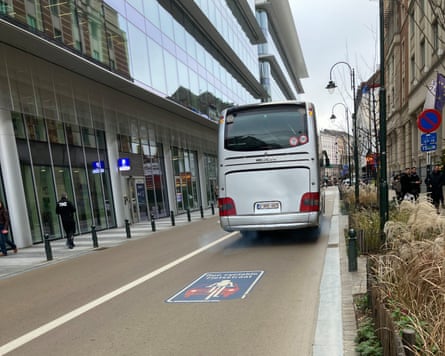
Bernards Heymans, the president of Heroes for Zero, a grassroots road safety movement, said the proposed alternative route was “not comfortable” and even dangerous, especially for child cyclists.
“If cyclists are banned on the Piétonnier, then we would really like a real second way to access the city centre for cyclists,” he said. “If we find a second way that is totally secure, of course, everybody will go through the second way.”
Maes does not think a separate bike lane in the pedestrian zone is the answer. “It doesn’t increase safety, because when every mode has its own designated space [cyclists] go faster,” which can also create conflicts with pedestrians crossing that lane, she said.
She was working hard, she said, to create a safe alternative route: “We are trying to solve a mobility-safety issue, but what I do not want to do is to create a bigger problem.”
Disclaimer : This story is auto aggregated by a computer programme and has not been created or edited by DOWNTHENEWS. Publisher: theguardian.com