In 2024, St George Christian School in south-west Sydney took a gamble. Caroline Lee, the head of its senior school, noticed her students were overly stressed and were submitting an increasing number of requests for disability provisions due to anxiety.
The school took a “pretty scary leap”, she admits, and overhauled its assessment structure.
It reduced the number of internal assessments from four to three, increasing the weighting of each but giving students a vital window of time to focus on their trial exams.
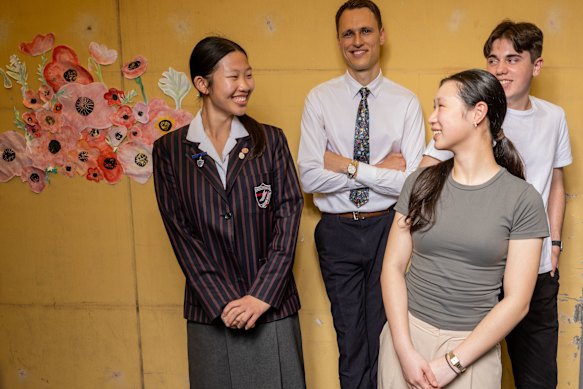
St George Christian School is a lower ICSEA school that punched above its weight in the HSC this year.Credit: Sam Mooy
“It was quite helpful,” said recent HSC graduate Vas Simmons.
Classmate Tiffany Du agreed, though she admitted to some initial nerves.
“All my other assessments were weighted so much higher and I had less of a chance to make an error,” she said.
“But it was a good change for my mental health, I was a lot less stressed, I was able to use this time more carefully.”
At St Narsai Assyrian Christian College in Horsley Park a similarly bold decision was made: the school removed all take-home assessments, replacing them with supervised written exams.
While their methods differed, the schools say the decisions were driven by knowing their students’ needs deeply.
And, for both schools, it paid off.
Each year the HSC school rankings are dominated by advantaged schools. But, despite being in the lowest and second-lowest socio-educational brackets, on Thursday it was revealed St George Christian School and St Narsai Assyrian Christian College had placed in the top 200.
The secret, according to teachers and students, is community. Both schools maintain relatively small class sizes that enable them to identify and remedy learning gaps.
There were just 73 year 12 students at St George, and 85 at St Narsai.
“Our school is pretty small … every teacher is able to develop a bond with their students,” said Tiffany, who received an ATAR of 98.85.
Vas agreed, adding that in larger schools, students can become “lost to parts of the system”, whereas at St George, “everyone knows you by name”.
St Narsai HSC graduate Mary Sada said it helped that many at the school are also from the same Assyrian community.
“We see each other at church, we see each other at Bible studies. We’re always in the same community so we start at the same schools and then we stay close for years, even after school,” Mary said.
This masthead analysed this year’s HSC data using the latest 2024 ICSEA scores – a measure of a school’s socio-educational advantage.
St Narsai, a co-educational independent school, recorded its best result in more than a decade, ranking 187th (up 37 places from the previous year) with a band 6 success rate of 10 per cent.
Their cohort outperformed partially selective public schools and prestigious high-fee schools including The McDonald College, Canberra Grammar School and Blue Mountains Grammar.
St Narsai had particular success in society and culture (where 35 per cent of students achieved top band marks), ancient history (20 per cent) and business studies (18 per cent).
Principal Edwar Dinkha said the school systematically reviews student performance data to “remedy any gaps” but credited the culture for the ultimate success.
“The leadership team in the college have been very deliberate in creating an environment where people thrive – students and staff,” Dinkha said.
He said that staff enjoy significant autonomy and even have a staff room equipped with table tennis and foosball.
“During the day it is very normal to find teachers playing … The principal will not interrupt. In fact, I might play with them,” he said.

Recent St Narsai HSC graduates Stavro Ablaha and Mary Sada said the school was close-knit, helping them achieve strong results.Credit: Andrew Quilty
St George Christian School recorded its second-best success rate in the past decade, with 17.3 per cent of students getting top marks, ranking 107th overall and 36th among all private schools, making it the best-performing school in the second-lowest ICSEA band.
One in three students scored an ATAR above 90. The majority of music students achieved a band 6, while 11 students got a band 6 in advanced maths.
Tiffany said it was because the school ran an accelerated maths program.
“We had seven people in our accelerated class, our maths teacher wrote weekly quizzes for us and every week he would mark it. You don’t get that normally when your class is around 40 to 50 people,” she said.
Read more of our HSC coverage
Most Viewed in National
Disclaimer : This story is auto aggregated by a computer programme and has not been created or edited by DOWNTHENEWS. Publisher: www.smh.com.au