Imagine stepping into a space where numbers seem to dance, shapes whirl with energy, and patterns greet you like old friends — a joyful way to celebrate National Mathematics Day on 22 December 2025.
For many of us, the subject didn’t start that way. It arrived with tests, formulas, and the pressure to get every answer right.
Math itself isn’t born frightening; it becomes so with drills and pressure.
But what if we returned to its playful roots? What if equations lived in movement, colour and curiosity? And could be felt alive in games, sculptures, music and the world around us.
That’s exactly the magic of the Agastya Foundation’s Ramanujan Math Park, where the fear of math melts into wonder.
A park built on curiosity
Ramanujan Math Park is nestled within Agastya’s 172-acre ‘Campus Creativity Lab’ in Kuppam, Andhra Pradesh, a sprawling rural campus dedicated to hands-on creative education.
Named after the Bhāratiya genius Srinivasa Ramanujan, who continues to inspire countless young minds, at the park, his legacy becomes a living experience for children.
Inaugurated on 22 December 2017, Ramanujan’s birthday, which is also celebrated across India as National Mathematics Day, the park was conceived with love, vision and deep commitment by mathematician-communicator V S S. Sastry, along with philanthropist-mathematician couple Sujatha Ramdorai and Srinivasan Ramdorai.
Ramanujan Math Park is not a conventional classroom with rows of desks and daunting blackboards; instead, it’s a vibrant world with outdoor installations, indoor labs, life-sized mathematical models, games and interactive digital exhibits where children can explore, experiment, and discover the joy of mathematics at their own pace.
The aim is to show that maths isn’t confined to concerns like scores and exams — it’s a living thread woven into art, architecture, music, and nature.
What happens inside the park
Imagine walking through a part of the campus where geometry isn’t jotted down but shaped into 3D solids you can hold. In this park, fractions become tangible with ‘fraction slabs,’ and the Pythagorean theorem springs to life on the ground.
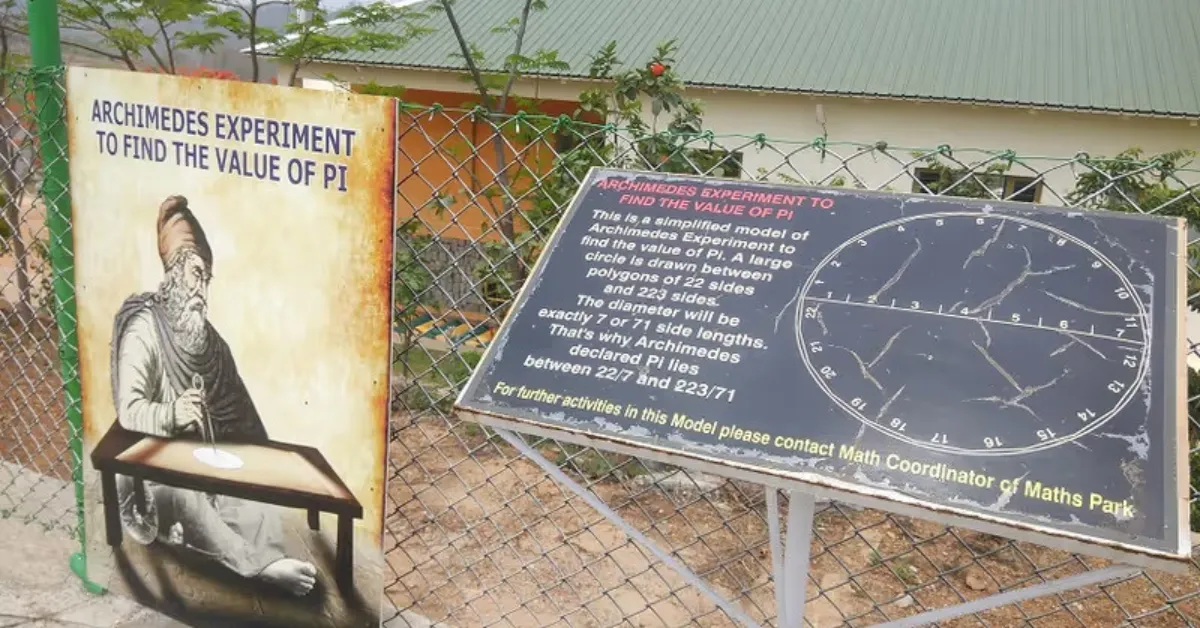
Where a tesseract (four-dimensional cube) or a circle explaining the ratio π isn’t something abstract, but a discovery you can walk around and inspect.
/filters:format(webp)/english-betterindia/media/media_files/2025/12/14/ramanujan-maths-park-2025-12-14-18-01-46.png)
There are touch-screen stations, too — rooms packed with digital exhibits of geometric patterns, optical illusions, and fun mathematical puzzles that draw kids in, urging them to explore and try things out for themselves.
The Ramanujan Park invites children to play, experiment, question, and learn. The ‘fear of math’ that many carry from early school experiences begins to melt away. Instead, there’s excitement, pride, and a sense of discovery.
For many children, especially those from underprivileged rural backgrounds, this isn’t just about better test scores — it’s about opening a door to a world that once seemed closed or alien.
The park doesn’t try to replace traditional classrooms — instead, it breathes wonder into them. It gives children a space where lessons leave the blackboard and become something they can touch, build, and question.
Teachers, too, find themselves transformed here. No longer the sole voice in the room, they become facilitators of discovery — guiding discussions, nudging curiosity, and helping students see how the math they learn in class quietly shapes the world around them.
In this space, learning becomes a shared journey, not a one-way lecture; a community experience rather than rote memorisation.
Where one park inspires a bigger change
Ramanujan Math Park is part of the broader ethos of Agastya International Foundation, which has pioneered experiential education across India.
Over the years, Agastya’s mobile labs, night-school volunteers, science centres and creativity camps have brought science and maths to millions of children and thousands of teachers — urban and rural, underprivileged and mainstream alike.
More than just a ‘math museum,’ the park stands as a proof point: mathematics can be beautiful, immersive, communal — something to enjoy, not fear.
This math park transforms every equation into an adventure waiting to be solved.
Why this matters — for kids, communities, and the future
In a country where math anxiety is all too common, where thousands of children shy away from arithmetic, algebra or geometry because of early bad experiences, the Ramanujan Park offers a fresh beginning.
Here, numbers are not obstacles instead, they are puzzles, stories, shapes, patterns and games.
For a child to enter the park and leave smiling, maybe after building a geometrical shape, or solving a puzzle, or simply exploring a digital exhibit is to change the narrative of what math can be.
It builds confidence, curiosity, and often friendship among children and educators alike.
/filters:format(webp)/english-betterindia/media/media_files/2025/12/14/ramanujan-maths-park-2025-12-14-18-06-33.png)
When children see that math connects to music, art, architecture, and nature, their world becomes bigger and richer.
And for a society hungry to nurture logical thinking, creativity, and a love for learning, this shift from fear to fun could make all the difference.
The story of the Ramanujan Maths Park shows us that the simplest shift from chalk and blackboard to hands-on play and exploration can turn dread into delight.
It’s a gentle revolution in how we view mathematics: not as a hurdle to pass, but a world to explore. And for the kids who walk through its gates, this might just be where they fall in love with numbers.
Location and how to reach the park
The park is part of the Agastya International Foundation campus in Kuppam, Chittoor district, Andhra Pradesh.
How to Reach:
By Air: The nearest major airports are Bengaluru International Airport (BLR) or Chennai International Airport (MAA). From there, you would need to take a taxi or bus to Kuppam.
By Train:Kuppam has its own railway station (Kuppam Station, KPN) with connections to major cities like Bengaluru and Chennai.
By Road:The campus is accessible by road via national and state highways. It is approximately 100 km from Bengaluru and around 250 km from Chennai.
Entry Fees and timing
Visiting hours at Ramanujan Math Park are mostly by prior appointment, as the campus hosts structured school programs and workshops.
Entry is free for registered school groups, though visitors are encouraged to contact the Foundation for confirmation and any nominal charges.
For further details, call: 80 4112 4132 (Agastya Foundation Bangalore); Visit: agastya.org
Or Email: [email protected].
Sources:
‘Campus At A Glance Part 4: Embodying Ramanujan’ by Agastya Foundation.
Disclaimer : This story is auto aggregated by a computer programme and has not been created or edited by DOWNTHENEWS. Publisher: thebetterindia.com