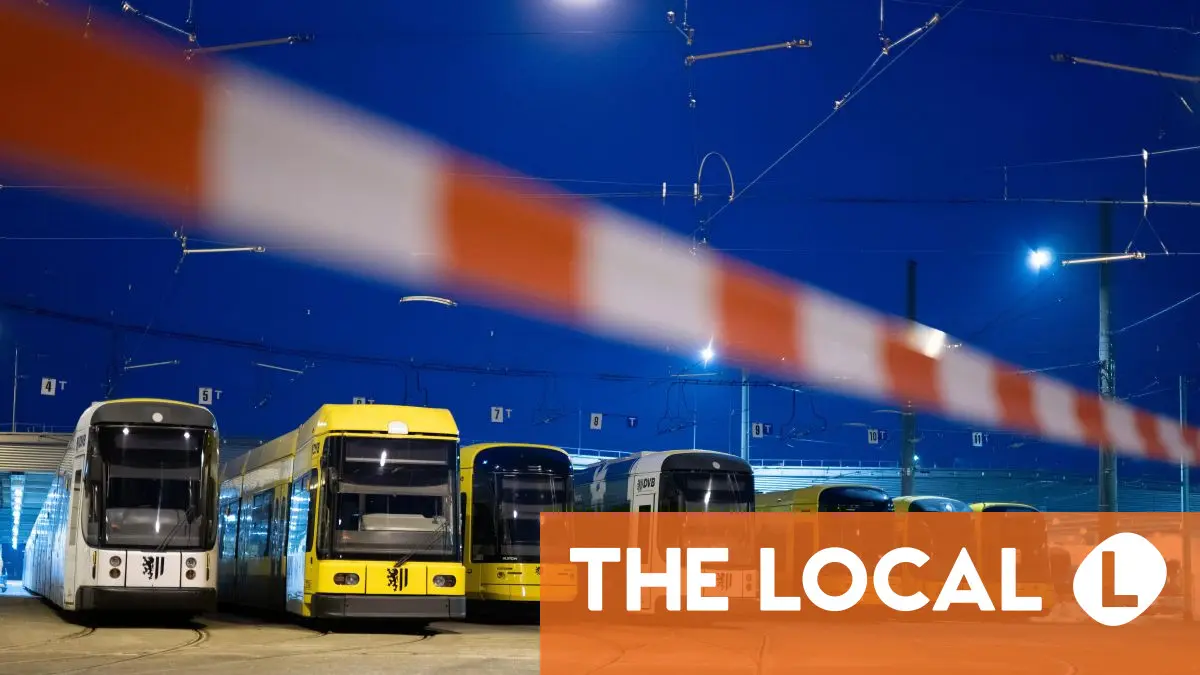
Public transport was severely disrupted across Germany on Monday as a large-scale warning strike brought buses, trams and underground lines in many regions to a halt. Here’s where passengers are most affected.
Local public transport came to a near standstill in much of Germany on Monday, after trade union Verdi called for warning strikes at around 150 municipal transport companies.
According to the union, almost all federal states are affected, with only Lower Saxony excluded due to an existing deal that covers around 5,000 employees.
The walkout began in the early hours, with the first depots closing from 3am on Monday morning. The strike action is expected to come to an end 24 hours later at 3am on Tuesday.
Millions of commuters faced difficult journeys – made worse by forecasts of freezing rain and icy roads in several regions.
Which transport is still running?
Several services are not involved in the strike, including:
- Deutsche Bahn’s regional (RE) and long-distance trains (IC, EC and ICE)
- S-Bahn networks in Berlin, Hamburg, Munich, Stuttgart, Cologne, Nuremberg and the Rhine-Main region
- Private bus subcontractors
- HADAG ferries in Hamburg
Where local transport is not running on Monday
The scale of disruption varies across Germany, with major cities and transport hubs likely to experience the most severe effects.
The city states: Berlin, Hamburg and Bremen
According to Verdi, underground, bus and tram services in the city states of Berlin, Hamburg and Bremen were at a near standstill.
In Berlin, only the S-Bahn and a limited number of buses are operating. According to current plans, some trams are expected to continue running but without passengers to prevent overhead lines from freezing.
During the walkout, passengers should still be able to use Jelbi sharing services, as well as a number of bus routes run by external companies. These include:
106, 114, 118, 124, 133, 175, 184, 204, 234, 275, 316, 318, 326, 161, 363, N12, N23, N35, N39, N53, N61, N69, N84, N91, N95, N97.
In Hamburg, S-Bahn services and HADAG ferries were set to continue running.
Most vhh.mobility bus routes in Hamburg and neighbouring districts in Schleswig‑Holstein were affected, although the operator expected to maintain limited services on a few isolated lines, depending on staffing and local conditions.
The Ahrensburg and Bargteheide city transport services are expected to continue operating as normal. These services are run by the Ahrensburger Busbetriebsgesellschaft (ABG), which has its own collective agreement.
Bavaria
Munich, Nuremberg, Augsburg, Regensburg, Bamberg, Passau, Landshut and Schweinfurt are expected to see extensive service cancellations.
Bayreuth, Schwabach and Ingolstadt are also set to be affected to a lesser degree.
North Rhine-Westphalia
Most large municipal operators indicated they would participate in the strike – including those in Cologne, Düsseldorf, Duisburg, Dortmund, Oberhausen, Gelsenkirchen and Bielefeld.
Only a few providers, such as Aseag in Aachen, are not involved.
Baden-Württemberg
Cities such as Stuttgart, Karlsruhe, Heilbronn, Freiburg, Baden-Baden, Esslingen and Konstanz are set to experience significant disruptions, with buses and trams remaining in depots.
Hesse
Municipal transport employees in Frankfurt, Kassel, Wiesbaden, Gießen and Marburg joined the strike.
Rhineland-Palatinate
Mainz, Trier, Kaiserslautern and Pirmasens saw services suspended, with some cancellations beginning on Sunday evening.
Saarland
All Saarbahn and bus routes are cancelled. Demonstrations and a central rally were planned for Saarbrücken.
Saxony
Only the City-Bahn in Chemnitz is likely to continue running, with full-day strikes expected to hit Dresden, Leipzig and Zwickau.
Saxony-Anhalt
Buses and trams in Halle, Magdeburg and the Burgenlandkreis district are likely to be affected.
Thuringia
Operators in Erfurt, Jena, Gera, Weimar and several surrounding districts were set to take part.
Brandenburg
Sixteen municipal operators are participating, including those in Potsdam, Cottbus, Uckermark, Barnim, Oder-Spree and Dahme-Spreewald.
Mecklenburg-Western Pomerania
Up to 80 percent of buses and trams are not expected to operate on Monday in cities including Schwerin, Ludwigslust-Parchim, Rostock, Greifswald and Nordwestmecklenburg.
Lower Saxony
Lower Saxony is the only federal state unaffected, with all services expected to run as scheduled.
What commuters and parents need to know
German labour law places the “travel risk” on employees. Workers are therefore still expected to arrive at their workplace on time, even when public transport was disrupted.
Labour law specialists emphasised:
- Employees are not permitted to arrive late solely because buses or trams were cancelled.
- Working from home is only allowed if approved by the employer.
- Parents remain responsible for ensuring children reached school. A cancelled school bus does not exempt pupils from compulsory attendance.
Heavy traffic on the roads
The walkout coincided with icy weather in many parts of the country, expected to cause substantial congestion on roads and motorways.
Transport experts recommended avoiding peak times between 7–9am and 4–6pm, checking traffic conditions before travelling, and setting off earlier than usual.
What’s the strike about?
Verdi negotiators said the strike was intended to increase pressure around the an ongoing round of collective bargaining, in which employees are demanding on shorter working hours, longer rest periods and higher bonuses for night and weekend shifts.
Union representatives said that industrial action was necessary to push employers towards meaningful improvements. But many employers described the strike as disproportionate and the demands as excessive.
Disclaimer : This story is auto aggregated by a computer programme and has not been created or edited by DOWNTHENEWS. Publisher: thelocal.de