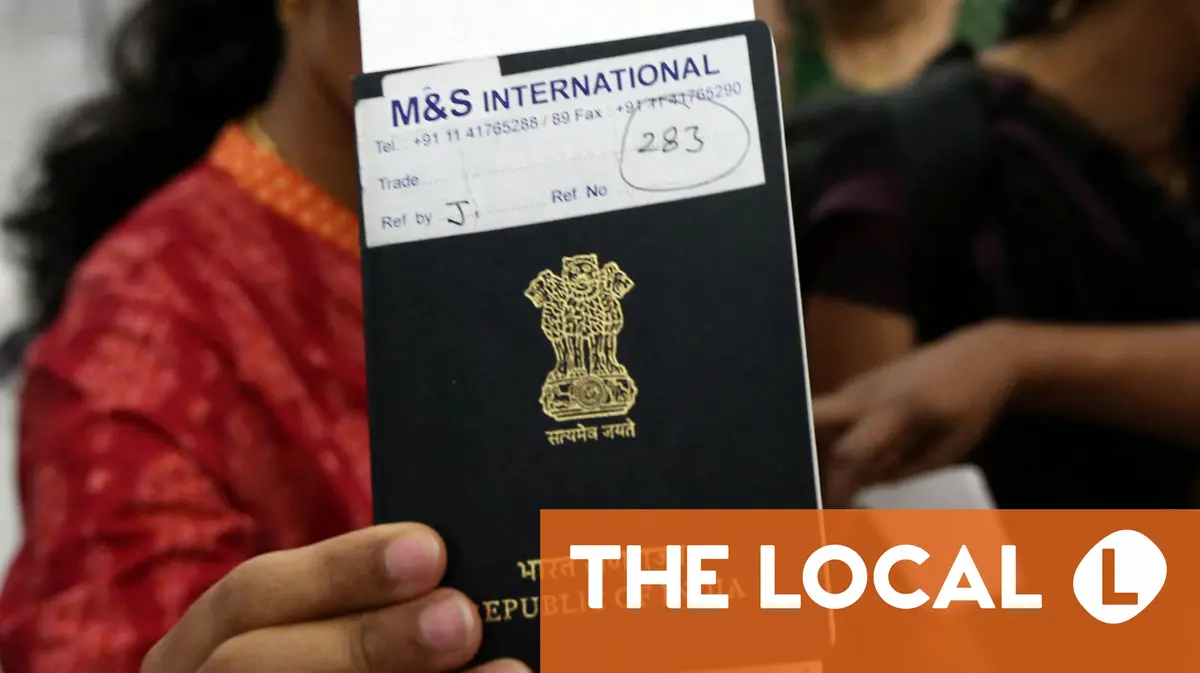
The EU hands out thousands of Blue Cards to highly-skilled third country nationals each year, according to the latest figures. But which nationalities receive the most and which EU country gives out the most?
In 2024, Indian nationals received the largest number of highly-qualified worker and researchers visas, according to the latest figures from Eurostat, the EU’s statistics office.
This trend looks likely to continue as the EU and India have recently adopted a free trade agreement including a ‘comprehensive framework of cooperation on mobility’ aiming to “facilitate the mobility of skilled workers, young professionals and seasonal works in shortage sectors, while promoting research and innovation”.
Blue Cards
In 2024, EU countries issued about 78,100 Blue Cards. Named to be the European version of the US Green Card, the blue cards can be obtained in all EU countries, except in Denmark and Ireland, which have opted out.
Blue Cards can be requested by non-EU citizens with a university degree or an equivalent qualification and who have a job offer and a salary meeting the threshold set by the EU country of expected residence. In addition to work and residence rights, they allow the holder to travel to other EU member states for up to 90 days in any 180-day period.
Indian citizens were granted the largest number of EU Blue Cards in 2024 (16,300), ahead of citizens of Russia (6,700, a number that declined from 9,500 in 2023), Türkiye (5,600) and China (4,600).
Almost 1,900 Blue Cards were issued to US citizens, just over 1,200 to Brits and almost 600 to Canadian nationals.
Germany issuing most Blue Cards
As in previous years, Germany issued the largest number of EU Blue Cards, more than half of the total (56,300), although there was a decline from 69,300 in 2023.
READ MORE: Why does Germany issue by far the most EU Blue Cards to skilled workers?
The large proportion compared to other EU countries has been partly attributed to the implementation, since 2023, of the Skilled Immigration Act, which expands the use of the EU Blue Card and makes it easier for qualified professionals from outside the EU to move to the country to address skill shortages.
In 2024, Germany notably issued 13,300 EU Blue Cards to Indian citizens, 4,500 to Turkish, 3,800 to Chinese, and 3,700 to Russian nationals.
As regards the total figures, Germany was followed by Poland (5,900), Hungary (2,900), France (2,800), and Spain (2,000). Austria issued 1,100 EU Blue Cards, Italy 600 and Sweden 62, all figures declining compared to the previous year.
Study and research
Eurostat data on highly qualified professionals also includes study and research permits, as well as visas for intra-corporate transferees, which refer to staff temporarily transferred from a company outside the EU to a branch in an EU country.
In 2024, EU countries issued 475,000 visas for study and research purposes. Germany issued the most (131,000), followed by France (118,000) and Spain (59,000), while Sweden issued 16,000, Austria, 8,200 and Italy 2,100.
The main recipients were again Indian nationals (53,000), followed by citizens of China (44,000), Morocco (23,000) and the United States (22,000).
The majority of Indian nationals studied in Germany (26,400), France (7,300), Sweden (2,500) and the Netherlands (2,300).
Some 21,700 US citizens were granted student and researcher permits, of which 7,400 were in France, 5,400 in Spain, 3,400 in Germany and 2,400 in the Netherlands.
UK nationals received 7,200 study and research visa, of which 2,100 were in France, 1,700 in Spain, and 800 in Germany.
For intra-corporate visas, the total in 2024 was just over 10,200, of which 2,400 issued by the Netherlands, 2,000 by Luxembourg, 1,800 by France, and 1,500 by Germany. Indian and Chinese nationals (3,300 and 2,200 respectively) made up for the majority of recipients.
Disclaimer : This story is auto aggregated by a computer programme and has not been created or edited by DOWNTHENEWS. Publisher: thelocal.de