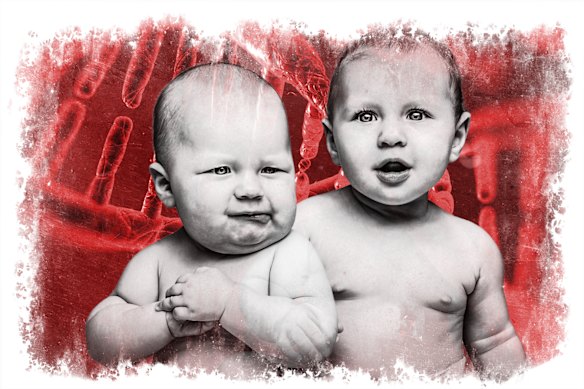

Australians are accessing a controversial technology that ranks embryos created during IVF based on disease risk and predicted traits such as intelligence, height and hair colour using a genetic testing method experts say is not ready for clinical use.
Screening embryos for such traits is a violation of the national guidelines for the use of assisted reproductive technology, but US companies offering the tests have begun exploring partnerships with Australian fertility clinics anyway, and Australian IVF patients can legally undergo the testing abroad.
The tests are called polygenic risk scores, where “polygenic” refers to traits or diseases influenced by multiple genes. The tests attempt to boil down thousands of genes into a number that represents an embryo’s future chance of developing a certain trait, such as high IQ, or diseases such as Alzheimer’s.
IVF patients can then use the predictions to decide which embryo to implant.
One of the companies offering the service, Nucleus Genomics, recently papered posters around New York spruiking slogans including “Have a smarter baby” and promoting a site that urges would-be parents to “preview” their future child.
The company offers a US$30,000 ($44,712) program that screens 20 embryos for 2000 traits and conditions including eye colour, risk of acne, left-handedness and baldness.
Clients are served a menu comparing their embryos’ predicted height, hair colour, IQ and risk of heart disease. Australians have expressed interest in working with Nucleus and the company is investigating ways to eventually offer their services locally, a spokesperson said, noting “under current regulation, there are limitations”.
Another company, Herasight, claimed in November it had developed the world’s most powerful genetic predictor of cognitive ability and could detect which embryos had higher IQs by up to 8.5 points.
An Australian couple working with Herasight overseas – who this masthead has agreed not to identify to protect their privacy – said they planned to have 10 children and would test between 60 and 80 embryos. Along with screening for breast cancer risk, they will prioritise the embryos deemed to have a better chance of good health and higher intelligence, in the hope it will make raising and homeschooling their many future children easier.
Many experts say the tests aren’t accurate enough to justify clinical use, however, and critics worry they mark a step towards “designer babies”, invoking the spectre of historical eugenics programs. Others argue that if we have the technology to choose smarter, healthier babies, it’s unethical not to use it.
The American Society for Reproductive Medicine said in December that the “nascent and unproven” method of testing embryos for polygenic disorders (called PGT-P) should not be offered to IVF patients because of ethical concerns and inaccuracy.
The Human Genetics Society of Australasia also opposes the use of polygenic scores during IVF.
“It’s just silly,” Associate Professor Alex Polyakov from the University of Melbourne, a fertility specialist who has analysed the scientific and ethical merits of the testing, said.
“I think the patients will be misled into believing that they’re making the right decision, when in actual fact, their decision will have very little impact on how the baby will grow up and what it will be.”
The testing can’t guarantee a certain level of IQ or height, he said, partly because DNA isn’t the only thing that governs the people we become.
Lifestyle factors such as diet, home life, stress, exposure to cigarette smoke and pollution exert an enormous influence on which genes are “turned on” or not. The powerful influence our environment exerts on gene expression is called “epigenetics”, and it’s something polygenic testing can’t account for.
The genetic databases the risk scores rely on are mostly from Europeans, so the tests are even less accurate – and for some traits, all but useless – for people of non-European ancestry.
Another risk is that one gene usually affects multiple traits. Selecting an embryo deemed more likely to achieve a high level of education may also increase the risk of bipolar disorder by 16 per cent, for example.
Peter Visscher, a professor of quantitative genetics at the University of Queensland, helped pioneer the science underpinning polygenic risk scores.
The tests are best used in the context of public health, he said, for example testing thousands of people for genetic risk of bowel cancer to identify the highest-scoring patients, who could then be screened for polyps more regularly.
“The power in this technology is because of the average,” Visscher said. If a thousand IVF patients used the tests to choose their “tallest” embryo, for example, the average height of that cohort of babies would probably be a few millimetres higher than normal.
“But for any particular individual or particular embryo, it is not very predictive. There is inherent variation that you’ll never capture … It’s always going to be a kind of probability,” he said.
“I’m not against the technology as such. If people want to do it, and it’s legal, and they can afford it, it’s fine with me. But I think the companies and the regulation should make it clear what it can and cannot deliver.”
Dr Jonathan Anomaly, communications director at Herasight, argued that accepted embryo tests – such as those that screen for the BRCA (BReast CAncer) gene mutations that increase a woman’s chance of developing breast cancer by 70 per cent – are also based on probability.
“All of medicine is probabilistic, including those tests considered clearly and unequivocally desirable,” he said.
“The only difference is, instead of testing for just chromosomal problems or single gene disorders, we test for polygenic traits and disorders, and those comprise the gigantic majority of diseases.”
Anomaly believes some experts oppose polygenic testing because they fear backlash in the media and academia. “People don’t want to express an opinion that they think will get them in trouble,” he said.
Globally, 12 babies have been born after they were analysed as embryos by Herasight.
The company stresses the scoring is based on probability and not a “magic bullet” that can prevent diseases such as cancer, Anomaly said, adding he often only recommends the testing to people with a high number of embryos (for better genetic variation) and a family history of disease.
“I think that people should be at liberty to choose between embryos. It really is a situation where, if you’re doing IVF, it’s quite literally a roll of the dice – or you can use information to guide your choice,” he said.
Beyond disease risk, screening embryos for other traits – especially cognitive ones – raises ethical problems, genetic statistician Professor Shai Carmi said.
“The main concern raised by researchers is that ‘optimisation’ of children (and particularly when done commercially, under marketing pressure) is overall not good for our society,” Carmi, from the Hebrew University of Jerusalem, said.
“It may worsen the way society treats those with ‘non-optimal’ traits. This frequently relates to the 20th century eugenics movement, where a similar way of thinking (‘improving the human gene pool’) ended up with the atrocities of the Nazis and forced sterilisations in many countries.”
Carmi co-led a 2019 study that found polygenic risk scoring could, at best, lead to a two to three point bump in IQ if you had between five and 10 embryos to choose from. He now believes an increase of four to five points may be possible after advances in genetic science in the years since; Herasight’s research (which hasn’t been peer-reviewed or published) claiming an 8.5 point improvement seemed reasonable but needed independent confirmation before it could be trusted, he said.
An average height gain of 3.5 centimetres was also theoretically possible in Europeans of perfect reproductive health, he said, but in practice these gains would probably be less impressive and subject to huge uncertainty.
Fertility specialist and University of Melbourne lecturer Dr Joseph Sgroi said he’d faced questions about polygenic testing from IVF patients.
“It is an exceptionally dangerous and slippery slope that we potentially find ourselves in, where we’re creating what we think is the ideal and perfect baby. The reality is in nature, there is variation, and that variation leads to the uniqueness and the wonderful tapestry of life,” he said.
“These are companies driven predominantly by profit and less by the general interests of humanity.”
Embryo testing can only be used to avoid genetic conditions and diseases that severely limit quality of life, under guidelines administered by the National Health and Medical Research Council.
Some embryos are checked for extra or missing chromosomes, or screened for diseases caused by a single gene, such as cystic fibrosis.
Clinics can also only offer treatments proven to be effective, a spokesperson for the Fertility Society of Australia’s Reproductive Technology Accreditation Committee said.
“As PGT-P is currently unproven, it should not be offered to patients in clinical practice,” the spokesperson said.
The Australian client of Herasight said it was a double standard to allow BRCA testing but not polygenic risk scoring, and argued the current rules violate rights to medical data and undermine parental freedom over family planning.
“It would be much easier and cheaper if we could use a local clinic with all the comforts of home. Instead, we have to travel overseas for IVF, which is complex and expensive to organise,” they said.
“The government shouldn’t have any say in how you have children.”
The Examine newsletter explains and analyses science with a rigorous focus on the evidence. Sign up to get it each week.
 Angus Dalton is the science reporter for The Sydney Morning Herald.Connect via X or email.
From our partners
Disclaimer : This story is auto aggregated by a computer programme and has not been created or edited by DOWNTHENEWS. Publisher: www.smh.com.au