This article is in partnership with Diageo India
Kalpana Yadav (29) wasn’t supposed to be working on a factory floor in Alwar. Chaithra L (19) didn’t grow up imagining herself in a luxury hotel in Bengaluru. And Alka (35) never thought a small processing unit in Nashik’s Dindori belt would become her way of earning beyond the farm.
They live in different parts of the country. They have never met. Their days look nothing alike.
But each of them knows what it means to earn for themselves for the first time and, with it, the relief of not having to depend entirely on someone else.
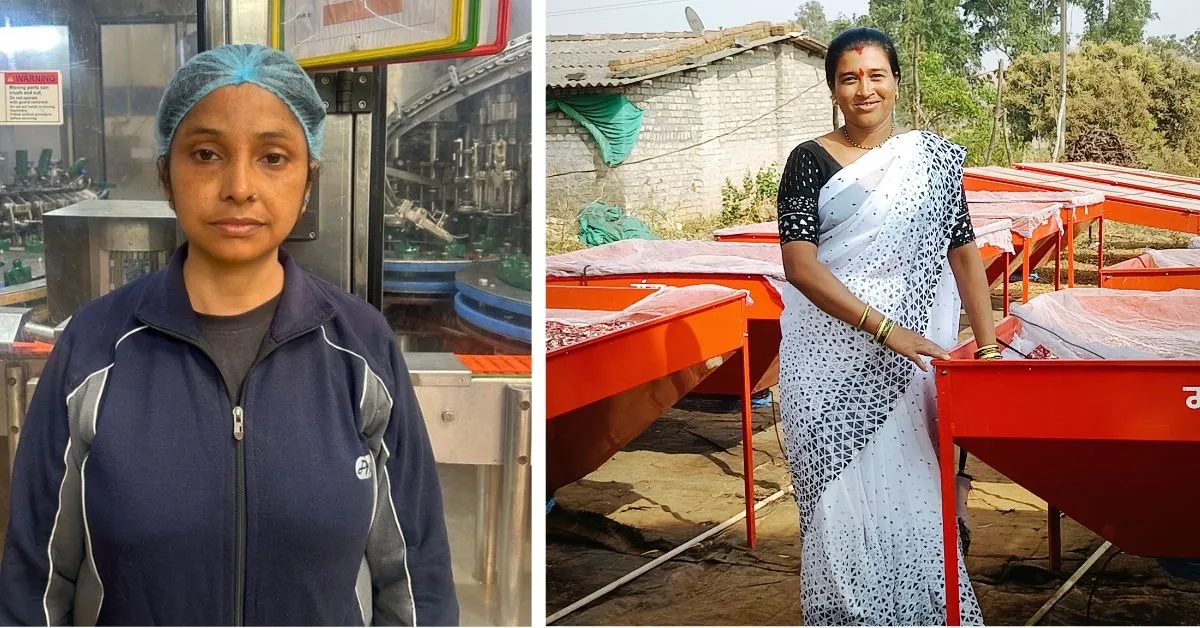
In Alwar, Kalpana’s day starts on the production line, surrounded by machinery that needs constant care and attention. Her role involves lubricating the machines and ensuring the work stays on track, batch after batch, target after target. But long before she learnt the ropes of the factory, she had to convince people at home that she belonged here at all.
“When I told my family about wanting to work in a factory, their first opinion was that I shouldn’t since I am a girl,” she says. “They wanted me to try for a government job, instead. It took some effort to convince them that I was capable of this work.”
Hundreds of kilometres away, in Bengaluru, Chaithra is part of the staff at the JW Marriott Hotel. She welcomes guests, sets tables, and makes sure the glassware, crockery, and cutlery are arranged just right. For someone with a speech and hearing impairment, it is a space she never imagined she would find a place in.
And in Nashik’s Dindori belt, Alka works with other women farmers at a processing unit where onions and ginger are cut, dried, and sent to larger city markets. It means vegetables that would otherwise rot after harvest can still bring an income.
Three women, in three corners of the country, each finding her own way into work that once felt out of reach.
When they speak about their journey, it’s clear that the doubt they once faced has now become a source of strength.
At the Alwar unit, where women make up 16 percent of the workforce, Kalpana has found something she didn’t expect when she first started out — other women beside her on the factory floor. Over time, that has brought its own kind of reassurance. Seeing more women take up similar roles has made the space feel less unfamiliar, and the work feel more possible.
This is one of the ways the factory has begun to open opportunities for women in the region, supported by Diageo India’s Alwar unit.
But the story here isn’t only about women entering new workplaces. It is also about what happens when opportunity is shaped to include those who are often left out.
A workplace that learned to speak her language
For Chaithra, working at the JW Marriott in Bengaluru has also meant being understood in ways she didn’t always experience growing up.
Her colleagues have begun learning sign language so they can communicate with her better — something she says she is deeply grateful for. It is a change from much of her childhood, when her speech and hearing impairment often left her feeling isolated from conversations around her.
Chaithra grew up in difficult circumstances. Domestic violence and financial instability shaped her early years. Her father worked as a tender coconut vendor, and her mother as a cook. She also speaks about how being born into a family that could hear and speak meant that, for a long time, they did not always know how to communicate with her.
For years, the future felt uncertain.
/filters:format(webp)/english-betterindia/media/media_files/2026/02/05/diageo-2026-02-05-09-06-57.jpg)
The shift, she says, began with something small: her uncle finding a flyer about a skill-training course.
“After clearing my class 10 from an inclusive school in Mysuru, where I secured 73.41 percent, I returned home to Mandya in Karnataka, where I continued living with my parents, younger brother, grandmother, and uncle. My uncle came across a flyer about a skill-training programme. Initially, I was scared to pursue it, but my mother encouraged me to try, and so, I did.”
That decision brought her to a three-month hospitality course at the NABK (National Association for the Blind), Bengaluru, supported through Diageo India’s Learning for Life programme, which has also expanded to include persons with disability.
“I learnt to be diligent,” she shares, through a series of hand gestures, translated by her trainer, Brenda. She adds, “One of the most important lessons my trainers taught me was to never give up, despite the challenges. I’m simply following their advice.”
Lessons in skills and hospitality etiquette, Chaithra adds, were also accompanied by something she hadn’t expected — lessons in empathy. Over those three months, she says, she forged some of the most meaningful friendships of her life.
Her hard work throughout the course led to a placement at the JW Marriott in Bengaluru, where she has recently completed a year of work.
“I remember I was nervous on my first day at work. But I’ve always loved meeting new people and making friends, and so I quickly settled in. If a guest wants to interact with me, I point to my badge that says ‘I cannot hear or speak but am happy to serve.’.”
Chaithra is one of the 303 persons with disabilities trained through the Learning for Life programme, which has impacted over 6,500 individuals.
While Kalpana brings home a factory salary, and Chaithra brings home her first steady income from hotel work, Alka’s earnings have always been tied to farming and to everything that can go wrong after harvest.
Earning beyond the uncertainty of the harvest
In Nashik’s Dindori belt, farming income is never fully in a farmer’s control. A harvest can look good in the field, but that doesn’t always mean it will translate into earnings. Sometimes, the loss begins after the crop is picked, when vegetables sit too long, markets fluctuate, or produce spoils before it can be sold.
India loses an estimated 17,703.33 million dollars annually to post-harvest losses of crops and allied produce. In regions like Nashik, where onion farming drives agricultural stability, that loss is a painful reality for farming families, season after season.
/filters:format(webp)/english-betterindia/media/media_files/2026/02/05/diageo-1-2026-02-05-09-08-07.jpg)
In May 2025, it was reported that more than 3,200 hectares of onions were damaged in unseasonal rains, with half “likely to be in the post-harvest state lying in farms, waiting to be picked up to transport to agriculture produce market committees (APMCs) or onion storage sheds”. The report noted that this put 50 percent of farmers in distress.
It is here that Alka’s micro-enterprise has taken shape.
Run collectively by women farmers, the unit focuses on processing onions and ginger so more of the harvest can be preserved, sold, and turned into income, even when market conditions are uncertain.
For Alka, the biggest change has been what the work has added to her life: a second source of income.
/filters:format(webp)/english-betterindia/media/media_files/2026/02/05/diageo-2-2026-02-05-09-08-58.jpg)
“Everyone has a certain benchmark of what they want to earn in a month. I did too. But earlier (before the micro-enterprise), my earnings would always be less than what I estimated I should get through farming. This is because we wouldn’t get the right market price for our produce,” she explains.
Before this, her income rose and fell with the season. Now, she says, she is no longer dependent only on farming. The micro-enterprise gives her a steady income, something she can count on amid the uncertainty of crops and prices.
The processing units are powered by solar energy, which also helps in regions where frequent power cuts can disrupt work.
“And all we need to invest is five hours every day to sort the produce, wash it, cut it, put it in the fan-based dryer (which removes the moisture), then shift it to the solar-based dryer, and then pack it and send it to the warehouse,” Alka shares.
The work translates into an earning of Rs 80,000 a year, complementing farming income.
Alka says she has channelled those savings into her children’s education. The feeling of being able to contribute financially at home, she adds, carries its own meaning.
More than income: what work gave them
Kalpana relates to that shift. She recalls what her first factory salary went towards: gifting her parents their first fridge at their home in Kanpur.
“That was the day they saw that I am capable. I felt good,” she shares.
While Kalpana’s parents were proud of how far she had come, their excitement was often accompanied by worry, especially about her safety in a factory environment. Kalpana says she would reassure them that the workplace felt secure for women.
At the Alwar unit, measures have been put in place to make the space safer and more supportive, from separate toilets and washing facilities to crèche services. There are also safeguards to protect women from discrimination, including provisions on pregnancy and maternity.
Anti-harassment systems operate under the POSH Act, along with internal grievance redressal mechanisms. Working hours and shifts follow regulated schedules, with defined rest breaks and welfare benefits.
Above all, Kalpana speaks of the camaraderie she shares with other women at the factory. And Alka, too, says it is the shared experience of working alongside other women — of earning together — that keeps her grounded and gives her strength.
What connects Kalpana, Chaithra, and Alka isn’t the kind of work they do, but what it has changed in their lives: a steadier income, more confidence at home, and a little more control over what comes next.
Kalpana had to justify her place on a factory floor. Chaithra found a workplace that learned how to communicate with her. Alka found a way to earn beyond the uncertainties of farming.
These are only three stories. Many more women across India are navigating similar changes, as reflected in the ‘Economic and Social Impact Assessment of Diageo India’ report.
Often, change begins with money of your own and a workplace that finally makes room for you.
All pictures courtesy Diageo India
Sources
‘Onion growers in trouble as govt has no provision to help with post-harvest losses amid widespread rain-related damage’: by Abhilash Botekar, Published on 27 May 2025.
‘Addressing Post-Harvest Losses in India: A Silent Crisis in Agriculture’: by K Shruti Prakash, Published on 24 January 2025.
Disclaimer : This story is auto aggregated by a computer programme and has not been created or edited by DOWNTHENEWS. Publisher: thebetterindia.com