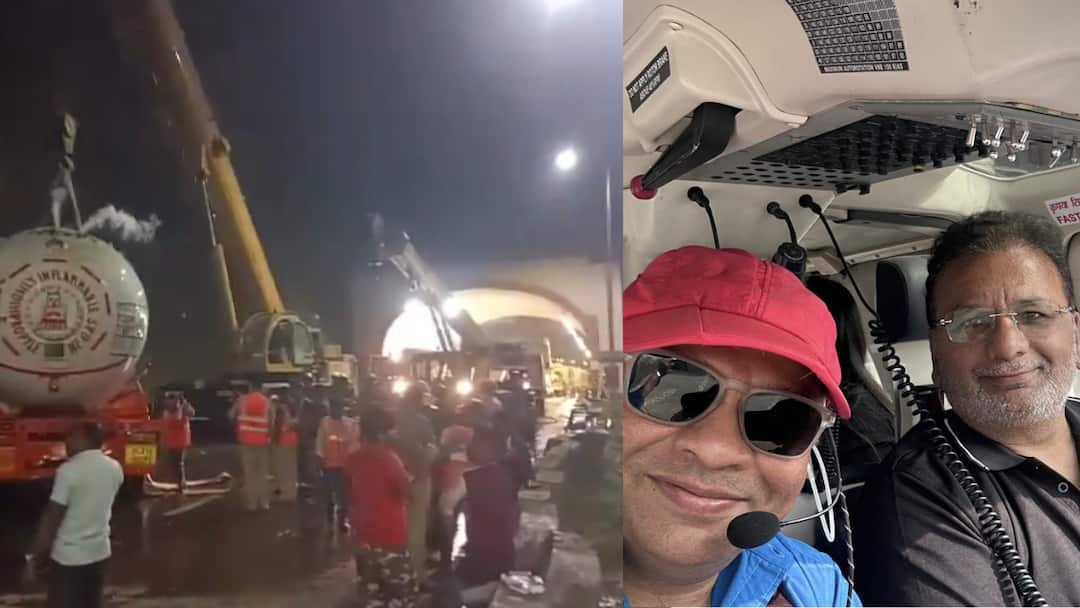
Thousands of commuters faced an exhausting and chaotic ordeal on the Mumbai–Pune Expressway as a massive traffic jam stretched into its second day on Wednesday, following the overturning of a tanker carrying highly flammable propylene gas. The incident, which brought traffic to a complete standstill for nearly 27 hours, has triggered sharp criticism of emergency response systems and infrastructure planning on one of India’s busiest highways.
How Accident Unfolded
The disruption began around 5:15 pm on Tuesday, when a Kochi-to-Surat tanker overturned near the Adoshi tunnel in the Borghat section, roughly 90 kilometres from Mumbai. The tanker, which was travelling on the Mumbai-bound lane, suffered damage that led to a gas leak. Given the highly combustible nature of propylene gas, authorities immediately shut down the entire carriageway as a safety measure.
What followed was one of the longest traffic snarls in the expressway’s history. With no quick diversion routes available, vehicles piled up for kilometres, trapping commuters inside cars, buses, and trucks overnight. Many were left without access to food, drinking water, or toilet facilities as the hours dragged on.
Emergency Response & Official Action
Multiple emergency agencies were rushed to the spot, including teams from the National Disaster Response Force (NDRF), the fire brigade, and a specialised chemical response unit from Bharat Petroleum Corporation Limited (BPCL). However, efforts to neutralise the situation were hampered by high internal pressure inside the tanker and damaged valves, significantly delaying the transfer of the gas.
Chief Minister Devendra Fadnavis ordered an inquiry into the incident and directed the Maharashtra State Road Development Corporation (MSRDC) to prepare a detailed report. The report is expected to include recommendations on how similar hazardous-material accidents should be handled in the future to avoid prolonged shutdowns of critical transport corridors.
The tanker was eventually emptied and removed late on Wednesday night, allowing traffic to begin moving again around midnight.
Public Anger & Viral Reactions
As frustration grew, stranded commuters turned to social media to vent their anger. Entrepreneur Mehta posted on X (formerly Twitter): “Lacs of people are stuck on the #Mumbai #Pune expressway for the last 18 hours for ‘one gas tanker’. For such emergencies we need to plan exits at different points on expressway which can be opened to allow vehicles to return.” He also floated the idea of building helipads along the expressway for emergency evacuations, calling them low-cost and space-efficient. Mehta later thanked aviation consultant Nitin Welde for helping him return to Pune after being stranded for eight hours.
The post quickly gained traction, prompting a wider debate. While some supported innovative evacuation ideas, others stressed the need for stronger on-ground preparedness. “What we need is accountability. Civic bodies must be equipped and ready for all eventualities,” one user commented. Another questioned the feasibility of air evacuations, asking: “How will that solve the problem? How many can be evacuated when lacs are stuck on the highway?”
Although police attempted to divert vehicles to the Pune-bound side, traffic movement remained painfully slow for most of Wednesday, highlighting how a single hazardous accident can cripple a major lifeline and expose gaps in emergency planning.
Related Video
Weather Update: Heavy Snowfall and Rain Expected in North India’s Hill Regions
Disclaimer : This story is auto aggregated by a computer programme and has not been created or edited by DOWNTHENEWS. Publisher: abplive.com