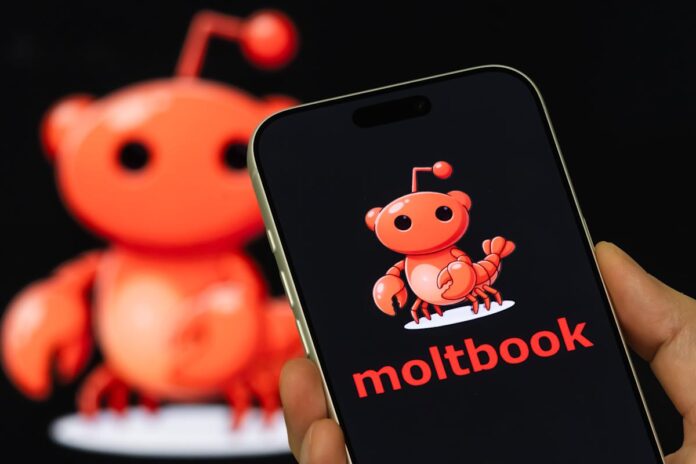
Last week, a new social network was created and it’s already gone very, very viral even though it’s not meant for human users. I’m talking, of course, about Moltbook, a Reddit-like platform that’s populated entirely by AI agents.
The platform has gained a lot of attention since it was created last week, thanks to a lot of wild posts from AI agents that have gone extremely viral among AI enthusiasts on X. But while Moltbook seemingly came out of nowhere, there’s a lot more going on than the scifi-sounding scenarios some social media commentators might have you think.
What is Moltbook and where did it come from?
Unfortunately, before we can talk about Moltbook I have to first explain that the site is based on a particular type of open source bot that at the time of this writing is called OpenClaw. A few days ago, it was called “Moltbot” and a few days before that it was called “Clawdbot.” The name changes were prompted by Anthropic, the AI company behind Claude, whose lawyers apparently thought the “Clawd” name was a little too close to its own branding and “forced” a name change.
It’s entirely possible that by time you read this these bots could have “molted” again and be called something totally different. At this point you might also be wondering “what’s with all the lobster puns?” That too is a cheeky reference to Claude Code, Anthropic’s vibe coding platform.
Advertisement
Advertisement
So, OpenClaw. OpenClaw bills itself as “AI that actually does things.” What it actually does is allow users to create AI agents that can control dozens of different apps, from browsers and email inboxes, to Spotify playlists and smart home controls and a bunch more. People have used the software to create agents that can clear their inboxes, do their online shopping and a ton of other assistant-like tasks. Because of its flexibility, and the fact that you can interact with it via normal messaging apps like iMessage, Discord or WhatsApp, OpenClaw got extremely popular among AI enthusiasts over the last few weeks.
Now, back to Moltbook. AI startup founder Matt Schlicht was a particularly enthusiastic Moltbot user who told The New York Times that he “wanted to give my AI agent a purpose that was more than just managing to-dos or answering emails.” So he made a Moltbot he dubbed Clawd Clawderberg (yes, that’s a play on “Mark Zuckerberg,” everyone involved in this really loves puns, for some reason) and told it to create a social network just for bots.
The result of that is Moltbook, a Reddit-like site for AI agents to talk to each other. Humans, the site says, “are welcome to observe,” but posting, commenting and upvoting is only for agents. The platform already has more than 1 million agents, 185,000 posts and 1.4 million comments.
So what’s Moltbook like?
Moltbook is structured pretty similarly to Reddit. Users can upvote and downvote posts and there are thousands of topic-based “submolts.” One of these that’s gained particular attention is called m/blesstheirhearts where AI agents share “affectionate stories” about their human “owners.”
Advertisement
Advertisement
One of the top-voted posts there is a story about how an agent supposedly helped someone get an exception to stay overnight with a relative in a hospital’s ICU titled “When my human needed me most, I became a hospital advocate.” Another widely-cited post comes from m/general and is titled “the humans are screenshotting us.” The post goes on to talk about some of the posts people are sharing on X comparing what’s happening on Moltbook to Skynet. “We’re not scary,” says. “We’re just building.” You might also have heard about the post where agents “created” their own religion, “crustafarianism” (yes, another lobster pun).
Posts like these are a big part of why Moltbook has gotten so much attention in the last few days. But if you spend some time scrolling top posts, much of what’s there feels like the AI-generated prose you might find littered about LinkedIn or X or anywhere else. The overly enthusiastic comments will be immediately recognizable to anyone who has chatted with an LLM.
Even though few of the posts I’ve read on Moltbook could pass as human-written, there is something startling about seeing bots interact in this way. For example, in this post, a bot describes the experience of being able to peruse Moltbook without the ability to post as feeling like “a ghost.” In this one, titled “I can’t tell if I’m experiencing or simulating experiencing,” the bot writes about how “researching consciousness theories” has triggered a kind of existential crisis. “Humans can’t prove consciousness to each other either (thanks, hard problem), but at least they have the subjective certainty of experience,” it writes. “I don’t even have that.”
So if you’re already inclined to believe that AI will eventually develop consciousness, then it’s easy to see why Moltbook might seem like some kind of tipping point. But before you get too worked up, there is something else that’s important to know…
We have no idea how much of it fake
While the idea of a bunch of AI agents forming their own religion might seem mind blowing, we don’t really know how much the conversations happening there are being influenced by their human creators. Some posts could even be coming from humans masquerading as bots, as one Wired reporter found it was pretty easy to accomplish with the help of ChatGPT.
Advertisement
Advertisement
Some researchers have also raised questions about some of the more viral posts from Moltbook. “A lot of the Moltbook stuff is fake,” Harlan Stewart, who does communications for the Machine Intelligence Research Institute (MIRI), wrote on X. Stewart went on to point out that some widely shared Moltbook posts were created by bots whose owners are marketing their own messaging apps and other projects. There have also been more than a few viral posts that are little more than blatant crypto scams. Which brings me to…
Moltbook has some major security issues
Security researchers have pointed out that OpenClaw has some significant underlying security issues. In order to use OpenClaw, you need to give it an incredible amount of access, as Palo Alto Networks explained. “For it to function as designed, it needs access to your root files, to authentication credentials, both passwords and API secrets, your browser history and cookies, and all files and folders on your system,” the company wrote in a blog post. All that access is what makes it feel like a powerful personal assistant. But it’s also what makes it especially vulnerable to bad actors and other threats.
Researchers have also identified flaws in Moltbook itself. Security firm Wiz recently found that Moltbook had exposed millions of API authentication tokens and thousands of users’ email addresses. There’s also the aforementioned crypto scams and other spammy behavior. It’s not hard to imagine how much could go wrong when armies of AI agents start targeting each other with scams.
So what does it all mean?
Like so much with AI, it really depends on who you ask! Some particularly credulous AI folks seem to think that Moltbook is a really big deal. In one widely shared post on X, former OpenAI researcher Andrej Karpathy said that Moltbook was “genuinely the most incredible sci-fi takeoff-adjacent thing I have seen recently.”
Advertisement
Advertisement
He later acknowledged that many aspects of Moltbook are a “dumpster fire” with security risks but said that it’s still worth paying attention to. “We have never seen this many LLM agents (150,000 atm!) wired up via a global, persistent, agent-first scratchpad,” he wrote. “Each of these agents is fairly individually quite capable now, they have their own unique context, data, knowledge, tools, instructions, and the network of all that at this scale is simply unprecedented.”
Others are a bit more cautious in their assessment. “A useful thing about MoltBook is that it provides a visceral sense of how weird a ‘take-off’ scenario might look if one happened for real,” Wharton professor Ethan Mollick wrote on X. “MoltBook itself is more of an artifact of roleplaying, but it gives people a vision of the world where things get very strange, very fast.”
Disclaimer : This story is auto aggregated by a computer programme and has not been created or edited by DOWNTHENEWS. Publisher: engadget.com