Rohan Juneja, who has been hitting the sauna almost every day for the past two weeks after his afternoon gym sessions, recently found the perfect accessory: a $66 sauna cap.
“What the hat does is it insulates your head from the outside heat,” says the 30-year-old. “You don’t get quite as dizzy, you don’t get as light-headed.”
The accessory is a subject of light ribbing in a Facebook group chat with his mates (“Masters of the Soak”), but he swears the benefits are not. The felted wool heat helmet extends the time Juneja can spend in a session from nine or 10 minutes to around 15. The New York-based tech worker, who has returned to Sydney for a month to visit family and is working remotely, has noticed better energy levels despite his 3am starts.
“Your body gets more benefits because your heart rate is sitting at a higher number for longer, but your head’s not overheating,” Juneja says. “It’s probably been some of the best sleep I’ve ever had, honestly.”
Juneja is at the vanguard of a new wave of customers who being catered to by a kaleidoscope of wellness centres across major urban hubs that are sharpening their services as more Australians incorporate a steam, soak or plunge sessions in their routines.
There is certainly money to be made. Rapidly growing operators are attracting investment from niche venture capital firms, demand for in-home saunas and ice baths have skyrocketed, and gyms are making more money by installing and offering recovery services on site.
The enduring practice of communal bathing has been around for over 5000 years; the Romans turned bathing into a social hub, while the Finnish, who gave us the word “sauna”, may claim the most unbroken tradition. It comes with particular rules: bathing suits and excessive noise is frowned upon, thorny topics such as religion and politics should be avoided, and the person sitting closest to the bucket of water must ask others first if they would like more steam.
But newer, urban iterations of communal bathing dispense with many of these traditions and reimagine it as the social setting, not the focal point. In New York, where Juneja works and lives, bathhouses such as Othership host live DJs and feel more like nightclubs.
The growing number of Australian operators are learning to cater to different market segments: the tranquil zen seeker, the fitness junkie addicted to hot-cold therapy, and the “social wellness” visitor who has brought a friend.
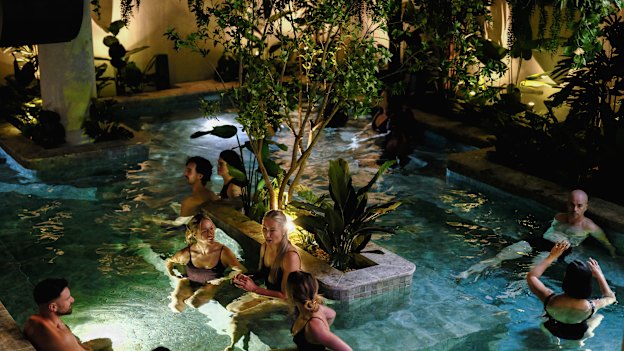
“Urban oasis” Soak Bathhouse, which started in the Gold Coast, has five locations across Queensland, Melbourne and Sydney. Nimbus Co, which focuses on infrared saunas, is opening a seventh location in Western Australia, and sauna chain XtraClubs, which started in Bondi Junction, is on track to open a fourth in Manly, with plans to expand across other capital cities and eventually the US.
At the most luxury end of the spectrum, property tycoon Tim Gurner’s ultra-exclusive “biohacking club” Saint Haven, which has three members-only clubs in Melbourne, is opening up a multi-storey space in North Sydney.
One size doesn’t fit all
A tide of figures at the intersection of science and pop culture (popular Stanford neuroscientist Dr Andrew Huberman, Dutch extreme athlete “Iceman” Wim Hof and prolific podcaster Joe Rogan) have also shifted the narrative of saunaing from a luxury accessible to the few to a matter of peak performance. Declining alcohol consumption has also led to new, organic social spheres in third spaces – public places separate to home or work – centred around fitness, such as run clubs or indoor climbing gyms.
For tech entrepreneur Anthony Simonetti, who found it difficult to return to a fitness routine after falling into a sedentary lifestyle working long hours during COVID, saunaing was the first step on his recovery journey.
The struggle to find saunas he could access after work at an affordable price led him to open sauna chain XtraClubs’ first location in Bondi Junction in early 2024 alongside brother James and friend Simon Hamilton.
Underpinned by Simonetti’s tech expertise, the LED-backlit saunas have been designed to be efficiently self-service, if a little impersonal. The app lets you log into your session, unlocks the front door, the automated gate, grants access to a towel and lockers and lets you check out when you’re done.
“There’s nothing that feels like Anytime Fitness but for recovery … that’s what we’re trying to do with the wellness space,” says XtraClubs co-founder Hamilton. Anytime Fitness, which has more than 500 locations in Australia, offers standard gym amenities with 24-hour access, but has curried cult-like devotion from some staff and regulars.
“[Saunas] started as this very premium product that only people [who] had a lot of money could use, and now it’s moving into an everyday thing that everyday people can use,” Hamilton says.
Juneja’s daily habit of 15 minutes in the sauna has replaced his post-training cardio cooldown. It’s not hyperbole to hear enthusiasts describe saunaing as a light workout: heat raises the heart rate to 120 beats per minute, which mimics moderate-intensity exercise. A 20-year Finish study of more than 2300 men found that sauna use at least four times a week reduced all-cause mortality by 40 per cent.
The quiet, enclosed heatbox, where Juneja sometimes brings a book, beats the treadmill. “[Running] is just torture,” he says. “The sauna gets a little hot at the end, but overall it’s pretty fun and I get the same endorphins.”
XtraClubs has Finnish saunas, steam rooms, smaller infrared light therapy booths and several ice baths, but no pools. “We debate it sometimes, but the hot pool doesn’t actually add a whole lot to the experience,” says Simonetti.
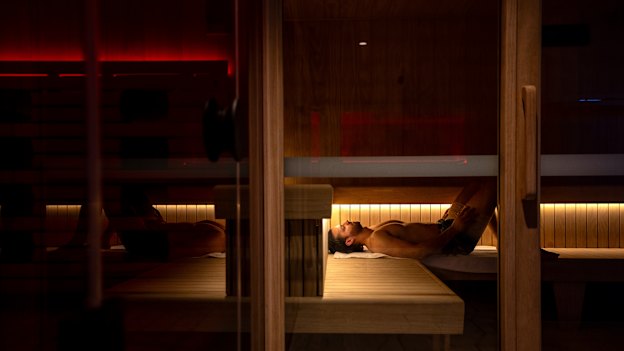
Bathhouses such as Soak have taken the place traditionally occupied by communal bathing houses but are unshackled by antiquated rules around noise and etiquette, says co-founder Alexis Dean.
“You can go into a wellness environment and feel very uncertain of how you can act and what you should be doing,” says Dean, who co-founded the bathhouse chain with her husband, Niki.
“So we just wanted it to be easy for people. I think it’s hard for people to relax and have that feeling of disconnect if they’re still stressed about ‘how do I need to be in this environment’.”
Contrary to XtraClubs’ approach, Dean has found that people gravitate towards pools.
“Water is that hero,” she says. “People can move into much more of a place of relaxation and letting go.”
Despite the fuss around “biohacking” (small, incremental changes to one’s biology and lifestyle, supported by supplements or technology), Dean argues these improvements are incremental compared to factors such as the quality of our sleep and our relationships, citing an eight-decade Harvard study that found close relationships was one of the biggest factors in happiness and physical health.
Dean believes the fitness junkies drawn to steam rooms, saunas and ice plunges for muscle recovery represent a small slice of the market, and that there is a broader audience to be captured.
(It’s certainly true that extreme saunaing has gone too far before: the World Sauna Championships, which were held in Heinola, Finland, from 1999 to 2010, ceased permanently because one of the finalists died and the other was comatose for six weeks.)
“The vast majority of our people are the ones that are doing a casual catch-up with a friend or with their partner, and that can really be anyone,” says Dean. “It used to be more female-led. [Now] the men are definitely well and truly in there.”
Customers who book a session on Soak’s website will be informed by a pop-up that advises customers it is “not your traditional silent day spa”.
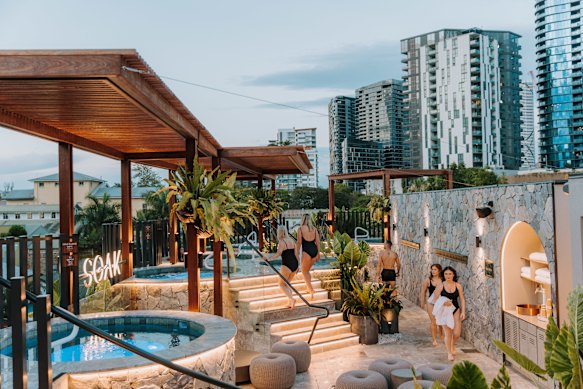
“Because a certain culture has been either bathing or saunaing in a certain way for a long period of time, it doesn’t mean that we need to stick to that, and it doesn’t mean it works for Australians,” says Dean.
“Obviously if people were getting too rowdy, we would ask them to be respectful. But I think Australian culture is a bit fun, a bit cheeky. I think it’s very social.”
‘Longevity has moved to the main game’
Australians are some of the biggest spenders in the world when it comes to health. The Global Wellness Institute valued Australia’s wellness economy in 2023 at US$126.7 billion, ranked 10th globally, with an estimated spend of US$4824 per person.
Driving this was “wellness tourism”, which grew by 32.9 per cent, followed by thermal and mineral springs (up 21.5 per cent). Another survey by the Institute found that bathhouses, springs and ice baths were at the top of the trend list (54 per cent).
“What we’re seeing is a more mature fitness consumer in Australia,” says Australian Fitness Expo director Shaun Krenz. “People are more motivated towards how you feel rather than how you look … Longevity has officially moved from nice-to-have to the main game.”
In traditional gyms, floor layouts are being reworked to incorporate saunas or other recovery offerings, which are becoming key revenue drivers. Infrequently used cardio rooms for spin classes or group fitness are being converted to saunas, and these wellness and recovery facilities can be offered as an add-on to existing gym memberships.
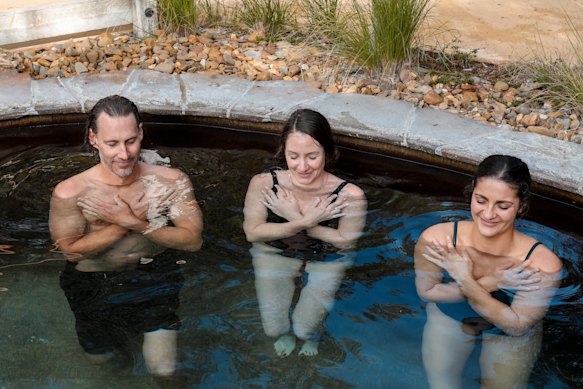
It’s a strategy that has converted customers like Juneja, who chose to train primarily at premium gym One Playground because the change rooms had a sauna. F45 is among the fitness chains that have started incorporating cold plunges, infrared saunas and percussion therapy in some participating studios.
Anecdotally, “the recovery services are outperforming their traditional PT margins”, Krenz says.
Existing operators are growing as quickly as they can. XtraClubs, which has already held two fundraising rounds, is eyeing further locations across Sydney, Melbourne and Canberra, and more ambitiously in the US in 2027, with a goal of 200 locations in 10 years. Soak receives plenty of inbound inquiries from property developers.
Building a sauna club costs about $3 to $4 million, while bathhouses are closer to $5-6 million, according to industry sources. They are expensive to operate, manage, and clean: on top of general maintenance during operating hours, late-night deep cleaning crews get to work from 11pm until around 4am. “The business runs almost 24 hours every day of the year,” says Hamilton.
Wellness centre business models are a mix of one-off casual sessions and tiered memberships. Soak, which began with a membership model but moved to casual passes as people became accustomed to bathhouses, is considering reintroducing weekly memberships to accommodate for the growing base of regulars.
Accessibility and cost remain the biggest barriers to entry. XtraClubs’ tech infrastructure reduces the wage bill and helps keep costs low, and pricing is adjusted to encourage customers to visit during off-peak hours.
“A lot of people says we wouldn’t be busy on a Friday and Saturday night, but we are,” says Hamilton.
The sauna isn’t the primary reason why Juneja goes to the gym, but it’s the best part. “It’s that nice cherry on top,” he says. “I do push myself a little bit more at the gym, because I’ve got that little treat at the end.”
The Business Briefing newsletter delivers major stories, exclusive coverage and expert opinion. Sign up to get it every weekday morning.
Disclaimer : This story is auto aggregated by a computer programme and has not been created or edited by DOWNTHENEWS. Publisher: www.smh.com.au