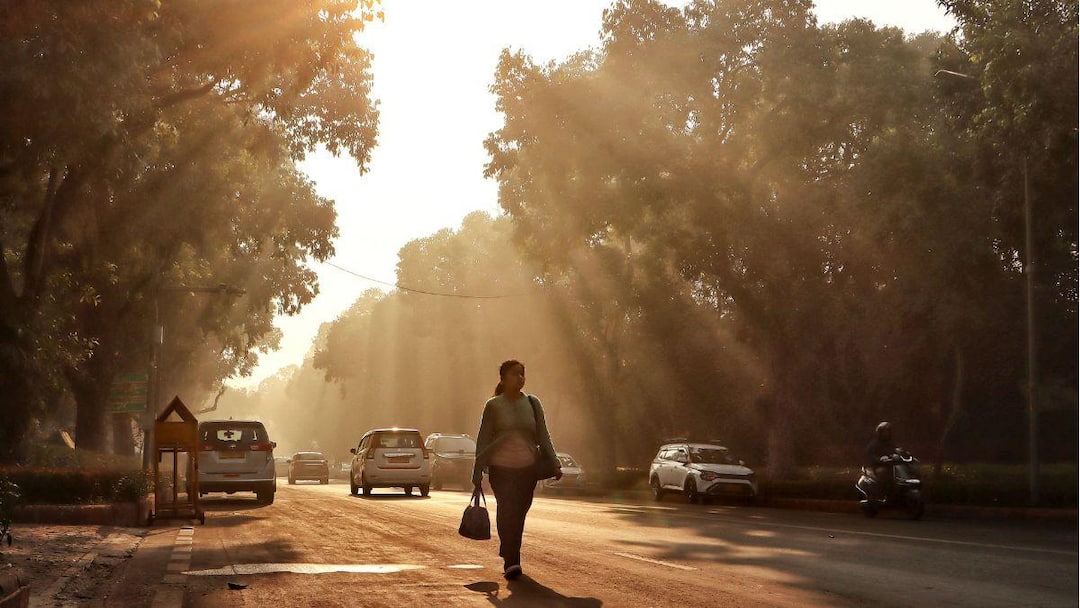
The weather pattern across the national capital has begun to shift with the arrival of the first week of February. The cold is gradually easing, with both maximum and minimum temperatures recording a steady rise.
According to the India Meteorological Department (IMD), temperatures are expected to climb further in the coming days, even as concerns over air pollution grow.
Temperature And Fog Outlook In NCR
The IMD has forecast dry weather conditions across the NCR from February 5 to February 10, with fog likely during morning hours. On February 5, the maximum temperature stood at 22 degrees Celsius, while the minimum dipped to 8 degrees Celsius. Minimum temperatures on February 6 and 7 are expected to hover between 10 and 11 degrees Celsius. From February 8 to 10, the maximum temperature may rise to 23–24 degrees Celsius.
High Humidity, No Weather Warning Yet
During this period, humidity levels are expected to remain between 90 and 100 per cent, increasing the likelihood of shallow to moderate fog in the mornings. At present, the weather department has not issued any warning. Meteorologists have also indicated the possible impact of El Niño this year, which could lead to higher temperatures and below-average rainfall in the months ahead.
What Is The Current AQI Situation?
As temperatures rise, air quality across the NCR continues to deteriorate. In several parts of Delhi, the Air Quality Index (AQI) has crossed the 300 mark, placing it in the “very poor” category. AQI levels were recorded at 327 in Anand Vihar, 315 in Ashok Vihar, 307 in Bawana, 309 in R.K. Puram, 317 in Rohini, 319 in Wazirpur and 343 in Vivek Vihar. At the Pusa DPCC station, AQI stood at 332, while the IMD station recorded 219.
In Ghaziabad, AQI readings were 342 in Loni, 329 in Vasundhara and 326 in Indirapuram. Noida also reported poor air quality, with Sector 125 at 310, Sector 1 at 289 and Sector 116 at 282. While a few areas remained in the ‘poor’ category, most locations continued to report ‘very poor’ air quality.
Slight Improvement Now, But Deterioration Likely Ahead
Despite the overall grim situation, a marginal improvement in Delhi’s air quality has been observed recently. The city’s 24-hour average AQI dropped from 339, categorised as ‘very poor’, to 241, bringing it into the ‘poor’ category. On February 5, daytime temperatures were relatively higher, with the maximum touching around 24 degrees Celsius.
According to the Central Pollution Control Board’s Sameer app, air quality in the evening was recorded as ‘poor’ at 25 stations, ‘very poor’ at two stations and ‘moderate’ at 10 stations. Experts warn that as temperatures continue to rise, the chances of air quality worsening again remain high.
Related Video
Breaking News: Missing Children Crisis Raised in Rajya Sabha, AAP MP Flags Shocking Data
Disclaimer : This story is auto aggregated by a computer programme and has not been created or edited by DOWNTHENEWS. Publisher: abplive.com