MILAN — After heavy snowfall earlier in the week, the forecast for Cortina d’Ampezzo, site of women’s Alpine skiing for the Milan-Cortina Winter Olympics, calls for a chance of rain, a severe ice warning and daytime temperatures well above freezing followed by an overnight chill in the 20s.
And that could be a big problem says Jonathan Belles, a meteorologist at The Weather Company and a self-described Olympic geek, because any snow that melts in the day, then freezes again at night, is no longer snow. It’s ice or slush.
And since no one wants to ski on ice or slush, artificial snow will be used. That’s an even bigger problem.
“As you layer snow on top of each other, different kinds of snow, that can create an avalanche risk,” Belles said. “I would not want to be a snow creator or event host this go around. It’s going to be kind of tricky.”
Man-made snow debuted at the Olympics in 1980, when a snow drought endangered the Lake Placid Games. It’s been used in ever since, increasing in importance in recent years.
Twelve years ago in Sochi, Russia, when temperatures rose into the mid 60s — so warm some snow groomers worked bare-chested — 80% of the snow used was artificial. Four years later more than 90% of the snow in Pyeongchang, South Korea, was man-made. Then came the 2022 Games in Beijing, the first to rely completely on fake snow.
Kaitlyn Trudeau, a senior research associate of climate science for Sacramento-based Climate Central, says the unmistakable trend is the result of climate change. And it threatens the future of the Winter Olympics.
“It’s going to get a lot harder to hold these Games without any kind of serious climate action,” she said. “We’re going to see more warming around the world. We’re going to see less-reliable snow pack. It will be a lot harder to find places where we can hold these Games.
“We’re actually seeing the Winter Olympic Games literally melting before our very eyes.”
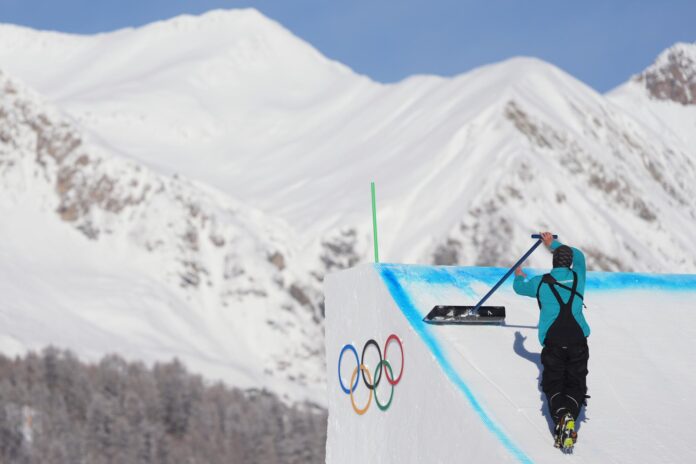
A worker preps a ramp before a freestyle skiing slopestyle training session in Livigno, Italy, on Thursday.
(Lindsey Wasson / Associated Press)
Between 1956-65, Trudeau said there were an average of 214 days a year with temperatures below freezing in Cortina, site of the 1956 Winter Games and one of Europe’s most popular ski resorts. In the last decade, that number dropped nearly 20%, to 173. A separate paper published in the International Journal of Climatology showed the average depth of winter snowfall in the southern Alpine region surrounding Cortina has declined more than 25% since 1980.
And yet another study, led by the University of Waterloo, found that if countries continue with their current climate policies, nearly half of the 93 potential host locations identified by the International Olympic Committee will not be climate-reliable for the Games by 2050.
“We have two major criteria when we look at climate reliability,” said Daniel Scott, a professor of environment at Waterloo and the chief author of the report. “One, can you get the snowpack in place? Can you build the snowpack if Mother Nature doesn’t give it to you?
“And then the other part is, during the Games, do you get those cold temperatures that allow emergency snow-making but more importantly, that the condition of the course can be regroomed and reset and recovered.”
For that you need temperatures below freezing at night — and, ideally, in the daytime too. Those kinds of conditions are forecast for just one of the four event clusters — the one at Valtellina, which will host Alpine and freestyle skiing, ski mountaineering and snowboarding — during the first 10 days of the Milan-Cortina Games. As a result, Olympic organizers said last week they have prepared 56 million cubic feet of fake snow for the ski venues.
The situation with climate change has gotten so dire Rocky Anderson, mayor of Salt Lake City when it staged the highly successful 2002 Winter Games, said he doesn’t think the Olympics will be able to return to Utah in 2034 as planned.
“I would bet it’s not going to happen,” he said.

Team Finland takes part in a biathlon training session at Anterselva Biathlon Arena on Wednesday.
(Harry How / Getty Images)
As evidence he pointed to the warmest November and December in Park City in more than 130 years, which dealt a massive blow to Utah’s $2.5 billion ski industry. The weather left the snowpack in parts of the state at record lows and forced the FIS freestyle World Cup events, scheduled for Park City in mid-January, to move to New York and New Hampshire.
“If that’s happening now, why do we think 2034 is going to be any better?” Anderson asked. “In fact, the globe is heating in unprecedented fashion with more fossil fuels building up this greenhouse gas blanket.”
Losing the Winter Games would be another huge financial blow for Utah, which is projecting $6.6 billion in economic activity from the Olympics over a 10-year period. Much of that money vanishes if the Games do.
And it’s not just Utah. Warm weather and a lack of snow forced the cancellation of seven of the first eight World Cup downhill and snowboard competitions in 2022-23. A year later 26 FIS events were canceled, Scott said, many because of dangerous conditions caused in part by the artificial snow, which is generally icier and harder than the natural snow.
“There are almost three types of snow,” Belle said. “There’s a very dry snow; that’s the fluffy snow. Then you get a wet snow that is concrete that does not move. And then there’s artificial snow, that usually tends to be somewhere in the middle. It’s humid, de-controlled almost.”
Still, man-made snow has become the go-to alternative simply because climate change has left no alternative. But it, too, exacts a high environment cost.
In Beijing, organizers needed 100 snow generators, 300 snow cannons and as much as 343 million gallons of water, according to Business Insider, to create faux ski runs and other facilities. That’s equivalent to a day’s worth of drinking water for nearly 900 million people — and finding it required significant water diversion from local reservoirs in a water-scarce region.
For the Milan-Cortina Games, high-elevation water reservoirs had to be constructed to store water for snowmaking. At the Livigno Snow Park, where the freestyle skiing and snowboard events will be held, a basin capable of holding about 200 million liters of water was built, making it one of the largest reservoirs on the Italian side of the Alps.
It didn’t have to be this way, Trudeau said with a sigh.
“It’s frustrating,” she continued. “We’ve understood the connection between carbon dioxide and temperature for over 100 years. There are only going to be more things like this that are going to start to disappear.
“It’s definitely a canary-in-the-coal-mine thing, where we’re seeing winter disappearing. And I don’t know how we’re supposed to have the Winter Games if we don’t have winter.”
More to Read
Disclaimer : This story is auto aggregated by a computer programme and has not been created or edited by DOWNTHENEWS. Publisher: latimes.com