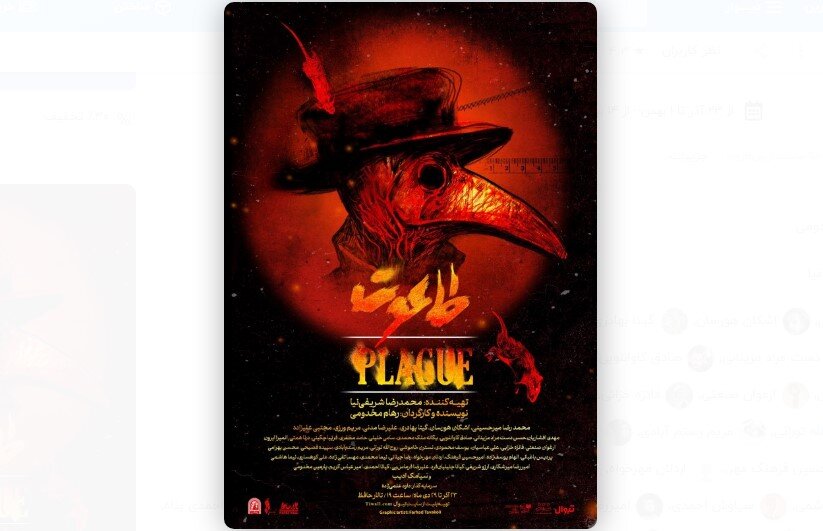
TEHRAN- A loose adaptation of French philosopher and novelist Albert Camus’ novel “The Plague” is currently on stage at Hafez Theater Hall in Tehran.
Roham Makhdoumi is the director of the play, which will be on stage for about one month.
Mohammadreza Mirhosseini, Ashkan Hoursan, Gita Bahadori, Alireza Madani, Maryam Varzi, Mojtaba Alizadeh and Mehdi Afsharian are the main members of the cast for the play.
In “The Plague,” set in the 1940s in the Algerian city of Oran, an unexpected crisis unfolds as rats begin to die en masse, a phenomenon initially overlooked by the townspeople. As the situation escalates, local newspapers report on the mysterious deaths, prompting authorities to take action by disposing of the deceased rodents. However, when Dr. Bernard Rieux, a local physician, discovers that a concierge in his building has succumbed to a fever, he consults a colleague and they conclude that a plague is sweeping through the town. Their warnings to fellow doctors and local officials are met with skepticism and denial, even as more residents fall ill.
As the death toll rises, it becomes increasingly evident that an epidemic is imminent. Authorities remain hesitant to acknowledge the severity of the situation, engaging in bureaucratic debates over how to respond. Although they eventually post official notices to implement control measures, these downplay the seriousness of the outbreak. As the plague spreads, homes are quarantined, and the management of corpses becomes strictly regulated. A limited supply of anti-plague serum arrives but is insufficient to address the growing number of cases, leading to a formal declaration of quarantine for the entire town.
Amidst this chaos, Raymond Rambert, a journalist stranded in Oran, concocts a plan to escape and reunite with his girlfriend in Paris by seeking help from criminals. Meanwhile, Father Paneloux, a Jesuit priest, delivers a sermon suggesting that the plague is a divine punishment for the city’s sins, which compels many citizens to turn to faith in desperation. Cottard, a remorseful criminal who previously attempted suicide, seizes the opportunity to profit as a smuggler during the crisis.
As Rieux works tirelessly alongside Jean Tarrou, a vacationer who becomes involved in the fight against the plague, and Joseph Grand, a civil engineer, they care for patients both at home and in hospitals. Rambert confides his escape plan to Tarrou, who urges him to consider the plight of others in the city. By mid-August, attempts to flee are met with violence as armed sentries shoot at those trying to escape. The situation deteriorates further with outbreaks of violence and looting, prompting authorities to declare martial law and enforce curfews.
As funerals become hasty and devoid of ceremony, Rambert ultimately decides against fleeing, feeling ashamed at the thought of abandoning those suffering in Oran. In late October, an anti-plague serum is administered for the first time to the son of local magistrate Othon; however, it fails tragically. Father Paneloux delivers another sermon addressing the suffering of innocent children as a test of faith and encourages his congregation to fight against despair.
As time passes, Paneloux himself falls ill and dies despite his earlier convictions. The narrative unfolds with Rieux and Tarrou sharing personal reflections on life and their opposition to violence. In a brief respite from the plague’s grip, Grand unexpectedly recovers after instructing Rieux to burn his writings.
By late January, signs of recovery emerge as deaths decline and townspeople celebrate the retreat of the plague. However, Cottard’s fortunes unravel with the return to normalcy, leading him to a breakdown. When the town gates finally open in February, families are reunited amidst lingering grief. Tragically, Tarrou succumbs to the plague after a courageous battle. In the end, Rieux reveals his identity as the chronicler of these events, reflecting on human resilience and solidarity in the face of suffering and existential despair.
SAB/
Disclaimer : This story is auto aggregated by a computer programme and has not been created or edited by DOWNTHENEWS. Publisher: tehrantimes.com