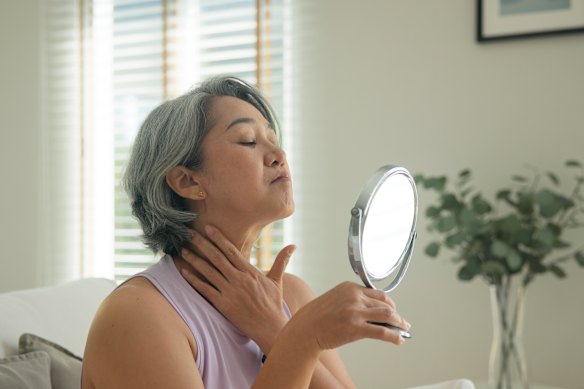
The first time I read the words “Ozempic face” I clicked, genuinely alarmed by the implication that this class of drug might be disfiguring its users. I was relieved to find nothing pointing to actual harm, especially given how many people in my immediate circle had started taking it. But the relief was short-lived.
As the months rolled on, my feeds filled with articles, TikToks and Instagram posts with disparaging descriptions of facial changes resulting from the use of GLP-1s; a class of drug originally developed to treat type 2 diabetes, now also prescribed for weight management.
Words like “sagging”, “hollow”, and “deflated” suddenly dominated the discourse around the drugs. And the “concerns” seemed to be migrating south, as “Ozempic neck” entered the chat, along with mention of “Ozempic arms” and “Ozempic butt” popping up in mainstream reporting.
Conversations about aesthetic changes linked to GLP-1 medications have been growing online since the term “Ozempic face” entered the lexicon around early 2023, finding a comfortable home in a TikTok ecosystem where Ozempic-related content has amassed hundreds of millions of views. Unsurprisingly, much of the chatter comes from the pages of cosmetic surgeons offering expensive and invasive procedures as a “fix”.
But what doesn’t seem to be catching on is the fact that these changes are not, strictly speaking, a medical side effect, or a formal diagnosis. They’re a purely aesthetic observation – one that is by no means unique to taking GLP-1 medication.
Phrases like “Ozempic neck”, or “Ozempic face” might imply an air of medical legitimacy, but they’re media buzzwords working to draw conversation away from anything medical and back to the real heart of the issue – physical attractiveness.
These biting critiques really give away the game for those who purport to be concerned only about the health of those taking the drugs for weight loss. I would suggest that gawking at those whose bodies are changing rapidly on the drugs does nothing to improve their health. And absurd as this nomadic “concern” might be, it shows the speed at which we’re careening ever closer to a world where a person’s appearance is all that matters.
Singling out Ozempic also implies the drug is uniquely “disfiguring”, which is inaccurate. Looser skin, facial volume loss, and changes to the neck can happen with any significant or rapid weight loss, and in some cases, the natural ageing process. But that doesn’t matter when the point is to frame bodily changes as failures, and to reinforce the idea that people in bigger bodies MUST lose weight, but not too fast! And certainly not in a way that shows.
Unfortunately, this is nothing new. It’s something people living in marginalised bodies have been dealing with forever, repackaged for the algorithm age: concern-trolling dressed up as clinical concern. And given these online spaces thrive on a combination of impossible beauty standards and body scrutiny (at least 500,000 Aussies are taking GLP-1s and climbing), we will no doubt have a new body part to nitpick within the month.
To be clear, this is not some new brand of stigma now targeting thin bodies. It’s an extension of the stigma that people in bigger bodies face in almost every corner of our culture. What we’re seeing now is a kind of unapologetic admission that we really, truly don’t give a rat’s furry behind about the health of people in larger bodies; we care about the way they look.
Indeed, if your body is deemed “unhealthy” due to its size, we offer a barrage of stigma and shame with a few “helpful” weight loss suggestions thrown in. If you lose weight quickly with medication or otherwise, we go about scrutinising your face, neck, arms and butt for “damage”. And perhaps most galling (and least surprising) is the pace at which clinics and specialists are jumping to offer fixes … for a price.
You might call it concern. You might call it a side effect. But in the end, it’s the same worn out permission slip to condemn fat bodies, with a checkout link attached.
Changing bodies remain season for public scrutiny, and when drastic weight changes are involved, cruelty becomes acceptable, even marketable.
Let’s be honest. That’s not “concern for health”, is it? It’s punishment for losing weight the “wrong” way.
Hannah Vanderheide is a freelance health writer and an actor.
Get a weekly wrap of views that will challenge, champion and inform your own. Sign up for our Opinion newsletter.
From our partners
Disclaimer : This story is auto aggregated by a computer programme and has not been created or edited by DOWNTHENEWS. Publisher: www.smh.com.au