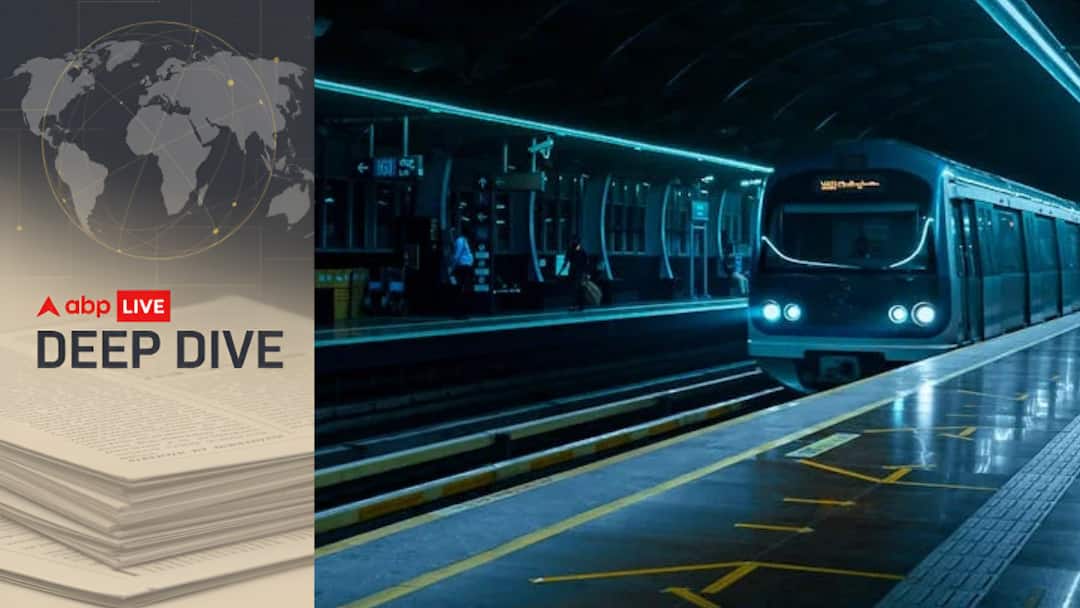
Commuters travelling between Bengaluru and Chennai could soon complete the journey in just 1 hour and 13 minutes, as plans for the proposed high-speed rail corridor move closer to implementation. The ambitious project is expected to significantly reshape regional connectivity, offering a faster alternative to existing rail and road travel while driving infrastructure development across Karnataka, Andhra Pradesh, and Tamil Nadu.
Officials from the National High-Speed Rail Corporation Limited (NHSRCL) have confirmed that the final alignment survey for the 306-kilometre corridor has been completed and the route will soon be locked in.
Bengaluru To Get Two Underground Stations
As part of the project, Bengaluru will feature two underground high-speed rail stations—one at Baiyappanahalli and the other at Whitefield. These locations were selected to ensure seamless integration with existing transport networks, including suburban rail and metro systems, while limiting surface-level disruption in densely populated zones.
Officials said underground construction in Bengaluru was unavoidable due to space constraints and urban density. A 12-kilometre tunnel section has been planned within the city limits to accommodate the corridor without affecting residential and commercial areas.
Chennai-Bengaluru Rail: Route Finalised After Multiple Surveys
The alignment survey evaluated four different route options before authorities chose the shortest and most technically feasible path. The final route will connect key urban and emerging infrastructure hubs along the way.
Major stations on the corridor will include Chennai Central, Poonamallee, and Parandur, which is earmarked as the location of Chennai’s second airport. Other planned stations include Ramapuram near Chittoor, Hudukula in Karnataka’s Kolar district, and Kodihalli near Hoskote, as per Hans India.
Hudukula was chosen to serve both Kolar and Bangarapet regions, while the Chittoor station was shifted from the city centre to Ramapuram near Gudipala to improve alignment with Katpadi and reduce construction complexity.
Tunnels, Depots & Technical Planning
While the majority of the corridor will be built at ground level, several underground sections have been planned to navigate challenging terrain. Apart from the Bengaluru tunnel, an 11.5-kilometre underground stretch is proposed through Mogili Ghat in Andhra Pradesh, along with a 2.5-kilometre tunnel in Chennai.
Maintenance depots will be established at Kodihalli near Hoskote and at Poonamallee near Chennai to support train operations and long-term upkeep. NHSRCL has roped in specialised firms for different components of the project, with RV handling surveys and alignment, Subudhi Tech mapping utilities, and Translink preparing general alignment drawings.
Part Of Larger National Push
The Bengaluru–Chennai high-speed rail corridor is part of a broader national plan announced in the Union Budget 2026–27. Finance Minister Nirmala Sitharaman outlined proposals for seven high-speed rail corridors covering nearly 4,000 kilometres across the country.
Among these, Bengaluru–Chennai and Bengaluru–Hyderabad corridors have been prioritised in the first phase. The Bengaluru–Mysuru high-speed rail line is expected to be taken up in a subsequent phase.
Once operational, Bengaluru–Chennai line is expected to drastically reduce travel time compared to existing options, boosting economic integration and improving connectivity between major cities and fast-growing regional centres.
Related Video
Delhi flood update: once again AAP points out BJP, for Delhi’s present situation
Disclaimer : This story is auto aggregated by a computer programme and has not been created or edited by DOWNTHENEWS. Publisher: abplive.com