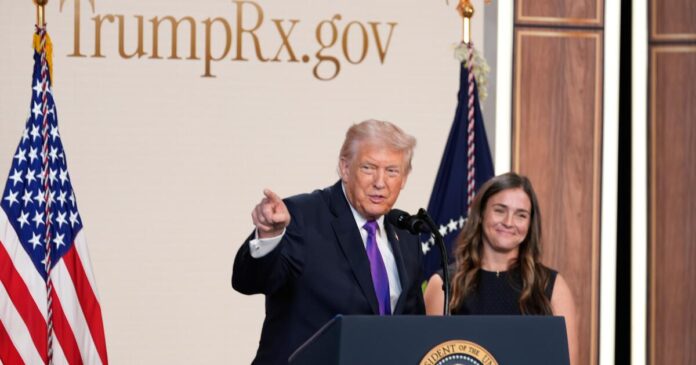
WASHINGTON — The White House’s TrumpRx website went live Thursday with a promise to instantly deliver prescription drugs at “the lowest price anywhere in the world.”
“This launch represents the largest reduction in prescription drug prices in history by many, many times, and it’s not even close,” President Trump said at a news conference announcing the launch of the platform.
Drug policy experts say the jury is still out on whether the platform will provide the significant savings Trump promises, though it will probably help people who need drugs not commonly covered by insurance.
Senate Democrats, meanwhile, called the site a “vanity project” and questioned whether the program presents a possible conflict of interest involving the pharmaceutical industry and the Trump family.
What is TrumpRx, really?
The new platform, trumprx.gov, is designed to help uninsured Americans find discounted prices for high-cost, brand-name prescriptions, including fertility, obesity and diabetes treatments.
The site does not directly sell drugs. Instead, consumers browse a list of discounted medicines, and select one for purchase. From there, they either receive a coupon accepted at certain pharmacies or are routed directly to a drug manufacturer’s website to purchase the prescription.
The White House said the reduced prices are possible after the administration negotiated voluntary “most favored nation” agreements with 16 major drugmakers including Pfizer, Eli Lilly and Novo Nordisk.
Under these deals, manufacturers have agreed to set certain U.S. drug prices no higher than those paid in other wealthy nations in exchange for three-year tariff exemptions. However, the full legal and financial details of the deals have not been made public, leaving lawmakers to speculate how TrumpRx’s pricing model works.
What does it accomplish?
Though the White House has framed TrumpRx as a historic reset for prescription drug costs, economists said the platform offers limited new savings.
But it does move the needle on the issue of drug pricing transparency, away from the hidden mechanisms behind how prescription drugs are priced, rebated and distributed, according to Geoffrey Joyce, director of health policy at the USC Schaeffer Center for Health Policy and Economics.
“This has been a murky world, a terrible, obscure, opaque marketplace where drug prices have been inconsistently priced to different consumers,” Joyce said, “So this is a little step in the right direction, but it’s mostly performative from my perspective, which is kind of Trump in a nutshell.”
Still, for the uninsured or people seeking “lifestyle drugs” — like those for fertility or weight loss that insurers have historically declined to cover — TrumpRx could become a useful option, Joyce said.
“It’s kind of a win for Trump and a win for Pfizer,” Joyce said. “They get to say, ‘Look what we’re doing. We’re lowering prices. We’re keeping Trump happy, but it’s on our low-volume drugs, and drugs that we were discounting big time anyway.’”
Where does it fall short?
Early analyses by drug policy experts suggest many of the discounted medications listed on the TrumpRx site were already on offer through other drug databases before the platform launched.
For example, Pfizer’s Duavee menopause treatment is listed at $30.30 on TrumpRx, but it is also available for the same price at some pharmacies via GoodRx.
Weight management drug Wegovy starts at $199 on TrumpRx. Manufacturers were already selling the same discounted rates through its NovoCare Pharmacy program before the portal’s launch.
“[TrumpRx] uses data from GoodRx, an existing price-search database for prescription drugs,” said Darius N. Lakdawalla, a senior health policy researcher at USC. “It seems to provide prices that are essentially the same as the lowest price GoodRx reports on its website.”
Compared to GoodRx, TrumpRx covers a modest subset of drugs: 43 in all.
“Uninsured consumers, who do not use or know about GoodRx and need one of the specific drugs covered by the site, might benefit from TrumpRx. That seems like a very specific set of people,” Lakdawalla said.
Where do Democrats stand?
Democrats slammed the program this week, saying it would not provide substantial discounts for patients, and called for greater transparency around the administration’s dealings with drugmakers. To date, the administration has not disclosed the terms of the pricing agreements with manufacturers such as Pfizer and AstraZeneca.
In the lead-up to the TrumpRx launch, Democratic members of Congress questioned its usefulness and urged federal health regulators to delay its debut.
“This is just another Donald Trump pet project to rebrand something that already exists, take credit for it, and do nothing to actually lower healthcare prices,” Sen. Alex Padilla (D-Calif.) said Friday. “Democrats will continue fighting to lower healthcare costs and push Republicans to stop giving handouts to billionaires at the expense of working-class Americans.”
Three other Democratic senators — Dick Durbin, Elizabeth Warren and Peter Welch — raised another concern in a Jan. 29 letter to Thomas March Bell, inspector general for the Department of Health and Human Services.
The three senators pointed to potential conflicts of interest between TrumpRx and an online dispensing company, BlinkRx.
One of Trump’s sons, Donald Trump Jr., joined the BlinkRx Board of Directors in February 2025.
Months before, he became a partner at 1789 Capital, a venture capital firm that holds a significant stake in BlinkRx and led the startup’s $140-million funding round in 2024. After his appointment, BlinkRx launched a service to help pharmaceutical companies build direct-to-patient sales platforms quickly.
“The timing of the BlinkRx announcement so closely following the administration’s outreach to the largest drug companies, and the involvement of President Trump’s immediate family, raises questions about potential coordination, influence and self-dealing,” according to an October 2025 statement by Democrats on the House Energy and Commerce Committee.
Both BlinkRx and Donald Trump Jr. have denied any coordination.
What’s next?
The rollout of TrumpRx fits into a suite of White House programs designed to address rising costs, an area of vulnerability for Republicans ahead of the November midterms.
The White House issued a statement Friday urging support for the president’s healthcare initiative, dubbed “the great healthcare plan,” which it said will further reduce drug prices and lower insurance premiums.
For the roughly 8% of Americans without health insurance, TrumpRx’s website promises that more high-cost, brand-name drugs will be discounted on the platform in the future.
“It’s possible the benefits will become broader in the future,” Lakdawalla said. “I would say that the jury remains out on its long-run structure and its long-run pricing effects.”
More to Read
Disclaimer : This story is auto aggregated by a computer programme and has not been created or edited by DOWNTHENEWS. Publisher: latimes.com