
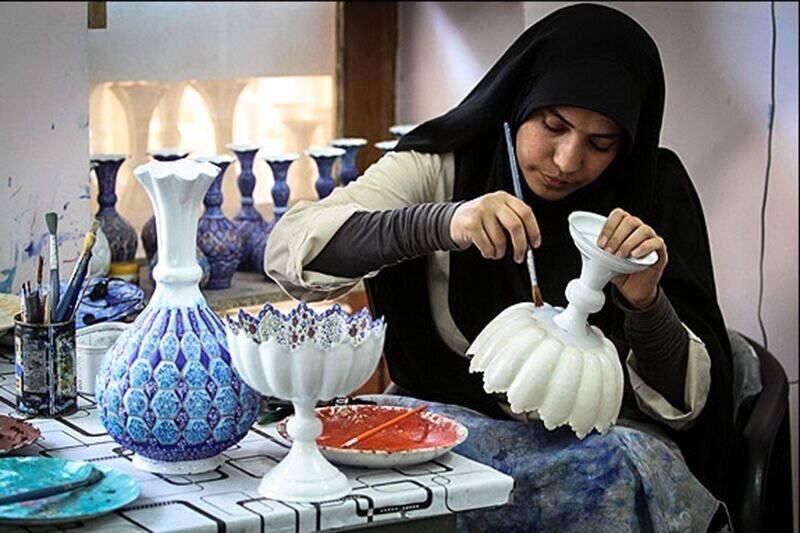
TEHRAN – The Iranian government has approved a comprehensive national document to manage the production, distribution, marketing and export value chain of handicrafts, aiming to coordinate executive bodies and strengthen the sector’s role in the economy.
The approval was granted by the cabinet on the proposal of the Ministry of Cultural Heritage, Tourism and Handicrafts, under Article 83 of Iran’s seventh five-year development plan, Mehr news agency reported.
The document, titled the “comprehensive management framework for the production, distribution, supply and export of handicrafts,” was endorsed in line with decisions of the Supreme Council of the Cultural Revolution and signed into effect by First Vice President Mohammad Reza Aref, Mehr reported.
According to the document, the government’s main objectives include completing the handicrafts value chain, improving production and supply conditions, expanding domestic and foreign markets, and enhancing the sector’s position within Iran’s cultural and creative economy.
The framework describes Iranian handicrafts as having both economic and cultural functions, citing their role in reinforcing cultural identity and values and promoting an Iranian-Islamic lifestyle, and classifies the sector as part of the country’s identity-based economy.
The document defines key concepts including the handicrafts value chain, professional associations, cultural and economic diplomacy, capacity building, large handicrafts enterprises and accredited institutions. It defines the value chain as a continuous process from design and production to distribution, marketing and export, with an emphasis on preserving authenticity and regional identity.
Policy principles outlined in the framework include upgrading the entire value chain, safeguarding national and local identity, developing target markets with an eight percent growth objective [per year], increasing investment in handicrafts and promoting their use in everyday consumption.
Strategic priorities include encouraging investment, particularly by large enterprises, cooperatives and professional associations; ensuring sustainable access to raw materials; improving product quality and design; strengthening distribution and sales networks through innovation and technology; diversifying exports; developing human capital; and [setting the ground for the] increasing household consumption of handicrafts.
Implementation measures include creating mechanisms to attract and direct investment, establishing new education and skills systems based on a master-apprentice model, developing data-driven infrastructure and a national handicrafts platform, stimulating demand through cultural storytelling and media campaigns, organizing credit facilities, and building sustainable marketing and export infrastructure.
To oversee implementation, a “joint action task force for managing the national handicrafts value chain” will be formed, chaired by the minister of cultural heritage, tourism and handicrafts. The task force will be responsible for coordination, monitoring, removing legal and administrative obstacles, preparing provincial and sectoral plans, networking among public and private entities, and issuing periodic reports.
According to the report, the document sets out a national division of responsibilities across executive bodies covering production, raw material supply, workshop design and equipment, standardization and commercialization, infrastructure support, domestic distribution, export market development and cultural-economic diplomacy.
Under the framework, the Ministry of Cultural Heritage, Tourism and Handicrafts is designated as the lead coordinating body, with ministries including industry, economy, labor, agriculture, foreign affairs, culture, roads and urban development, the central bank and other institutions named as cooperating agencies.
Export-related measures outlined in the document include forming export consortia, revising base export pricing, supporting brand registration and development, easing export licensing, expanding e-commerce, organizing trade missions, holding international events, engaging Iranians abroad and pursuing preferential trade agreements.
In addition, the document states that responsibilities related to handwoven carpets are excluded from its scope and will remain under the authority of the Ministry of Industry, Mine and Trade.
Tourism officials say a total of 299 branches of handicrafts, which are classified into 18 groups, are practiced across the ancient country.
AM
Disclaimer : This story is auto aggregated by a computer programme and has not been created or edited by DOWNTHENEWS. Publisher: tehrantimes.com



