
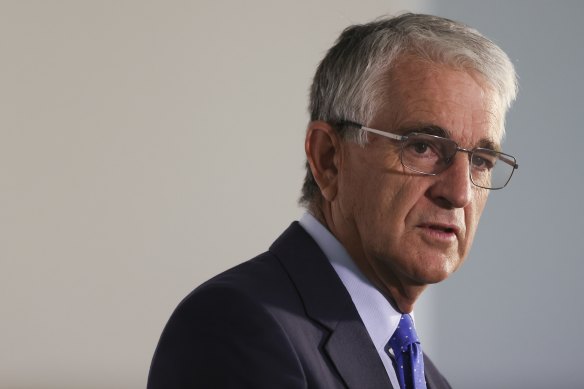

Former Nationals leader John Anderson has warned that the fracturing of the conservative vote from the rise of One Nation will ultimately benefit Labor.
The conservative luminary, who served as deputy prime minister under John Howard, predicted a mixed preference flow from One Nation voters would further splinter support on the right and result in the Albanese government adding to its already dominant majority.
In an interview with this masthead, Anderson described the Coalition break-up as “absolutely astonishing” and said the flow of preference votes from Pauline Hanson’s party was less uniform than that typically recorded from the progressive side of politics.
“The reality is, the preferential system means that, unlike say the Greens, who tightly preference Labor, people who vote One Nation will, we know, spray their preferences everywhere,” he said.
“And at the moment, if you had an election now and those polls were reflected, the preferential vote would give Albanese a bigger majority, not a smaller one.”
His comments came as it was revealed the Liberal and National parties were nearing reunification after Opposition Leader Sussan Ley and Nationals leader David Littleproud moved to patch things up after weeks of feuding.
The latest Resolve Political Monitor poll, conducted for this masthead, showed Labor’s primary vote slumping five percentage points to 30 per cent, and One Nation rising to 18 per cent.
This narrowed the two-party-preferred contest to 52-48 Labor’s way, from 55-45 in December, but other more recent polls have recorded a much higher primary for One Nation.
Anderson said his fear of votes bleeding from the right transcended the shock of Hanson’s party rising to 26 per cent in the Redbridge Group/Accent Research poll published last week by The Australian Financial Review.
“They’re missing the point that, in fact, this is making the Labor Party’s job easier and not harder,” he told this masthead.
“I actually understand why people are protesting at the moment and parking their vote with One Nation. I get it. They’re saying we’ve got an ineffective government, the country’s in trouble, and we don’t even have an effective opposition to represent us, let alone look like an alternative government.
“That’s the crux of what’s happening.”
George Hasanakos, head of research at polling group DemosAU, said the analysis of preferences spraying from One Nation was true of previous generations, but that they had since flowed more consistently to the Coalition.
Preferences from Hanson’s party to the Coalition in 1998 was in the mid-50s, but that flow increased to the mid-70s in last year’s election.
Hasanakos said it could rise further, given the trend of One Nation directly snatching support from the Coalition base.
“There will be some leakage, if you treat them as one broad force – the Coalition and One Nation – but it’s a question of degree, and I’m not sure it’s going to be massive,” he said.
Strategy and campaigns director at polling company RedBridge, Kos Samaras, said the scale of the Coalition’s destruction meant preference flows were irrelevant.
He said that while One Nation’s national primary vote was 26 per cent, according to his group’s poll, he expected the support to be between 35 and 45 per cent in regional electorates.
“If you’re a political party like the Liberals or the Nationals, who basically only rely on regional Australia, that’s quite an existential problem,” Samaras told this masthead.
“You’ve been pushed out of the big cities by Labor and the Teals, and now you’re getting hunted by One Nation in the remaining territory you’ve got left – that is fundamentally the problem.”
Conversely, Samaras said the flow of preferences from Labor in regional seats could be the difference for Liberal or National MPs staving off One Nation candidates, given the common disdain for Hanson’s party among progressive voters.
Start the day with a summary of the day’s most important and interesting stories, analysis and insights. Sign up for our Morning Edition newsletter.
 James Hall is the News Director at the Brisbane Times. He is the former Queensland correspondent at The Australian Financial Review and has reported for a range of mastheads across the country, specialising on political and finance reporting.Connect via X or email.
From our partners
Disclaimer : This story is auto aggregated by a computer programme and has not been created or edited by DOWNTHENEWS. Publisher: www.smh.com.au


