Last spring, the National Security Agency (NSA) flagged an unusual phone call between two members of foreign intelligence, who discussed a person close to Donald Trump, according to a whistleblower’s attorney who was briefed on details of the call.
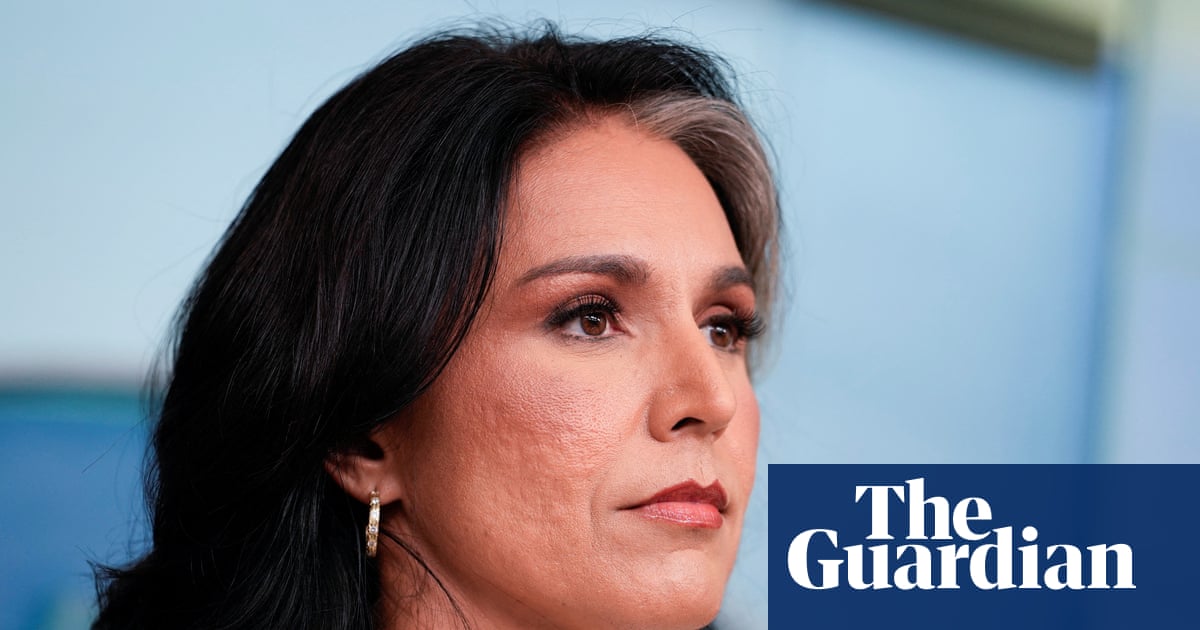
The highly sensitive communique, which has roiled Washington over the past week, was brought to the attention of the director of national intelligence (DNI), Tulsi Gabbard.
But rather than allowing NSA officials to distribute the information further, Gabbard took a paper copy of the intelligence directly to the president’s chief of staff, Susie Wiles, according to the whistleblower’s attorney, Andrew Bakaj.
One day after meeting Wiles, Gabbard told the NSA not to publish the intelligence report. Instead, she instructed NSA officials to transmit the highly classified details directly to her office, Bakaj said.
Details of this exchange between Gabbard and the NSA were shared directly with the Guardian and have not been previously reported. Nor has Wiles’s receipt of the intelligence report.
On 17 April, a whistleblower contacted the office of the inspector general alleging that Gabbard had blocked highly classified intelligence from routine dispatch, according to Bakaj, who has been briefed on details surrounding the highly sensitive phone call flagged by the NSA. The whistleblower filed a formal complaint about Gabbard’s actions on 21 May, Bakaj said.
The Guardian reported earlier Saturday that the phone conversation was between a person associated with foreign intelligence and a person close to Trump, based on Bakaj’s recollection of the complaint, which he confirmed over multiple calls. However, after publication, Bakaj said he misspoke.
He clarified his understanding of the complaint in a statement: “The NSA picked up a phone call between two members of foreign intelligence involving someone close to the Trump White House,” he said. “The NSA does not monitor individuals without a reason.”
The person close to Trump is not understood to be an administration official or a special gov employee, according to a person familiar with the matter.
Bakaj said that members of the intelligence community are often referred to him for legal counsel because of his background and expertise. He previously served in the office of the inspector general for the CIA.
A press secretary for the office of the director of national intelligence (ODNI) said to the Guardian in a statement: “This story is false. Every single action taken by DNI Gabbard was fully within her legal and statutory authority, and these politically motivated attempts to manipulate highly classified information undermine the essential national security work being done by great Americans in the Intelligence Community every day.
“This is yet another attempt to distract from the fact that both a Biden-era and Trump-appointed Intelligence Community Inspector General already found the allegations against DNI Gabbard baseless,” the statement said.
For eight months, the intelligence report has been kept under lock and key, even after the whistleblower pushed to disclose details to congressional intelligence committees.
Acting inspector general Tamara A Johnson dismissed the complaint at the end of a 14-day review period, writing in a 6 June letter addressed to the whistleblower that “the Inspector General could not determine if the allegations appear credible”.
The letter stipulated that the whistleblower could take their concerns to Congress, only after receiving DNI guidance on how to proceed, given the highly sensitive nature of the complaint.
The independence of the watchdog’s office may be compromised, lawmakers have said, ever since Gabbard assigned one of her top advisers, Dennis Kirk, to work there on 9 May, two weeks after the whistleblower first made contact with the inspector general’s hotline.
Gabbard’s office issued its first public acknowledgment of the highly sensitive complaint in a letter addressed to lawmakers on Tuesday, one day after the Wall Street Journal reported on the classified brief. It was posted to the ODNI’s X account, including claims that the inspector general had not informed Gabbard of her obligations to transmit the complaint to Congress.
Bakaj said that the ODNI’s office cited various reasons for the delay in intelligence sharing, including the complaints’ top secret classification, the fall government shutdown and the intelligence community inspector general’s failure to notify Gabbard of her reporting requirements.
Two attorneys and two former intelligence professionals who reviewed details of the incident and ensuing complaint shared with the Guardian have identified what they believe are a series of procedural anomalies that raise questions about Gabbard’s handling of national intelligence and the whistleblower disclosure, which was reported to the inspector general as a matter of “urgent concern”.
Members of the “gang of eight”, a group of Senate and House leaders privy to classified information from the executive branch, received a heavily redacted version for review on Tuesday night. They have disagreed about the legality of Gabbard’s conduct, as well as the credibility of the whistleblower complaint.
Two Republican lawmakers dismissed its credibility and backed Gabbard’s conduct, including the Arkansas senator Tom Cotton, who said in a statement on X that “the DNI took the necessary steps to ensure the material has handled and transmitted appropriately in accordance with law”.
But Democrats have raised questions about the delay. “The law is clear: when a whistleblower makes a complaint and wants to get it before Congress the agency has 21 days to relay it,” said the senator Mark Warner of Virginia, the senior Democrat on the Senate intelligence committee, in a Thursday press conference. “This whistleblower complaint was issued in May. We didn’t receive it until February.”
Warner said that the months-long delay reflected an effort to “bury the complaint”.
The contents of the whistleblower complaint are still largely unknown. Bakaj, the whistleblower’s attorney, said that Gabbard’s office had redacted much of the complaint that was released to intelligence committee members on Tuesday, citing executive privilege.
“I don’t know the contents of the complaint, but by exercising executive privilege they are flagging that it involves presidential action,” he said.
On 3 February, Bakaj again requested guidance from Gabbard’s office about how to share the whistleblower’s full report while taking appropriate precautions.
“As you are well aware, our client’s disclosure directly impacts our national security and the American people,” Bakaj wrote. “This means that our client’s complete whistleblower disclosure must be transmitted to Congress, and that we, as their counsel, speak with members and cleared staff.”
Bakaj said that the DNI’s office did not respond to his letter by its Friday deadline. He plans to contact members of the Senate and House intelligence committees on Monday to schedule an unclassified briefing on Gabbard’s conduct and the “underlying intelligence concerns”.
Members of the gang of eight have contacted the NSA to request the underlying intelligence that the whistleblower says Gabbard blocked, according to staff in Warner’s office.
Lawmakers can make routine requests for classified information directly from intelligence agencies such as the NSA. The request circumvents the ODNI’s involvement, as well as the office of the inspector general.
The leading Democrat on the House oversight committee, Stephen F Lynch, wrote a letter to acting inspector general Johnson to warn her that the integrity of the watchdog office could be compromised by Kirk’s May appointment to the group.
Kirk served in the first Trump administration and was a co-author of Project 2025, a policy roadmap for restructuring the federal government.
“The appointment of a highly partisan advocate for prioritizing personal loyalty to President Trump above independence and professionalism in the federal government – and one who apparently answers to DNI Gabbard rather than to you – in a senior role within [the intelligence community inspector general’s office] raises troubling questions about the independence of the IC IG,” Lynch wrote.
Johnson did not respond to a request for comment related to this story. She was replaced as the intelligence community inspector general in October by Christopher Fox.
Editor’s Note: This story was updated to clarify that the phone call was between two people associated with foreign intelligence who discussed someone close to Donald Trump, not between someone and a person close to Trump. The earlier version was based on multiple phone calls with a source who later said he misspoke and clarified the actual details of the call.
Disclaimer : This story is auto aggregated by a computer programme and has not been created or edited by DOWNTHENEWS. Publisher: theguardian.com