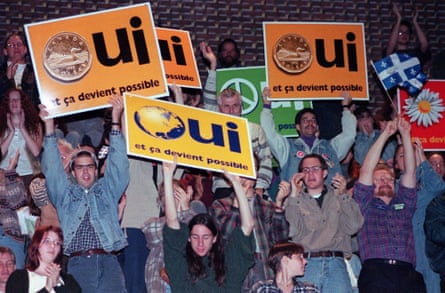
A separatist push for a referendum on independence from Canada. Meetings with foreign officials perceived to be sympathetic to their cause. Accusations of treason and sedition.
Ahead of a 1995 referendum, leaders of Quebec’s independence movement made a string of provocative overtures to foreign governments, including a trip by the province’s premier to France. In a move that outraged anglophone Canada, the mayor of Paris gave Quebec’s Jacques Parizeau a welcome befitting a national leader.
Three decades later, reports of a far more covert visit to the US by a group of would-be separatists from the western province of Alberta have provoked a similar backlash, reviving longstanding anxieties about foreign involvement in domestic unity debates.
“To go to a foreign country and to ask for assistance in breaking up Canada, there’s an old-fashioned word for that,” British Columbia’s premier, David Eby, told reporters. “And that word is treason.”
Proto-diplomacy – the act of courting sympathetic countries for support – has often been undertaken by separatist movements around the world, said André Lecours, a professor of political science at the University of Ottawa.
“There have been criticisms of this for sure, but when actively preparing a referendum on independence, leaders often look abroad in an attempt to secure sympathy or support. They want some signs or assurances that foreign states would be ready to recognize their independence.”
But the recently revealed contacts with the Trump administration by members of Alberta’s nascent independence movement had few substantive parallels with Quebec’s attempts in the 1990s, he said.
“What makes this movement so different is that none of these people associated with Alberta’s push for independence are democratically elected. They don’t hold any public office,” Lecours said. “While I am very reluctant to use words such as ‘treason’, I find it strange that the Trump administration would meet with non-elected officials. They have no formal democratic legitimacy.”
Within the province’s legislative assembly, there are no pro-independence parties that hold seats. Only one Alberta separatist has ever managed to get elected – in a 1982 byelection victory – but lost in a general election soon afterwards.
None of the members of the Alberta secession efforts are elected officials. And support for independence is muted in the province: a recent poll of Albertans showed roughly 18% supported leaving Canada. Prominent politicians from Alberta, including former prime minister Stephen Harper and two former Alberta premiers have rejected the idea of independence, instead calling for national unity at a time of diplomatic upheaval with the US.
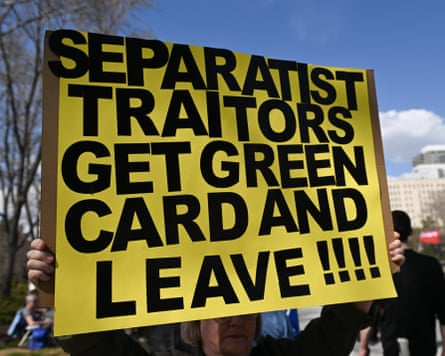
Alberta’s current rightwing premier, Danielle Smith, has also come out against separation, although critics say that her call for “a strong and sovereign Alberta within a united Canada” merely confuses the issue.
Conversely, in Quebec, five premiers have campaigned on – and won – provincial elections on an explicit separatist platform. The independence-oriented Partí Québécois is widely expected to win the next provincial election this October and has pledged to bring a third referendum.
Canada’s laws permit groups to advocate and campaign in support of a province or territory leaving the country. In Alberta, members of the pro-independence campaign have been travelling across the province in an attempt to collect nearly 178,000 signatures by May. But the recent allegations that independence activists have repeatedly met officials from a government which has become increasingly hostile to Canadian sovereignty have prompted suggestions that the movement could constitute a threat to Canada’s national security.
While pro-independence politicians in Quebec courted the French, the country’s position on the province was “non-ingérence, non-indifférence” – an official policy of neutrality.
But Donald Trump has threatened to annex Canada and turn it into the 51st state – an effort seemingly welcomed by a leader of the Alberta independence movement. Lawyer Jeffrey Rath, part of the delegation that met secretly with state department officials, said last year he and others wanted to “petition” for Alberta to gain US statehood.
And influential figures in the White House have signalled support for the separatists.
“Albertans are a very independent people,” the US treasury secretary, Scott Bessent, told the conservative website Real America’s Voice. “Rumour [is] that they may have a referendum on whether they want to stay in Canada or not … People are talking. People want sovereignty. They want what the US has got.”
Mark Carney has said he “expects the US administration to respect Canadian sovereignty”. But there is a growing sense of unease among senior officials in Ottawa that the US could use secession movements as a political wedge to meddle in Canadian domestic affairs.
“It seems now that if there were to be a referendum on independence in Alberta – or in Quebec for that matter – the US would not stay silent and/or support Canadian unity,” Lecours said. “You’d likely hear another, far different message.”
Disclaimer : This story is auto aggregated by a computer programme and has not been created or edited by DOWNTHENEWS. Publisher: theguardian.com